Skip to Content Facebook Feature Image

Final main bridge over Pinglu Canal completed, paving way for full navigation operations

China

China

China

Final main bridge over Pinglu Canal completed, paving way for full navigation operations

2026-04-28 17:32 Last Updated At:23:37

The final main bridge over the Pinglu Canal, a core project of the New International Land-Sea Trade Corridor, was officially put into service on Tuesday morning in Qinzhou City , south China's Guangxi Zhuang Autonomous Region, marking the completion of all the 27 main bridges on the canal and paving the way for its full navigation in September.

Stretching 134.2 kilometers, the Pinglu Canal is the first river-to-sea canal built since the founding of the People's Republic of China.

Upon completion, it will wind its way across Nanning and Qinzhou in Guangxi until it reaches the Beibu Gulf, serving as an artery for river-sea inter-modal transportation in the southwestern part of the country.

The Pinglu Canal project involves a total of 104 bridges along its entire route, of which 27 are main bridges spanning the canal.

As one of them, the newly completed Zicai Bridge crosses the canal's main navigation channel in the urban area of Qinzhou. The bridge, built on the site of an old bridge, has been fully upgraded. Featuring a main span of 270 meters and a navigational clearance height of 19.3 meters, the bridge can accommodate vessels of up to 5,000 tons.

In addition, the bridge deck has been widened by 4.5 meters to a total width of 40 meters, effectively easing cross-river traffic pressure in Qinzhou's main urban area.

"The biggest challenge in construction was the demolition of the old bridge. Located in the center of Qinzhou with a dense surrounding population, traditional blasting methods could not be used. More critically, the old bridge was a self-anchored suspension bridge, with the main cables anchored directly into the bridge's own main structure -- a highly complex structural system. Throughout the demolition process, precise control of the structural balance was essential, making the demolition extremely difficult," said Yuan Mingyang, an engineer with Guangxi Pinglu Canal Construction Co., Ltd.

With innovative methods, the construction team completed the demolition of the old bridge in just seven months.

During the construction of the new bridge, a temporary bridge was built to ensure that urban traffic remained uninterrupted.

Final main bridge over Pinglu Canal completed, paving way for full navigation operations

Final main bridge over Pinglu Canal completed, paving way for full navigation operations

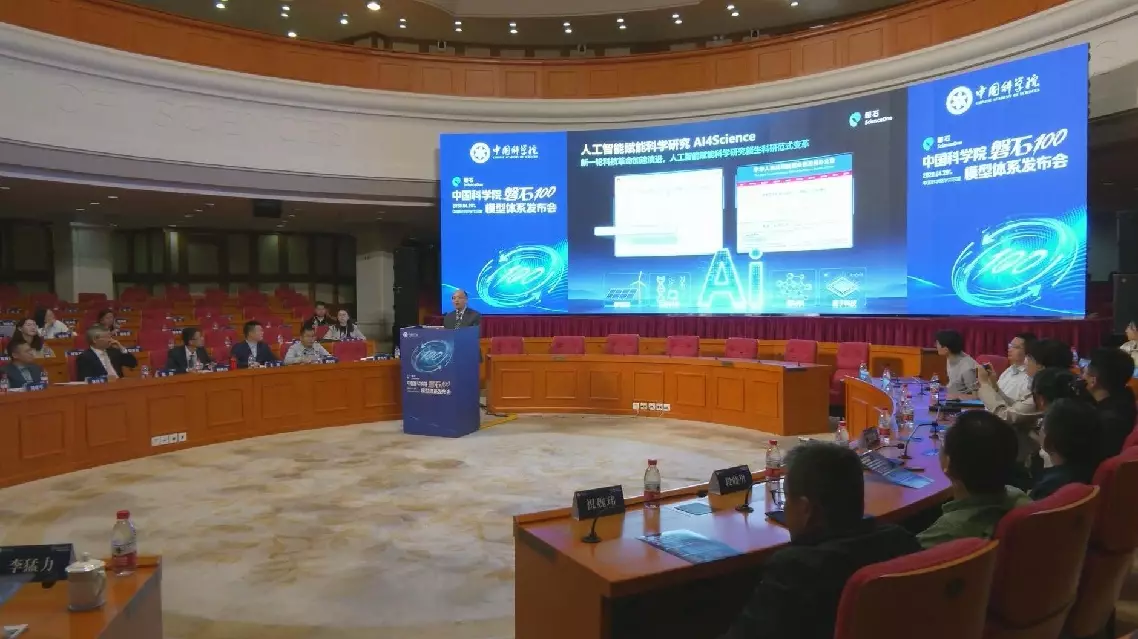
The Chinese Academy of Sciences (CAS) on Tuesday revealed an artificial intelligence (AI) model system supporting scientific research, empowering multiple scientific domains including mathematics, physics and biology.

This marks a transition in AI-driven scientific research from fragmented and isolated exploration toward collaborative, efficient and platform-based innovation.

Named ScienceOne 100, the model system has been built on the basis of the scientific foundation model ScienceOne, with a cluster of multidisciplinary domain-specific large models.

ScienceOne provides three core functions: literature compass, innovation evaluation and agent factory, empowering the entire research and innovation workflow.

ScienceOne was released in 2025 and trained on professional scientific corpus and data. Its latest version has achieved flagship-level performance for scientific knowledge and agentic long-horizon reasoning, and has attained state-of-the-art results in terms of multiple benchmarks related to scientific image understanding and manipulation.

The model system currently comprises eight domain-specific large models, covering mathematics, physics, materials science, astronomy, environmental science, aerospace, geosciences and biology.

Zeng Dajun, deputy director of the Institute of Automation at CAS, cited the system's application in materials design as an example.

"In the design of various materials, catalyst design is a critical step. In the past, developing a new catalyst was highly time-consuming, requiring extensive literature review and numerous experiments. Now, with the ScienceOne 100 model system, research efficiency can be boosted by dozens of times," said Zeng.

The system has already been deployed and applied across over 50 CAS institutes, covering more than 100 research scenarios.

It has demonstrated tremendous potential in typical applications such as high-speed rail flow field reconstruction, spectral identification, materials discovery, adjuvant design, astronomical observation, Qinghai-Tibet Plateau scientific expedition, marine forecasting and ecological research.

Chinese Academy of Sciences unveils AI model system for scientific research

Chinese Academy of Sciences unveils AI model system for scientific research

Recommended Articles