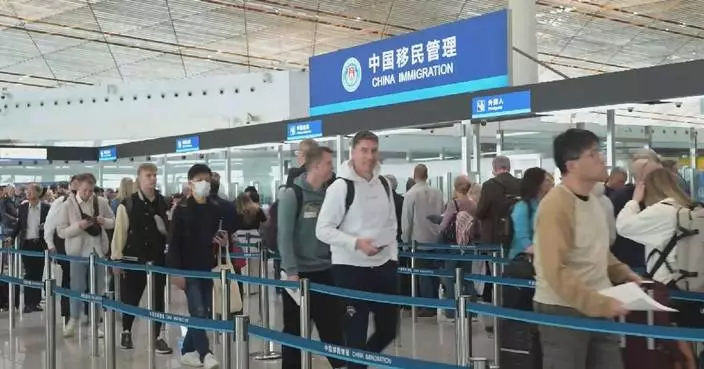
South China's Guangdong Province has rolled out upgraded departure tax refund services for overseas visitors, which helps stimulate inbound consumption and drive strong growth in tax-refund sales during the ongoing 139th China Import and Export Fair, also known as the Canton Fair.
As an upgrade within China's existing departure tax refund policy, instant tax refund allows overseas visitors to receive a tax rebate in cash on the spot at designated retail stores after signing an agreement and processing a credit card pre-authorization.
On this weekend, a shopping mall in Guangzhou's Tianhe District has seen a surge in overseas visitors due to the city's effort to facilitate inbound spending. So far, nearly 50 retail stores in this shopping mall now offer the "immediate refund" option.
"We just need the shopper's departure tax refund application form, her invoice, and her purchase receipt. As long as we have these three documents along with her passport, our system makes it very convenient to process everything directly. Also, on the B3 level of Tianhuan (shopping mall), we have a centralized point [for departure tax rebates]," said a store manager.
According to the head of a smart imaging equipment store, driven by the brand's integrated online and offline marketing campaigns, a rising number of foreign consumers are visiting the store during this year's Canton Fair.
"The billboards are designed with both Chinese and English signs to attract foreign customers. Compared with the period when there was no tax refund, the change is quite significant. The number of foreign customers has also increased by 20 to 30 percent," said store manager Li Ruicheng.
"I'm here as a tourist, so paying tax for a tourist is something like a kind of burden, so that's why it's a very nice service given to the tourists mainly," said Arun, an Indian customer.
At the policy level, Guangdong and east China's Fujian Province have implemented cross-provincial mutual recognition of the instant tax refund service since April 1 this year.
After overseas visitors complete the on-site procedures at "instant refund" stores or centralized refund points in either Guangdong Province or Fujian Province, they could choose to depart from a port of departure for tax refund.
Also, many shopping malls in Guangzhou City have offered a series of discounts together with other promotion activities to attract international visitors during the Canton Fair.
The current edition of the Canton Fair is taking place in three phases in Guangzhou, the provincial capital of Guangdong, with the first two phases having attracted 245,000 overseas buyers from 219 countries and regions. The third phase of the biannual event is scheduled to run from May 1 to 5.

Guangdong improves departure tax refund services, boosting inbound consumption during Canton Fair