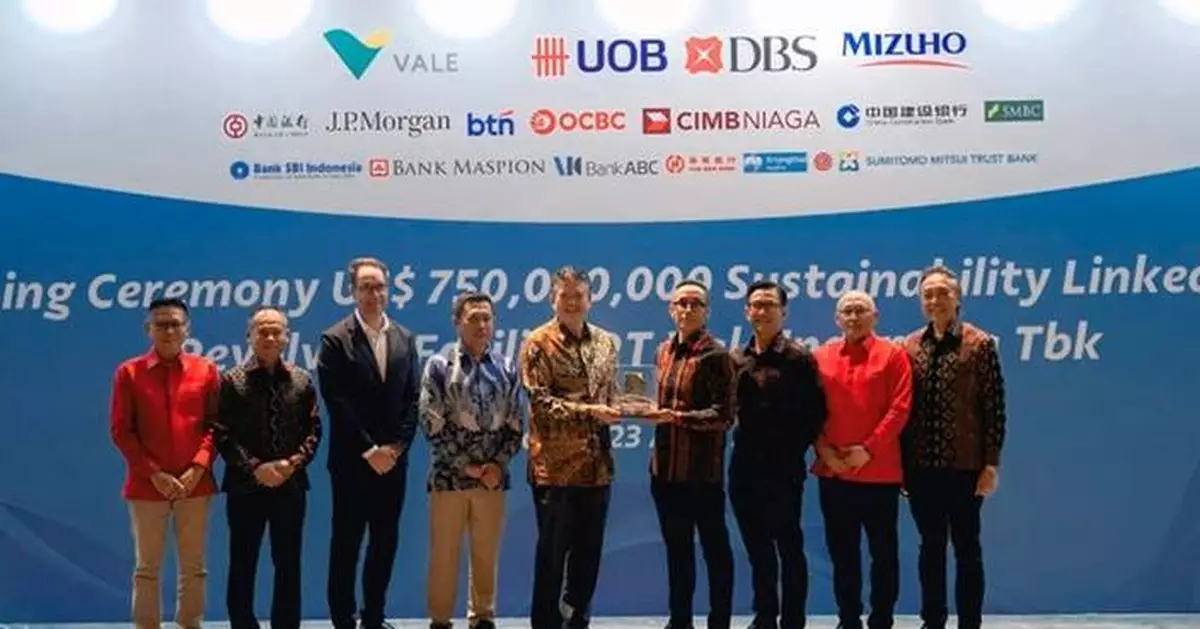
JAKARTA, Indonesia, April 29, 2026 /PRNewswire/ -- PT Vale Indonesia Tbk ("PT Vale" or the "Company") has secured a US$750 million Sustainability-Linked Loan (SLL) facility, including a US$250 million greenshoe option, marking its debut in the syndicated loan market and reinforcing its sustainable finance strategy. Supported by 14 international banks and 1.7 times oversubscribed, the facility reflects strong lender confidence in PT Vale's credit profile, strategic project pipeline, and ESG-linked growth trajectory.
Structured under PT Vale's Sustainability-Linked Financing Framework, the facility is linked to two performance metrics: reducing carbon emissions intensity and increasing renewable energy consumption. Both KPIs received a "strong" rating from an independent Second Party Opinion provider, aligned with the Paris Agreement's 1.5°C pathway and Indonesia's Nationally Determined Contributions.
As demand for responsibly produced nickel grows, driven by electrification, energy storage, and global decarbonisation, PT Vale is positioned as a relatively low-carbon producer supported by hydropower-based operations.
President Director and Chief Executive Officer of PT Vale, Bernardus Irmanto, stated: "This facility marks an important step in our journey to align our financing strategy with our decarbonisation agenda and long-term growth ambitions. We remain committed to delivering high-quality nickel with a lower carbon footprint, while supporting Indonesia's downstreaming agenda and contributing meaningfully to the global energy transition."
Harapman Kasan, Wholesale Banking Director, UOB Indonesia, stated: "As Southeast Asia's nickel sector continues to evolve, the role of well-structured transition financing becomes increasingly critical. This transaction reflects our commitment to aligning financing structures with measurable sustainability objectives, while supporting Indonesia's broader industrial and energy transition priorities."
Mike Zhang, Global Head of Metals & Mining, Institutional Banking at DBS Bank, added that the metals and mining sector plays a pivotal role in enabling the energy transition and must demonstrate credible, measurable progress in sustainability.
Ken Matsuo, President Director of PT Bank Mizuho Indonesia, commented: "The energy sector is a cornerstone of Indonesia's economy, and we are pleased to support PT Vale's inaugural syndicated loan. Despite market volatility, the strong participation and oversubscription underscore confidence in PT Vale's business model. We see ESG integration in financing structures such as this as a critical enabler of a sustainable energy transition."
PT Vale will also allocate financial benefits from sustainability-linked margin adjustments to community development programmes, extending ESG impact beyond operations.
Media Contact:
Vanda Kusumaningrum
Head of Corporate Communications
PT Vale Indonesia Tbk.
Vanda.Kusumaningrum@vale.com
** This press release is distributed by PR Newswire through automated distribution system, for which the client assumes full responsibility. **
Strengthening Its Sustainable Finance Strategy, PT Vale Secures US$750 Million ESG-Linked Syndicated Loan Facility
BEIJING, April 29, 2026 /PRNewswire/ -- At the 19th Beijing International Automotive Exhibition (hereinafter referred to as "Auto China"), DeepRoute.ai held a press conference to showcase its latest advances in Physical AI. During the event, CEO Maxwell Zhou reflected on the company's founding mission and outlined its latest advances and vision in Physical AI. Chief Scientist Chong Ruan then delivered his first public keynote, providing a systematic overview of the company's technical architecture around its Foundation Model. The event marks a milestone in DeepRoute.ai's push to establish leadership in Physical AI and shape the direction of next-generation advanced intelligent driving systems.
Maxwell Zhou: Aiming to Become the AI Infrastructure of the Physical World
Opening the press conference, CEO Maxwell Zhou recounted a traffic accident that occurred near him in the early days of his startup journey in 2016. "At that time, I wondered whether we could use AI technology to save more lives," Zhou said. He acknowledged that current advanced intelligent driving systems are not yet perfect, with MPCI (Miles Per Critical Intervention) in urban areas still measured in the tens of kilometers, but noted that available data indicates their safety is already several times higher than that of human drivers. "We believe that within the next two to three years, as large models continue to develop their comprehension capabilities, we will achieve truly safe advanced intelligent driving systems."
Zhou set out a long-term vision for DeepRoute.ai: "I hope that in the future, the company will become the AI infrastructure of the physical world, serving as a foundational capability that sustains real-world operations, much like telecommunications and electricity. When people talk about intelligence in the physical world, DeepRoute.ai should be an essential part of that foundation."
Chief Scientist Chong Ruan's Keynote: Updates on the Foundation Model
Chong Ruan, former Head of R&D at DeepSeek and a core researcher in multimodal AI, made his public debut as DeepRoute.ai's Chief Scientist at this event. He provided a systematic overview of the Foundation Model and the latest progress in building cognitive capabilities for the advanced intelligent driving system.
Ruan noted that as intelligent driving enters the mass production phase, earlier approaches relying on smaller models have shown limited progress in system stability and consistent user adoption. These systems still exhibit performance fluctuations in complex, edge-case scenarios, and a reliable foundation of trust in the driving experience has yet to be established. To address this, DeepRoute.ai has developed a next-generation technical approach centred on the Foundation Model.
The Foundation Model unifies driving decision-making, scene understanding, and behaviour evaluation within a single architecture. By leveraging greater model scale, higher data quality, and a faster data-driven closed-loop, it enables the continuous improvement of the advanced intelligent driving system. Under this framework, the iteration cycle of the data-driven closed-loop has been cut from approximately five days to around 12 hours, significantly improving operational efficiency.
Ruan also noted that the value of the Foundation Model extends beyond product capabilities and is now influencing how the organisation operates. "From internal knowledge base Q&A and automated code generation to cross-departmental collaboration and autonomous experimental analysis, AI is reshaping our R&D and management workflows."
Cross-Industry Dialogue: Focusing on the Core Proposition of "AI for what"
At the press conference, DeepRoute.ai also hosted an "AI Talk" industry dialogue themed "AI for what." The panel was moderated by Li Zhang, Professor at the School of Data Science at Fudan University. Participants included Jian Huo, General Manager of Automotive and Energy Solutions at Alibaba Cloud; Yinghao Xu, Assistant Professor at HKUST CSE and Staff Research Scientist at RobbyAnt; Hao Jingfang, Hugo Award-winning author, Founder of Tong Xing College, and holder of a PhD in Economics and an M.S. in Astrophysics from Tsinghua University; and Chong Ruan.
Unlike traditional product presentations, the dialogue was structured around a series of probing questions: from the capability boundaries of large models in real-world environments and the debate between World Models and VLA models, to the broader societal impact of Physical AI. Each question built on the last, keeping the discussion focused on the fundamental question of what AI is ultimately for.
Propelled by the Data Flywheel for Scaled Evolution, Fully Entering the Era of Physical AI
During the event, DeepRoute.ai also previewed its Cabin-Driving Integration Agent. Rather than functioning as a conventional voice assistant or in-vehicle infotainment system, the feature is designed to evolve the system into an "AI Brain" capable of understanding user needs and responding proactively to complex scenarios.
DeepRoute.ai reports that mass production vehicles equipped with its Urban NOA solution have now exceeded 300,000 units. Over the past year, vehicles running DeepRoute.ai's active safety systems have accumulated over 1.3 billion kilometres of real-world road operation and 44.8 million hours of user driving time. This volume of real-world data, generated through the Data Flywheel, both validates the system's safety performance and provides a critical foundation for the ongoing optimisation of the Foundation Model.
By 2026, DeepRoute.ai plans to grow mass production delivery of its advanced intelligent driving system past one million units. The company also aims to increase its MPCI metric to over 1,000 kilometres and raise its active daily use rate to over 50%. These targets are intended to drive continued improvements in system safety, stability, and user experience, advancing the commercial deployment of Physical AI at scale.
** This press release is distributed by PR Newswire through automated distribution system, for which the client assumes full responsibility. **
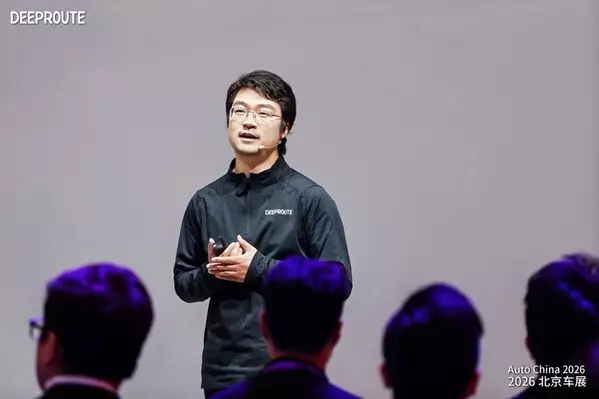
DeepRoute.ai CEO Maxwell Zhou: Aiming to Become the AI Infrastructure of the Physical World
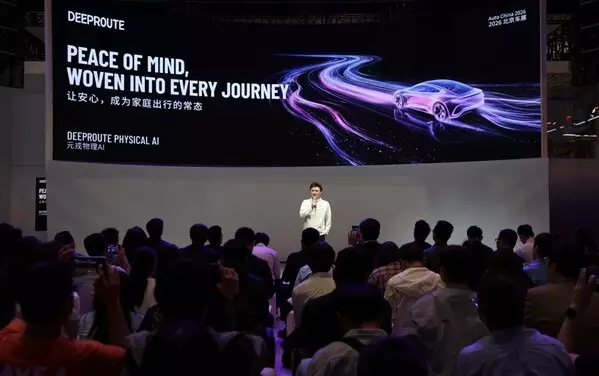
DeepRoute.ai CEO Maxwell Zhou: Aiming to Become the AI Infrastructure of the Physical World