LOS ANGELES--(BUSINESS WIRE)--Apr 29, 2026--
Most people update LinkedIn when they start a new job. Kevin Villatoro rode a motorcycle 3,700 miles.
This press release features multimedia. View the full release here: https://www.businesswire.com/news/home/20260429664761/en/
After a two-week, 15-state journey from Brooklyn to Los Angeles, advertising veteran Kevin Villatoro has officially arrived at Creativ Company’s Los Angeles headquarters as the Machine Intelligent Marketing firm’s new Vice President of Product & Client Strategy.
The cross-country ride wasn’t just about the destination. For Villatoro, it marked a transition point after more than a decade at leading global agency networks, including Dentsu and IPG, where he built a reputation for forging high-impact partnerships and exploring the frontiers of performance media and emerging technology.
Now at Creativ Company, Villatoro will focus on driving new business, building long-term partnerships with enterprise brands across media, entertainment, and advertising, and leading the company’s evolving product roadmap. Villatoro will also oversee key client relationships, develop data partnerships, and drive the company’s next phase of growth for their digital and product divisions. He’ll report to the CEO and COIO between New York and Los Angeles.
“I’ve spent my career helping brands unlock new sources of value through partnerships and emerging technology, and Creativ Company is a natural extension of that,” said Villatoro. “The team is building a truly differentiated product portfolio powered by cutting-edge LLMs, and while every company’s AI journey will be different, I want to be on the side shaping what that future looks like.”
Villatoro’s background includes senior roles at Dentsu, where he led cross-agency gaming initiatives and built strategic partnerships for major brands including Kraft Heinz, eBay, and Hilton as Group Director. Earlier in his career, he managed performance media for clients such as Johnson & Johnson, Mastercard, Dannon, and gaming leaders including 2K and Rockstar Games. He also led Dentsu’s global gaming research under the Attention Economy and in his spare time, founded Satoshi’s Index, an early Web3 finance platform supported by a Google Cloud grant.
For Creativ Company CEO and Co-Founder Wes Morton, Villatoro’s arrival feels a bit like a full-circle moment. “Kevin and I met as 20-something junior admen in the halls of Dentsu NYC. He asked if I wanted to fly his drone around the office. HR quickly put an end to that, but I knew we’d become fast friends,” said Morton. “Kevin has always possessed an insatiable professional curiosity and instinct for where technology is going. We can’t wait to build advertising’s next marketing-technology firm together.”
With Villatoro now officially onboard (and off the bike), Creativ Company welcomes a new marketing-technology leader to aid its mission to build the next-generation of products to understand and motivate the consumer.
About Creativ Company
Creativ Company’s mission is to understand and motivate the consumer. The machine intelligent marketing firm combines cutting-edge technology and human creativity to service the world’s premier media, entertainment, and technology companies. With patented machine-generated insights, a global digital development team, and world-class marketing communications, Creativ Company delivers inventive solutions to complex marketing-technology challenges.
Leading organizations including Electronic Arts, Scopely, WEBTOON, Mocean, 1stAveMachine, SpecialGuestX, Iconic Arts, Havoc Robotics, Wells Fargo trust Creativ Company. Challenges welcome. To learn more, visit creativ.com.

Pictured, Kevin Villatoro in Ouray, Colorado after completing the scenic yet treacherous Million Dollar Highway.
The Supreme Court has weakened a key tool of the Voting Rights Act that has helped root out racial discrimination in voting for more than half a century in a case concerning a Black majority congressional district in Louisiana.
The court’s conservative majority found that the district, represented by Democrat Cleo Fields, relied too heavily on race. Chief Justice John Roberts had described the district as a “snake” that stretches more than 200 miles (320 kilometers) to link parts of the Shreveport, Alexandria, Lafayette and Baton Rouge areas.
The plaintiffs argued that Louisiana’s second Black-majority congressional district, drawn to correct a previously discriminatory map, has an unconstitutional racial basis and did not follow the standards for drawing a district, including compactness.
“The Voting Rights Act as a means to protect minority voters from vote dilution is essentially dead,” said Jonathan Cervas, a political scientist at Carnegie-Mellon University who’s served as a special master in multiple Voting Rights Act cases.
The 1965 Voting Rights Act, the centerpiece legislation of the Civil Rights Movement, succeeded in opening the ballot box to Black Americans and reducing persistent discrimination in voting. Nearly 70 of the 435 congressional districts are protected by Section 2, election law experts estimate.
It’s unclear how much is left of Section 2, but the ruling could open the door for Republican-led states to eliminate Black and Latino electoral districts that tend to favor Democrats and affect the balance of power in Congress. President Donald Trump has already touched off a nationwide redistricting battle to boost Republican chances.
Here's the latest:
Louisiana Attorney General Liz Murrill said she will work with fellow Republican Gov. Jeff Landry and the GOP-dominated Legislature to “provide guidance as we move forward to adopt a constitutionally compliant map.”
“The Supreme Court has ended Louisiana’s long-running nightmare of federal courts coercing the state to draw a racially discriminatory map,” Murrill wrote. “That was always unconstitutional—and this is a seismic decision reaffirming equal protection under our nation’s laws.”
The ruling is expected to be an enormous boost for Republican efforts to expand their number of winnable seats in the House of Representatives and state legislatures.
The GOP has long complained that Democrats turned the Voting Rights Act’s protections into a partisan weapon to gain seats.
“For decades the left has spent hundreds of millions of dollars seeking to divide Americans along racial lines in a cynical pursuit of partisan power masquerading as civil rights,” said Adam Kincaid, the National Republican Redistricting Trust’s executive director, in a statement. “Today’s decision rebukes that divisive and unconstitutional effort.”
A federal court in 2023 ordered the creation of a new near-majority Black district which led to the election of Alabama’s second Black congressional representative.
Alabama is under a court order to use the new map through the rest of the decade, but the state appealed to the Supreme Court. Alabama has argued the court-drawn map is an illegal racial gerrymander.
Alabama House Speaker Pro Tempore Chris Pringle, a Republican, said he is hopeful that the Louisiana ruling means justices will rule in favor of Alabama in that appeal, eventually clearing the way for Alabama to draw its own map.
“I do believe the ruling today vindicates the state’s argument that the court illegally racially gerrymandered the state in its ruling,” Pringle said.
The head of an organization that works to elect Democrats to state legislatures says it’s an “all-hands-on-deck moment.”
Heather Williams, who leads the Democratic Legislative Campaign Committee, says Democrats need to strengthen their numbers at statehouses to fight GOP gerrymanders. She says the ruling gives Republican-led legislatures greater ability to “rig maps to protect their own power.”
“State legislatures play a role in drawing over 300 congressional districts, and we must charge into the 2026 elections clear-eyed about the urgency and stakes,” she said.
In most of the states where Republicans could benefit from eliminating Democratic districts that have majority Black or Hispanic populations, filing deadlines for congressional elections have already passed. In some, primaries have already occurred.
Barring extraordinary action, that means the most likely impact of Wednesday’s decision will come in 2028, when the GOP can potentially replace more than a dozen Democratic-held House districts that were previously protected under the Voting Rights Act.
“The Voting Rights Act as a means to protect minority voters from vote dilution is essentially dead,” said Jonathan Cervas, a political scientist at Carnegie-Mellon University who’s served as a special master in multiple Voting Rights Act cases.
Over time, the decision could result in a sweeping rollback to Black political power at the state and local level.
There are hundreds of Black state legislators in the South. There are many more Black officials on county and parish governing bodies, school boards and city councils that make decisions about policing, road paving and school districting that touch everyday lives.
In many cases, Black-majority districts that those officials represent have been carved out through decades of repeated Section 2 litigation. In states like Alabama and Mississippi, the racial cleavage is so deep that there are few Democratic state legislators who aren’t Black.
Wednesday’s ruling could let white majorities wipe out districts where Black voters exercise power, particularly where they are numerous but in the minority. That would be a change from today, where Black officials often exercise real influence, even on governing bodies where they are in the minority.
Rep. Richard Hudson of North Carolina is the chairman of the House GOP campaign arm.
“The Supreme Court made clear that our elections should be decided by voters, not engineered through unconstitutional mandates,” he said.
“For too long, activists have manipulated the redistricting process to achieve political outcomes, dividing Americans instead of bringing them together,” he said. “This ruling restores fairness, strengthens confidence in our elections, and ensures every voter is treated equally under the law.”
“This ruling is about far more than lines on a map — it’s about whether Black Louisianians will have a meaningful opportunity to make their voices heard,” U.S. Rep. Troy Carter, whose predominately Black congressional district encompasses New Orleans, said in a written statement.
Carter said the consequences of the high court’s decision will be “immediate and severe” and that Louisiana’s two majority-Black congressional districts are now at risk of being dismantled.
“Without the protections of the Voting Rights Act, there is no evidence to suggest that Black voters in our state will be able to elect candidates of their choice,” Carter wrote.
“The Civil War Amendments were forged at tremendous human cost to secure a constitutional order grounded in equality before the law—not racial classifications,” Roberts said. “Today’s decision restores that understanding and reaffirms that the Constitution does not permit sorting Americans by race in the exercise of political power.”
“Today’s appalling decision by the Supreme Court is the latest in a long line of attacks by the conservative Court, congressional Republicans, and President Trump against the fundamental right of every American citizen to vote,” said Rep. Suzan DelBene, who leads Democrats’ campaign efforts for the U.S. House.
She said “Democrats remain poised to retake the House Majority in November.”
Derrick Johnson, president of the NAACP, the nation’s oldest civil rights group, said the high court’s decision delivers “a devastating blow to what remains of the Voting Rights Act.”
The ruling is “a license for corrupt politicians who want to rig the system by silencing entire communities,” Johnson said Wednesday. “The Supreme Court betrayed Black voters, they betrayed America, and they betrayed our democracy.”
The ruling comes a month and a half after foot soldiers of the Civil Rights Movement marked 61 years to the day that voting rights marchers were brutally beaten by Alabama state troopers on the Edmund Pettus Bridge in Selma. The violence that became known as Bloody Sunday shocked the nation and helped spur passage of the landmark legislation that the Supreme Court has now weakened.
“This ruling is a major setback for our nation and threatens to erode the hard-won victories we’ve fought, bled, and died for. But the people still can fight back,” Johnson said. “Our democracy is crying for help.”
The decision “guts” voting rights protection while “pretending to uphold it,” said Lauren Groh-Wargo, executive director of Fair Fight Action, a Georgia-based voting rights group founded by Democrat Stacey Abrams.
She said the court rewrote the law to require a showing of intentional discrimination.
That’s after Congress in the early 1980s specifically rewrote the Voting Rights Act to overturn an earlier Supreme Court decision in an Alabama case that tried to do the same thing. At the time, Roberts was a Justice Department attorney advocating for a showing of intentional discrimination.
“It allows states, counties and cities to shield their discriminatory maps by claiming they are advancing their own partisan interests, ignoring that race and party are highly correlated in places across the country, particularly the South,” Groh-Wargo wrote in a text message to the AP.
“This is a complete and total victory for American voters,” White House spokesperson Abigail Jackson said.
“The color of one’s skin should not dictate which congressional district you belong in. We commend the court for putting an end to the unconstitutional abuse of the Voting Rights Act and protecting civil rights,” she said.
More than a half-dozens states have already adopted new U.S. House districts since Trump urged Texas Republicans to redraw their districts last year in a bid to win more seats and maintain a slim House majority in the midterm elections.
The battle has been pretty even thus far. Republicans think they could gain up to nine more seats from new districts in Texas, Missouri, North Carolina and Ohio — and perhaps four more if Florida lawmakers pass a new map. Democrats, meanwhile, think they could win 10 additional seats from new districts in California, Utah and Virginia.
Mayor Helena Moreno, a Democrat who represents the largest city in Louisiana’s other predominantly Black congressional district, said the Supreme Court’s ruling was “a step backward.”
“For decades, the Voting Rights Act has served as a critical safeguard to ensure every voice, especially those historically marginalized, has a meaningful opportunity to be heard,” Moreno said.
“Striking down a district that reflected diversity suppresses voices and weakens our democracy. We should be working to expand representation, not roll it back,” she said.
AP took a closer look at the history of the act, which the NAACP’s Demetria McCain said last year was at “a critical juncture.”
▶ Read more
The Florida Senate reversed itself and took a brief break so senators could review the decision and talk with attorneys. But the Republican-dominated chamber is still expected to vote later Wednesday to approve a GOP gerrymander of the state’s congressional districts.
House Republicans have not broken to consider implications of the Louisiana case in their arguments, despite the Democratic majority’s urging.
The current Florida congressional map gave Republicans a 20-8 advantage in the 2024 election. Gov. Ron DeSantis’ proposal is designed to push that to as much as 24-4 in November.
▶ Read more about redistricting in Florida
The 1965 voting rights law was the centerpiece legislation of the Civil Rights Movement. It succeeded in opening the ballot box to Black Americans and reducing persistent discrimination in voting.
Nearly 70 of the 435 congressional districts are protected by Section 2, election law expert Nicholas Stephanopoulos has estimated.
▶ Read more on what the Voting Rights Act did
“The consequences are likely to be far-reaching and grave. Today’s decision renders Section 2 all but a dead letter,” Kagan stated in dissent.
Justice Samuel Alito, writing for the six conservatives, said the Louisiana district at the heart of the case “is an unconstitutional gerrymander.”
Roberts, the chief justice, described the district as a “snake” that stretches more than 200 miles (320 kilometers) to link parts of the Shreveport, Alexandria, Lafayette and Baton Rouge areas.
The court’s decision was released as Florida legislators debated a proposed redraw of the state’s congressional lines, submitted by Republican Gov. Ron DeSantis and intended to give the GOP a chance at as much as a 24-4 advantage in the state’s U.S. House delegation.
Senate Democrats urged the Republican supermajority to delay debate to at least offer lawmakers a chance to read the decision and consult attorneys on how it might affect DeSantis’ proposal. Florida Senate Republicans refused.
The AP contacted multiple law professors and redistricting attorneys in the minutes after the decision came out who said they were still reading the decision so did not yet know its full implications.
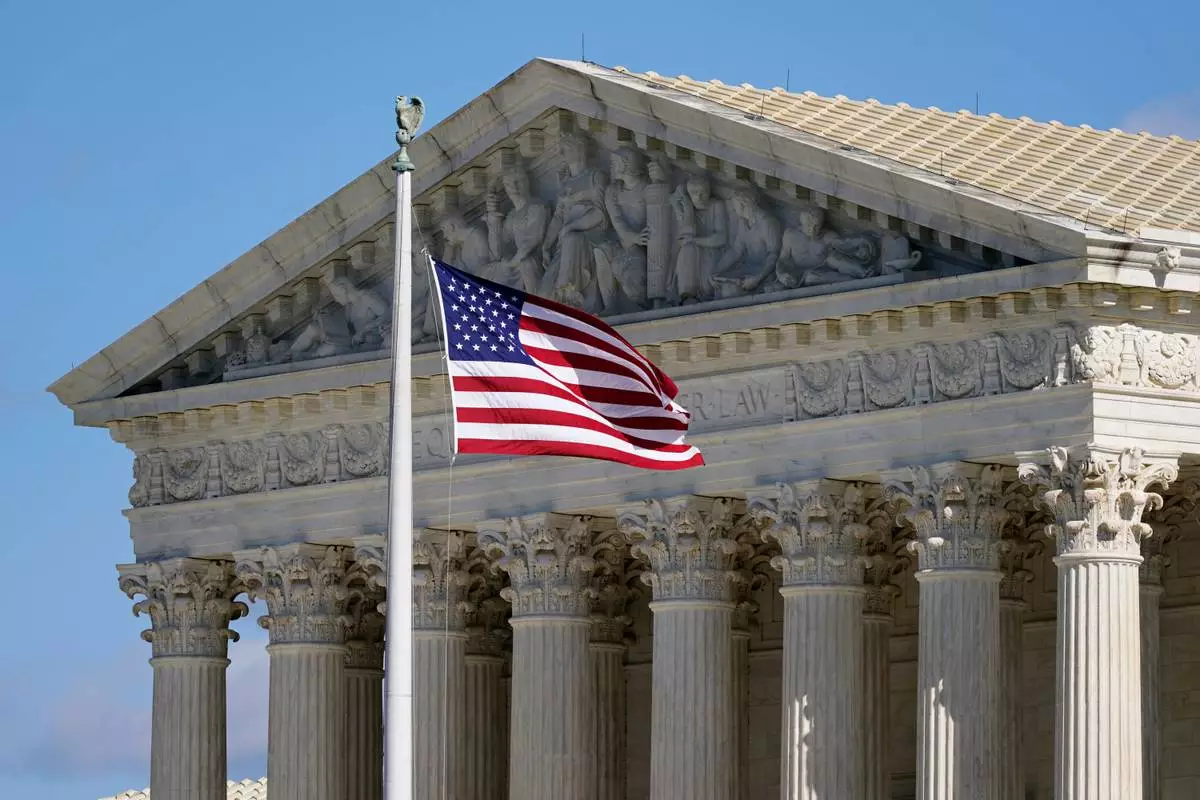
FILE - An American flag waves in front of the Supreme Court building on Capitol Hill in Washington, on Nov. 2, 2020. (AP Photo/Patrick Semansky, File)