International visitors are enjoying a range of special immersive cultural activities and taking full advantage of upgraded departure tax refund services during the ongoing 139th China Import and Export Fair, also known as the Canton Fair, in south China's Guangdong Province.
The current edition of the biannual Canton Fair is taking place in three phases in Guangzhou City, the last of which is scheduled to run from May 1 to 5.
The biannual event has already attracted 245,000 overseas buyers from 219 countries and regions during its first two phases, highlighting the considerable global interest in the fair.
Away from the main exhibition venues, major commercial districts and shopping malls across Guangzhou have launched a series of activities to allow business visitors to experience local culture beyond their trading schedules.
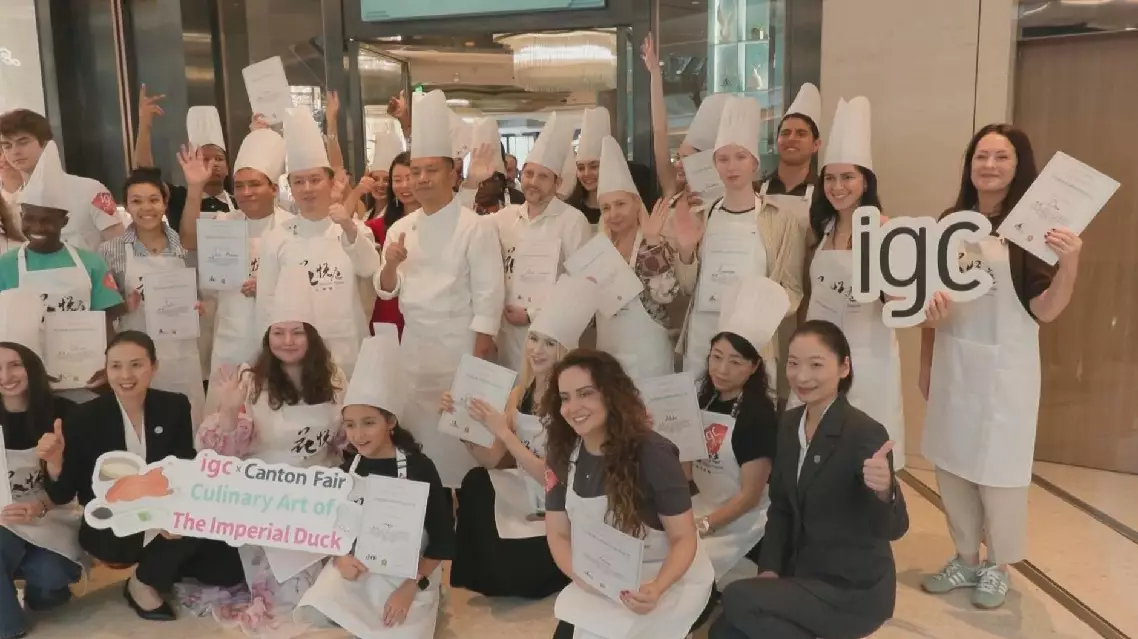
One such activity invited overseas visitors to try their hand at making a mouthwatering roast duck dish. They were given a full rundown of the history and culture behind this traditional cuisine by a seasoned chef, who then guided them through the time-honored process.
The visitors were given the chance to carefully place the meticulously air-dried ducks into the piping hot furnace using long poles, before later slicing the duck skin themselves.
Participants say the fun-filled experience helped them broaden their horizons and make some new contacts away from the fair.
"I think this activity is very interesting because I can meet many new friends. The Canton Fair happens twice a year, offering great opportunities for foreigners to source various products in China. Guangzhou's foreign trade and all industries are already doing very well," said Ajay, an overseas purchaser.
Consumption in Guangzhou has also been boosted with the city's International Grand City (IGC) shopping mall offering multiple Canton Fair guest benefits, including members' privileges and a 200-yuan (around 29 U.S. dollars) cash voucher package upon presentation of their fair credentials, attracting many buyers.
Tax refund services have also been continuously upgraded with the introduction of an instant departure tax refund, as well as cross-provincial mutual recognition between Guangdong and the neighboring Fujian Province, spurring more spending among foreign visitors.
Over 40 stores in the IGC mall now provide departure tax refund services, covering electronics, apparels, cosmetics, food, and other sectors.
The mall has also cooperated with 15 hotels to offer specialized shopping and shuttle bus services, facilitating a convenient "accommodation plus consumption" linkage.
There is also good news for music fans with the Canton Fair offering a special promotion for concertgoers. Residents and tourists holding any concert ticket stub in Guangzhou can head to the service center to receive a gift package for food and beverages worth 120 yuan.
Global attendees, including those who are regular visitors, have praised the convenience of the tax refund procedures.
"I'm from Canada and I've been coming to the fair since 2018. Now, basically, all the shopping in downtown Guangzhou is basically the same as duty free in the airport, because you can do your shopping in the mall here. And then where you would normally have to declare things and pay taxes on them when leaving the country, you can take care of that right here and get it all refunded. So it's basically duty free everywhere. It's amazing," said Joshua Cawthorpe, a Canadian purchaser.
Guangzhou now has more than 1,600 departure tax refund stores with some 55,000 tax refund applications being issued in the first quarter of 2026, more than 17 times higher than last year.
Established in 1957, the Canton Fair is the longest-running of several comprehensive international trade events in China, and it has been hailed as the barometer of China's foreign trade.
In'l visitors enjoy immersive activities, tax refunds during Canton Fair