Chinese Foreign Minister Wang Yi met with Lao Deputy Prime Minister and Minister of Foreign Affairs Thongsavanh Phomvihane on Thursday in Beijing.
Noting that China and Laos are comrades and brothers, Wang, also a member of the Political Bureau of the Communist Party of China Central Committee, said China is ready to work with Laos to promote cooperation in the construction of the China-Laos Railway and in areas such as minerals, economy and trade, and human resources development, as well as to deepen cooperation within multilateral frameworks.
China is willing to jointly implement the important consensus reached by the top leaders of the two parties and the two countries, and continuously advance the building of the China-Laos community with a shared future of strategic significance to a higher level, Wang added.
Thongsavanh said Laos firmly adheres to the one-China principle, and looks forward to taking the 65th anniversary of Laos-China diplomatic ties and the Year of Laos-China Friendship as an opportunity to further promote practical cooperation and implement the action plan for the Laos-China community with a shared future.
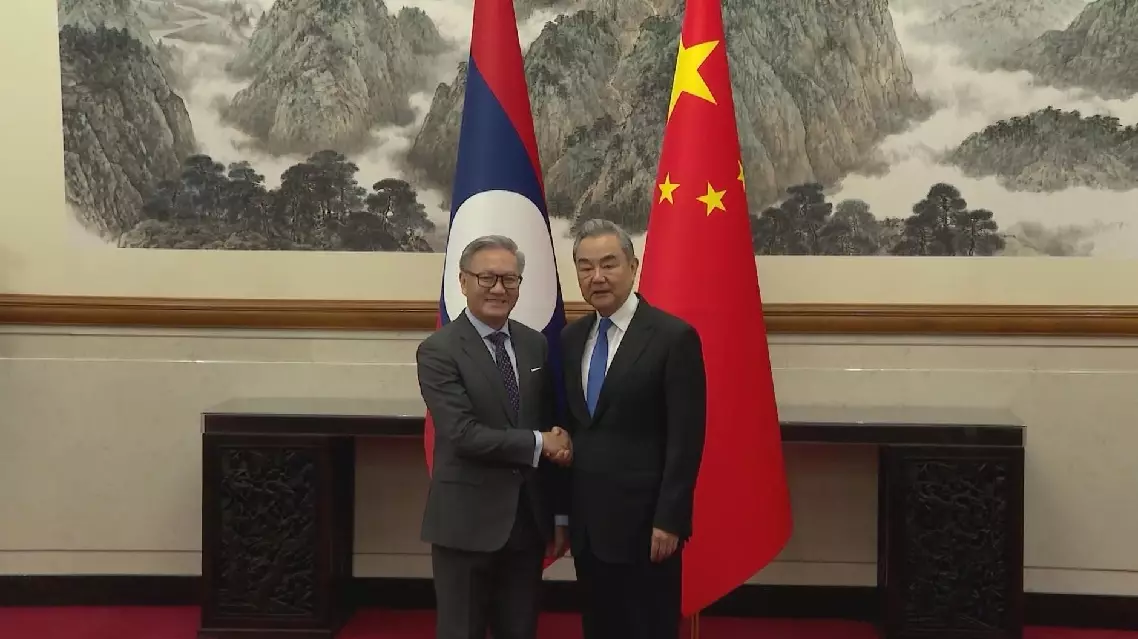
Chinese foreign minister meets Lao counterpart
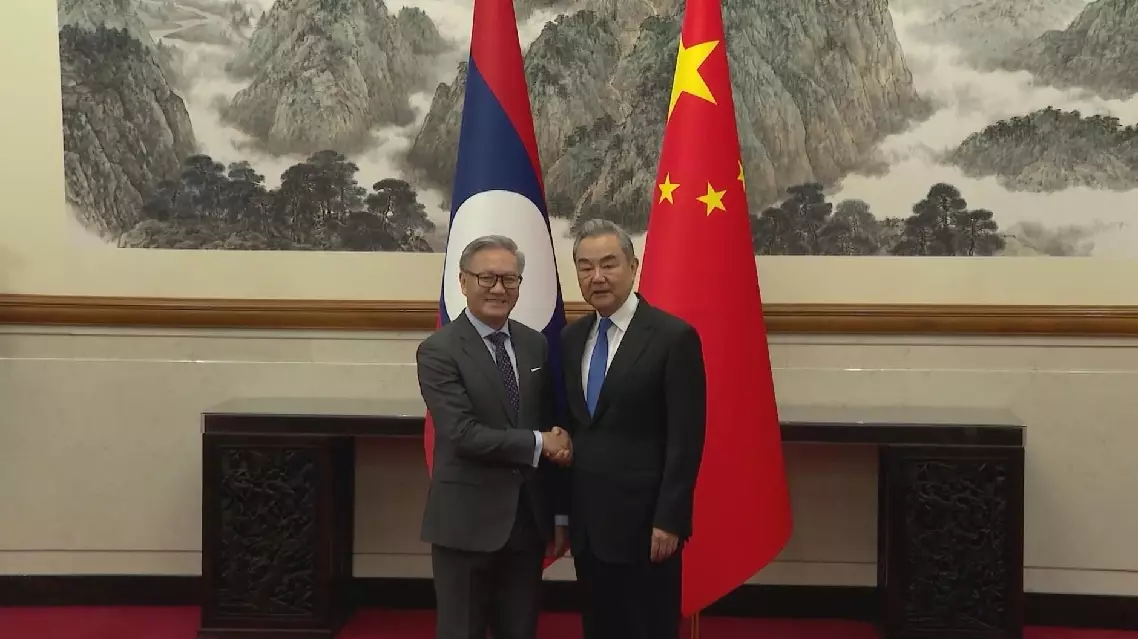
Chinese foreign minister meets Lao counterpart
A Vietnamese vlogger had a rare opportunity to witness how the once poverty-stricken Du'an Yao Autonomous County in Hechi City, south China's Guangxi Zhuang Autonomous Region, lifted itself out of poverty through effective policies and various social programs. China's experience serves as an example for the world, she said.
The vlogger, Tieu Thanh, pursued her master's degree at Beijing Language and Culture University (BLCU), which was a partner in the poverty elimination program in Du'an, Guangxi. This connection gave her the chance to learn firsthand how her university participates in China's poverty alleviation efforts.
China declared victory over absolute poverty in 2021, then set a five-year transition period to lock in its gains by turning what was an emergency response into routine governance. The country's 2026 "No. 1 central document" lays out a systematic framework to prevent social and economic backsliding.
Du'an was once a national-level poverty-stricken county in China. In 2020, Du'an lifted itself out of poverty. But poverty alleviation work for the county did not end there. In the same year, BLCU took on the task of targeted assistance to Du'an.
Besides providing financial support for local industries, BLCU also purchases many supplies from Du'an every year. The university focuses on leveraging its academic strengths: training local primary and secondary school teachers each year, conducting online and offline volunteer teaching, and helping preserve local intangible cultural heritage.
Inviting Du'an to promote its culture and products at the university's annual World Culture Festival is also part of this effort.
Many other universities besides BLCU also provide targeted assistance to Du'an. For example, China University of Mining and Technology (Beijing) has been doing this for more than 10 years.
"This reveals a distinctive feature of China's poverty alleviation: east-west poverty alleviation cooperation. It is a support mechanism that has played a vital role in China's poverty reduction. Put simply, the eastern regions are more economically developed, while the central and western regions are less developed. Thus, provinces and institutions in the east provide targeted assistance to underdeveloped areas in the west, offering funding and personnel to support local economic and social development," she said.
According to World Bank data, over the past four decades, China has lifted nearly 800 million people out of extreme poverty, accounting for nearly three-quarters of global poverty reduction.
Whether measured by international or national poverty lines, China's speed and scale of poverty alleviation are unprecedented in history. Agricultural development, industrialization, urbanization, and infrastructure investment have been key drivers of China's poverty reduction.
"China's poverty alleviation achievements are thanks to its efficient governance system. However, eliminating extreme poverty is not the end of China's poverty reduction efforts. Therefore, China has set a new goal: to make significant progress toward common prosperity by 2035. We hope that China will continue to move forward and achieve even greater accomplishments in poverty reduction," said the vlogger.
From 2013 to 2020, total poverty alleviation funding from China's three levels of government reached nearly 1.6 trillion yuan (about 234.4 billion U.S. dollars). In addition to this budgetary input, various industrial and sectoral authorities also participated in poverty alleviation, with resources exceeding the official budget. Furthermore, the east-west poverty alleviation cooperation mentioned earlier is also a major part of this effort.

Vietnamese vlogger hails China's efforts in poverty alleviation