SANYA, CHINA - Media OutReach Newswire - 30 April 2026 - The ninth day of competition marked the conclusion of the sixth Asian Beach Games in Sanya, bringing the multi-sport event to a close. Gathering over 1,600 athletes from 45 countries and regions across Asia, the Games not only delivered high-level competition but also offered a window into the new phase of openness following the island-wide special customs operations of the Hainan Free Trade Port (Hainan FTP).
 The 6th Asian Beach Games was held in Sanya, Hainan, China from April 22 to 30, 2026.
 The smooth staging of the Games demonstrated Sanya's capacity to host major international events. From competition venues stretching across 22 kilometers of coastline, to 22 designated hotels accommodating domestic and international guests, and the support of 4,680 volunteers, as well as touristic and cultural engagement activities, the host city's organization and services received broad recognition. Abdulaziz Baeshen, Secretary General and CEO at the Saudi Olympic & Paralympic Committee, said, "The organization of this Asian Beach Games has been of a very high standard, once again demonstrating China's outstanding capability in hosting major international sporting events."

The 6th Asian Beach Games was held in Sanya, Hainan, China from April 22 to 30, 2026.
The success of the Games was underpinned by the policies of the Hainan FTP. Benefiting from visa-free access for citizens of 86 countries and event-specific facilitation measures, cross-border travel was efficient and seamless. Qatari athlete Ahmed Elmeniawy said, "The entry procedures were extremely convenient. It took less than two minutes to complete all arrival formalities -- a truly excellent experience." An official from the Saudi Olympic Committee also noted that the FTP policies and visa-free arrangements facilitated participation by delegations and promoted bilateral sports exchanges.
During the Games, Sanya launched a series of cultural tourism activities and consumer incentive packages centered on a "spectating plus vacation" model, boosting the integration of sports and tourism consumption. At the same time, the Asian Beach Games served as a platform for exchanges among Asian countries. During his visit to Hainan, Thomas Bach, Honorary President of the International Olympic Committee, said he felt "the unity of Asia." Raja Randhir Singh, President of the Olympic Council of Asia, noted that despite differences in language and traditions, a shared passion for sport brings people together.
Although the Games have concluded, openness and cooperation continue. The event has provided valuable experience for the Hainan FTP in hosting major international events and demonstrated China's continued efforts to expand high-level opening-up. The FTP will continue to deepen international exchanges and cooperation with an open and inclusive approach.
Hashtag: #6thAsianBeachGame #Sanya #China
The issuer is solely responsible for the content of this announcement.
** This press release is distributed by Media OutReach Newswire through automated distribution system, for which the client assumes full responsibility. **
SINGAPORE - Media OutReach Newswire - 30 April 2026 - AI for Global Civilization: China-Singapore Dialogue was held in Singapore on April 28. The event gathered around 100 participants, including experts, scholars, and representatives from Chinese and Singaporean academic institutions, cultural organizations, as well as technology and cultural enterprises. Participants engaged in in-depth discussions on China-Singapore digital industry cooperation and how digital and intelligent technologies empower inter-civilizational mutual learning. They also jointly showcased innovative achievements and frontier practices of both sides in the integrated field of culture and technology.
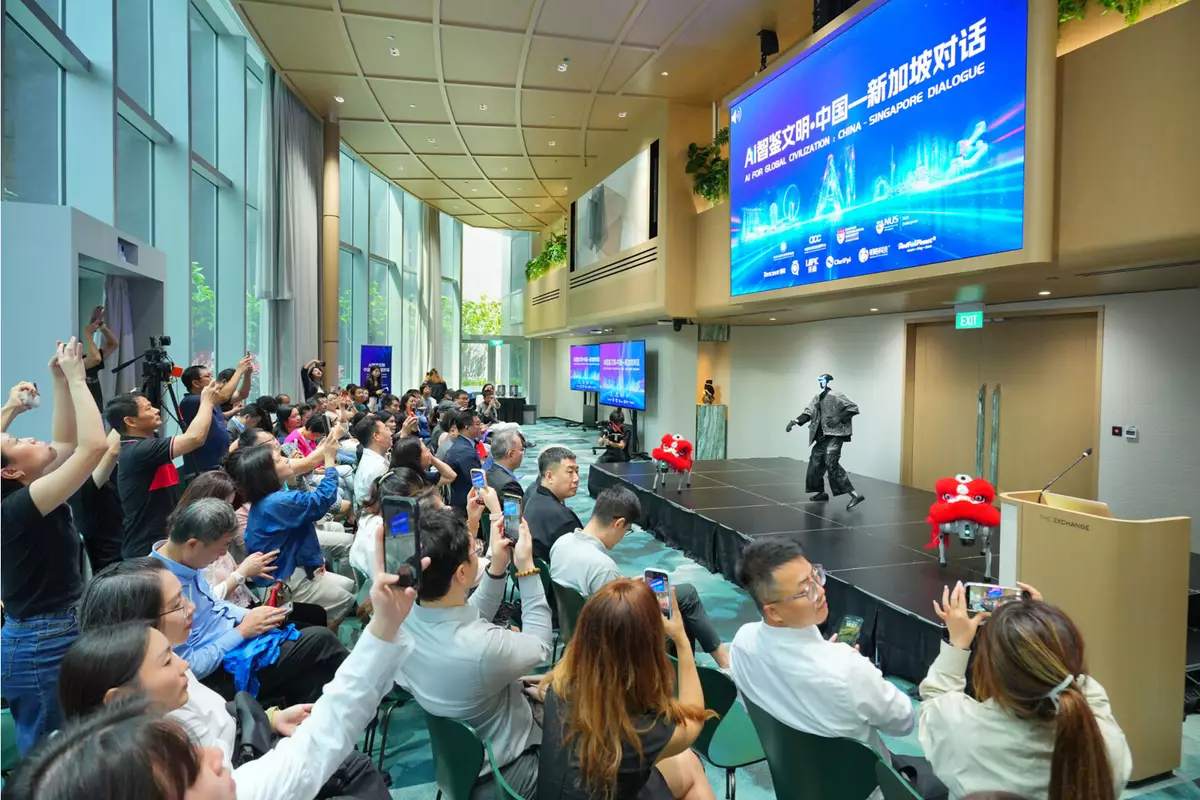
Event Highlights
Opening remarks were delivered by Yuan Lin, Executive Assistant to the President of the Academy of Contemporary China and World Studies, and Wang Donghai, Associate Director of NUS Enterprise. Keynote speeches were delivered by Cai Yiyu, Professor at Nanyang Technological University; Director of the Computer-Aided Engineering Labs and The Strategic Research Program on Virtual Reality; Co-President of Association of Global Technomics Education and Exchange; Cui Kai, Director of the Digital Culture Promotion Department, Center for International Cultural Communication, China International Communications Group (CICG); and Yang Jianwei, Visiting Professor at the National University of Singapore.
Yuan Lin stated that the rapid development of artificial intelligence technology has injected new momentum into China-Singapore cultural exchanges. He stressed the importance of innovating cultural expression forms empowered by digital intelligence, upholding a correct value orientation in technological application, deepening people-to-people exchanges enabled by smart technologies, and actively exploring the profound value of intelligent technologies in advancing cross-cultural understanding.
Wang Donghai pointed out that it is essential to prioritize the integration of technological applications with social needs. Leveraging cutting-edge technologies such as artificial intelligence to build bridges for civilizational exchange helps enhance cross-cultural understanding, enabling technology to better serve humanity and drive social progress.
Cai Yiyu noted that Singapore is forging ahead in cutting-edge fields including semiconductors, aerospace and artificial intelligence, opening up broad prospects for bilateral cooperation between China and Singapore. He emphasized that digital and intelligent technologies can be harnessed to revitalize and inherit traditional culture via youthful, trendy formats, thereby further deepening scientific, technological and people-to-people exchanges between the two countries.
Cui Kai stated that intelligent imaging technology is profoundly reshaping the logic of cross-cultural narrative. Digital content creation is not merely about keeping pace with technological advancement; more importantly, it should take emotional resonance as the bond to break down cultural barriers, foster in-depth empathy, mutual learning and appreciation among global civilizations, and enable more outstanding civilizational achievements to be seen, understood and respected worldwide.
Yang Jianwei noted that artificial intelligence is becoming an important vehicle for inter-civilizational mutual learning, while cultural differences remain a core obstacle to cross-cultural communication. He advocated for the innovative and rational use of artificial intelligence in the future to eliminate prejudices and enhance civilizational understanding through technological power.
In the Case Sharing Session, guest speakers included Lisa Meng, Head of Singapore of Tencent Cloud International; Koh Chin Yee, Managing Director of Singapore Eye; Bai Yu, Director and Partner of LAiPIC; Hu Chengchen, Founder & CEO of ClariPpi (Singapore); Jane Zhao, SVP and Head of Global Business at Mininglamp Technology; and Jerry Tuo, AI Technology Director of Red Fun Planet. They delivered insightful presentations on the application prospects of artificial intelligence in content production as well as inter-civilizational mutual learning and exchange.
The participating guests agreed that artificial intelligence has brought revolutionary changes to the intelligent production, targeted communication and immersive presentation of cultural content. China and Singapore boast strong complementarity in digital infrastructure and cultural resources. Going forward, the two sides may deepen cooperation in joint research and development and scenario-based application, develop benchmark cultural-technology products and integrated solutions tailored for Southeast Asia, and jointly advance the high-quality development of the digital cultural industry.
This event was jointly hosted by the Academy of Contemporary China and World Studies and the Center for International Cultural Communication,CICG, with Nanyang Technological University and other cultural and business exchange institutions participating as supporting partners.
Hashtag: #ACCWS
The issuer is solely responsible for the content of this announcement.
** This press release is distributed by Media OutReach Newswire through automated distribution system, for which the client assumes full responsibility. **