
Skip to Content Facebook Feature Image

A citizen campaign returns iconic kiwi birds to New Zealand's capital after a century-long absence

News

A citizen campaign returns iconic kiwi birds to New Zealand's capital after a century-long absence
News

News

A citizen campaign returns iconic kiwi birds to New Zealand's capital after a century-long absence

2026-05-01 11:26 Last Updated At:13:24

WELLINGTON, New Zealand (AP) — The kiwi, New Zealand’s sacred national bird, vanished from the hills around Wellington more than a century ago. Now the capital's residents are waging an improbable citizen campaign to return the endangered flightless birds to the city.

“They are a part of who we are and our sense of belonging here,” said Paul Ward, founder of the Capital Kiwi Project, a charitable trust. “But they’ve been gone from these hills for well over a century and we decided as Wellingtonians that wasn’t right.”

On a hill wreathed in mist above the dark sea that runs between New Zealand’s North and South Islands, Ward and others crossed rugged farmland late on Tuesday night, carrying seven crates in silence by dim red torchlight. Inside each one nestled a kiwi, including the 250th bird relocated to Wellington since the Capital Kiwi Project began.

The kiwi gives New Zealanders the name by which they’re often known. It’s a shy and odd-looking bird with underdeveloped wings and a whiskery face.

Spiritually significant for many New Zealanders, the kiwi’s image appears everywhere, including on the tail of the country’s air force planes — curious for a bird with no tail which can’t fly.

It’s thought that there were 12 million of the birds roaming the landscape before humans arrived in New Zealand. Today only about 70,000 kiwi are left across the country, with the population dropping 2% each year.

In the hills where Wellington’s kiwi now live and breed, the only late-night sound on Tuesday was the whoosh of wind turbines. Ward and his friends set their crates down in pairs, slid them open and gently tilted the boxes.

Some in the small group of hushed onlookers were tearful. One man chanted a karakia, a Māori prayer.

From each crate, a long, curved beak eventually protruded as kiwi took their first tentative steps into the shadowed landscape, then sped to a run and disappeared into the darkness.

One place kiwi had never set foot until this week was inside New Zealand’s Parliament. Hours before Wellington’s seven newest residents were transported to their hillside home, they were carried into Parliament’s grand banquet hall by handlers for a celebration of the 250th kiwi's arrival in the city.

Lawmakers and schoolchildren alike expressed whispered delight at seeing the timid, nocturnal birds up close, many for the first time, as conservation workers cradled the large birds like human babies, with their gnarled feet outstretched.

“This animal has given us as a people so much in terms of our sense of identity,” Ward told The Associated Press. “We want to challenge our civic leaders, our politicians and say this is a relationship we need to honor.”

New Zealand is home to some of the world’s strangest and rarest bird species. Some have only survived because of against-all-odds conservation programs, at times with uncertain funding.

Initiatives decades ago saw all surviving birds of some species moved onto offshore, predator-free islands or into sanctuaries where they could be carefully monitored and protected, but where few New Zealanders would ever see one.

Ward and his group had a different dream: that New Zealand’s iconic national bird could flourish alongside people in a bustling capital city, where human encroachment and introduced predators had wiped out the kiwi before.

“Where people are is also the places where we can bring them back because we’ve got the means to do that guardianship,” Ward said.

Although unmanaged kiwi populations are shrinking, their numbers have thrived in carefully managed wild bird sanctuaries — so much, in fact, that some of these protected areas have run out of room for them.

That’s prompted their relocation to places like Wellington, where groups such as Ward’s rally residents to embrace their new neighbors. Kiwi have been spotted by late night mountain bikers and on backyard security camera footage in the capital, he said.

“They’re living and calling and being encountered on the hills surrounding our city,” Ward said.

That's taken work. Over the past decade, efforts between landowners, the local Māori tribe and the Capital Kiwi Project have produced a sprawling, 24,000-hectare tract of land where kiwi can roam.

It’s dotted with more than 5,000 traps for stoats, the main predator of kiwi chicks. So far, the Wellington population has a 90% chick survival rate.

The kiwi initiative is part of New Zealand’s quest to rid the island nation of introduced predators, including feral cats, possums, rats and stoats, by the year 2050. Since a previous government established the target in 2016 its chances of success have been debated, but community groups have taken up the work in earnest.

Parts of Wellington are now entirely free of mammalian predators apart from household pets, and native birds flourish. Volunteers monitor suburbs with military precision for the appearance of a single rat.

“When I think of endangered species globally, for the most part you can’t do much other than campaign or donate money,” said Michelle Impey, chief executive of Save the Kiwi. “But we have this incredible movement throughout the country where everyday people are taking it on under their own steam to do what they can to protect a threatened species.”

Staff members of conservation organizations hold kiwi birds during an event at Parliament in Wellington, New Zealand, Tuesday, April 28, 2026. (AP Photo/Charlotte Graham-McLay)
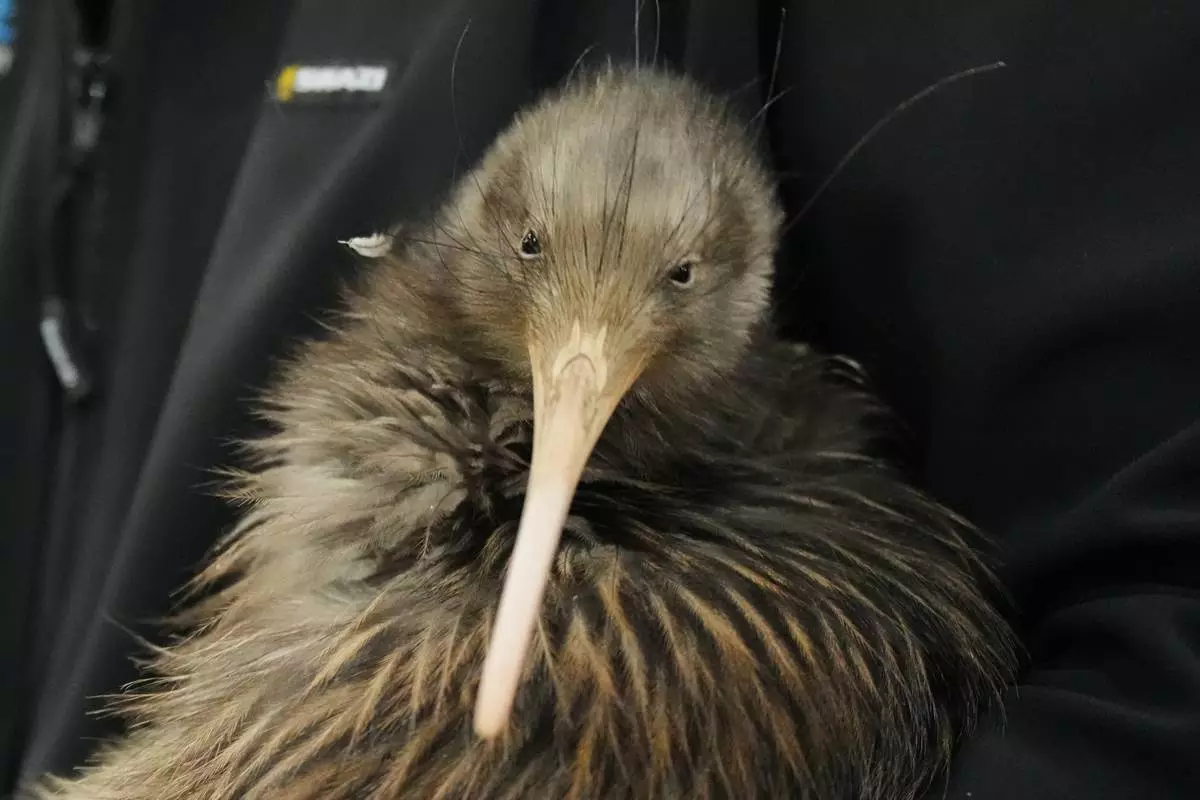
Staff members of conservation organizations hold kiwi birds during an event at Parliament in Wellington, New Zealand, Tuesday, April 28, 2026. (AP Photo/Charlotte Graham-McLay)

A staff member of a conservation organization carries a kiwi bird during an event at Parliament in Wellington, New Zealand, on Tuesday, April 28, 2026. (AP Photo/Charlotte Graham-McLay)

A staff member of a conservation organization carries a kiwi bird during an event at Parliament in Wellington, New Zealand, on Tuesday, April 28, 2026. (AP Photo/Charlotte Graham-McLay)

A staff member of a conservation organization carries a kiwi bird during an event at Parliament in Wellington, New Zealand, Tuesday, April 28, 2026. (AP Photo/Charlotte Graham-McLay)


A staff member of a conservation organization carries a kiwi bird during an event at Parliament in Wellington, New Zealand, Tuesday, April 28, 2026. (AP Photo/Charlotte Graham-McLay)

NEW YORK (AP) — Stocks wavered to a mixed close on Wall Street Wednesday as technology stocks once again weighed down the market.

Declines for several influential tech heavyweights, including Microsoft, pulled the broader market lower even though most stocks in the S&P 500 gained ground. That was also the case on Tuesday, when tech stocks pulled the market lower despite broader gains elsewhere.

The S&P 500 fell 7.24 points, or 0.1%, to 7,358.22, despite nearly 2 out of every 3 stocks gaining ground. The Dow Jones Industrial Average, which is less weighted with tech stocks, rose 182.06 points, or 0.4%, to 51,848.90.

The tech-heavy Nasdaq composite fell 110.40 points, or 0.4%, to 25,476.64.

A 2.3% drop in Microsoft was the heaviest weight on the market. Oracle slumped 4.6%.

Many large tech companies have been behind Wall Street’s record-setting run throughout the year, but analysts have warned their valuations may have become stretched.

“The next phase of the AI investment cycle is beginning to collide with market discipline,” said Jason Vaillancourt, chief portfolio strategist at Columbia Threadneedle, in a research note.

Google’s parent company Alphabet slipped 0.2%. The company is replacing Verizon in the Dow on Monday. The company’s inclusion in the S&P 500 means more to investors, however, because 401(k) accounts are much more likely to include an S&P 500 index fund than anything tied to the Dow.

Alphabet will become the fifth Magnificent 7 company to join the Dow. The others are Apple, Amazon, Microsoft and Nvidia.

Oil prices continued slipping as the U.S. and Iran negotiate a possible end to their war. Brent crude, the international standard, fell 3.8% to $73.87 a barrel. It has been trading below $80 in recent days but is still above the roughly $70 per barrel it was trading at in late February before the war began. U.S. crude prices fell 3.9% to $70.34 a barrel.

Oil companies had some of the biggest losses. Exxon Mobil fell 2% and Chevron lost 2.6%.

Some of the bigger winners on Wall Street included homebuilders following approval of legislation beneficial to the industry. KB Home surged 16.7% and D.R. Horton jumped 6.7%.

Treasury yields mostly fell, removing some pressure from stocks. The yield on the 10-year Treasury fell to 4.40% from 4.50% late Tuesday. The yield on the 2-year Treasury eased to 4.15% from 4.16%.

Treasury yields are still elevated from earlier in the year, especially the 2-year Treasury, which more closely tracks anticipated action from the Federal Reserve. The central bank has signaled that it is considering raising its benchmark interest rate by the end of the year. Wall Street is forecasting at least one hike to interest rates by December, according to data from CME Group.

The Fed is worried about stubborn inflation, which had been rising throughout the year as tariffs raised the costs for a wide range of goods. A shock to energy prices because of the U.S. war with Iran worsened inflation. Gasoline prices surged and shipping costs rose. The impact is expected to linger even as oil and gasoline prices fall.

The central bank will get an update on inflation Thursday, when its preferred measure for prices is released. Economists expect the Personal Consumption Expenditures price index, or PCE, to show that prices rose 4.1% in May. That would be the highest level in three years.

“Thursday’s PCE is set to take on greater importance for markets, especially since Federal Reserve Chair (Kevin) Warsh was emphatic in last week’s meeting about the central bank’s desire to achieve price stability,” wrote Rick Gardner, chief investment officer at RGA Investments, in a research note.

Gold prices fell 3.4% to settle at $4,008.80 an ounce. Earlier in the day, gold briefly traded below $4,000, and hasn't settled below that level since November. Gold was above $5,000 an ounce earlier in the year. The precious metal is often seen as a barometer of the appetite for risk among investors, with more buying at times of increased anxiety and more selling as anxiety eases.

Markets were mixed in Europe.

AP Business Writers Chan Ho-him and Matt Ott contributed to this report.

Options trader Doran Swan works on the floor of the New York Stock Exchange, Tuesday, June 16, 2026. (AP Photo/Richard Drew)

Options trader Doran Swan works on the floor of the New York Stock Exchange, Tuesday, June 16, 2026. (AP Photo/Richard Drew)

Specialist Michael Pistillo, left, and trader Sean Spain work on the floor of the New York Stock Exchange, Tuesday, June 16, 2026. (AP Photo/Richard Drew)

Specialist Michael Pistillo, left, and trader Sean Spain work on the floor of the New York Stock Exchange, Tuesday, June 16, 2026. (AP Photo/Richard Drew)

Anders Opedal, President and CEO of Norway's Equinor, left, meets with specialist Patrick King on the floor of the New York Stock Exchange, after he rang the closing bell, Tuesday, June 16, 2026. (AP Photo/Richard Drew)

Anders Opedal, President and CEO of Norway's Equinor, left, meets with specialist Patrick King on the floor of the New York Stock Exchange, after he rang the closing bell, Tuesday, June 16, 2026. (AP Photo/Richard Drew)

Options trader Anthony Spina, center, works on the floor of the New York Stock Exchange, Tuesday, June 16, 2026. (AP Photo/Richard Drew)

Options trader Anthony Spina, center, works on the floor of the New York Stock Exchange, Tuesday, June 16, 2026. (AP Photo/Richard Drew)

A currency trader watches monitors near a screen showing the Korea Composite Stock Price Index (KOSPI) and the foreign exchange rate between U.S. dollar and South Korean won at the foreign exchange dealing room of the Hana Bank headquarters in Seoul, South Korea, Wednesday, June 24, 2026. (AP Photo/Ahn Young-joon)

A currency trader watches monitors near a screen showing the Korea Composite Stock Price Index (KOSPI) and the foreign exchange rate between U.S. dollar and South Korean won at the foreign exchange dealing room of the Hana Bank headquarters in Seoul, South Korea, Wednesday, June 24, 2026. (AP Photo/Ahn Young-joon)

Currency traders work near a screen showing the Korea Composite Stock Price Index (KOSPI) at the foreign exchange dealing room of the Hana Bank headquarters in Seoul, South Korea, Wednesday, June 24, 2026. (AP Photo/Ahn Young-joon)

Currency traders work near a screen showing the Korea Composite Stock Price Index (KOSPI) at the foreign exchange dealing room of the Hana Bank headquarters in Seoul, South Korea, Wednesday, June 24, 2026. (AP Photo/Ahn Young-joon)

A currency trader watches monitors near a screen showing the Korea Composite Stock Price Index (KOSPI) and the foreign exchange rate between U.S. dollar and South Korean won at the foreign exchange dealing room of the Hana Bank headquarters in Seoul, South Korea, Wednesday, June 24, 2026. (AP Photo/Ahn Young-joon)

A currency trader watches monitors near a screen showing the Korea Composite Stock Price Index (KOSPI) and the foreign exchange rate between U.S. dollar and South Korean won at the foreign exchange dealing room of the Hana Bank headquarters in Seoul, South Korea, Wednesday, June 24, 2026. (AP Photo/Ahn Young-joon)

Currency traders work near a screen showing the Korea Composite Stock Price Index (KOSPI) and the foreign exchange rate between U.S. dollar and South Korean won at the foreign exchange dealing room of the Hana Bank headquarters in Seoul, South Korea, Wednesday, June 24, 2026. (AP Photo/Ahn Young-joon)

Currency traders work near a screen showing the Korea Composite Stock Price Index (KOSPI) and the foreign exchange rate between U.S. dollar and South Korean won at the foreign exchange dealing room of the Hana Bank headquarters in Seoul, South Korea, Wednesday, June 24, 2026. (AP Photo/Ahn Young-joon)

Recommended Articles