France's gross domestic product (GDP) stalled in the first quarter of 2026, recording zero growth from the previous quarter, according to preliminary data released on Thursday by the National Institute of Statistics and Economic Studies (INSEE).
The stagnation came as final domestic demand excluding inventories remained sluggish. Household consumption edged down 0.1 percent in the first three months of the year, a reversal from the 0.4 percent growth seen in the fourth quarter of 2025. Meanwhile, gross fixed capital formation also fell back by 0.4 percent.
Foreign trade exerted a strong negative contribution to GDP growth in the first quarter, subtracting 0.7 percentage point after adding 0.6 point in the previous quarter. This downturn was driven by a sharp 3.8 percent drop in exports, while imports also continued to decline, falling 1.7 percent.
In contrast, changes in inventories provided a strong positive contribution of 0.8 percentage point, rebounding from a negative 0.7 percentage point in the fourth quarter of 2025. The INSEE said the inventory build was driven mainly by aerospace products.
Total production of goods and services remained sluggish in the first quarter, rising by 0.1 percent after a 0.2 percent increase in the fourth quarter of 2025.

France's GDP stalls in Q1 2026 as foreign trade drags
Iranian residents are adjusting their spending habits and are being forced to tighten their belts as ongoing turmoil in the Middle East wreaks havoc on Iran's currency and gold markets, sending the prices of daily goods soaring.
While the spillover effects of the U.S.-Israeli war on Iran have brought economic instability and supply chain disruptions to much of the Middle East region and the wider world, the impact within Iran is also becoming more pronounced.
The value of Iran's currency, the rial, has plunged in recent days while the country's gold markets have seen sharp increases. The U.S. dollar has risen by about 16 percent, while gold prices have climbed roughly 18 percent -- all in less than a week.
For many residents in the capital Tehran, the rapid rise in prices is making daily life increasingly difficult. Many are now having to buy less and prioritize essentials -- a sign of the growing strain on household budgets.
"The economic pressure is very high. Every time you go to the store, the prices today are different from yesterday. People are struggling and having to endure it because of the war, but fortunately, goods are available, though prices are high," said a female resident at the city's bustling Tajrish Bazaar.
"Things were very good before the war, but now the prices change every day. We used to buy by the kilo, but now we buy by 100 grams, and we may feel embarrassed in front of our family," said a local man.
The volatility has raised concerns about inflation and the broader economic outlook for the country, with experts pointing to some of the internal structural challenges which may hinder Iran's long-term recovery.
While explaining the recent sharp movement in the Iranian currency and gold markets, local economist Saeed Laylaz highlighted several factors.
"It has a delay. It should be higher sooner than now. Why? Because we are injecting a huge amount of liquidity into the Iranian economy [and] because of the lack of financial discipline of the government and because of the economic corruption. Because of these two factors, which are the main and essential elements, we are facing inflation, and inflation is essentially an internal problem, not an external one," he said.
While some are concerned that a continuation of the U.S. strategic blockade in the Strait of Hormuz might push Iran's economy to the verge of collapse, Laylaz firmly disagrees and believes Iran is resilient enough to survive.
"A country like Iran, with 14-15 neighbors, most of them are poorer than us, never you can blockade it, never. I could not see any country, in the history of humankind -- [or] since about 200, 250, 300 years ago -- that has collapsed just because of an economic blockade," he said.
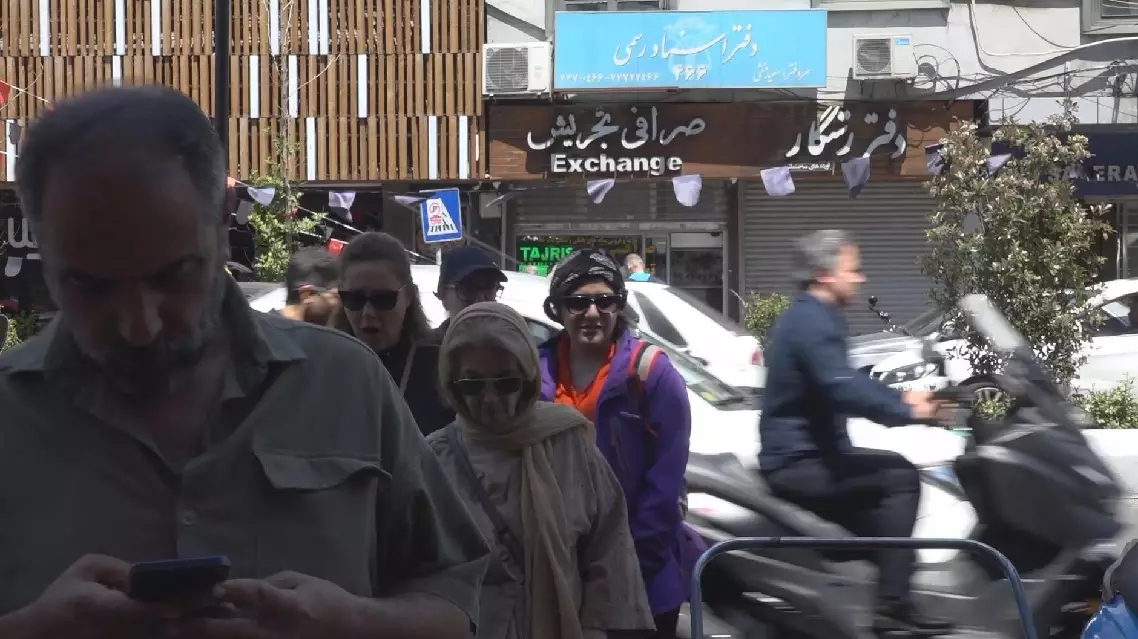
Residents tighten belts as sharp market movements hit daily life in Tehran