Skip to Content Facebook Feature Image

After major enforcement operations, the Trump administration recalibrates its immigration crackdown

News

After major enforcement operations, the Trump administration recalibrates its immigration crackdown
News

News

After major enforcement operations, the Trump administration recalibrates its immigration crackdown

2026-05-01 19:32 Last Updated At:19:41

WASHINGTON (AP) — When Homeland Security Secretary Markwayne Mullin was questioned by senators during his confirmation hearing about his vision for implementing President Donald Trump's mass deportation agenda, he said his goal was to keep his department off the front pages of the news.

To some degree, he has. Gone are the social media video clips of now-retired Border Patrol commander Greg Bovino clashing with protesters. Mullin's predecessor, Kristi Noem, made her first trip as secretary to New York City to make arrests with Immigration and Customs Enforcement. In contrast, Mullin went to North Carolina to review hurricane recovery efforts.

More Images
FILE - A federal agent approaches a vehicle on Jan. 29, 2026, in Minneapolis. (AP Photo/Adam Gray, File)

FILE - A federal agent approaches a vehicle on Jan. 29, 2026, in Minneapolis. (AP Photo/Adam Gray, File)

Federal agents from U.S. Immigration and Customs Enforcement and U.S. Customs and Border Protection walk along West Wacker Drive in the Loop, Sunday, Sept. 28, 2025, in Chicago. (Ashlee Rezin/Chicago Sun-Times via AP)
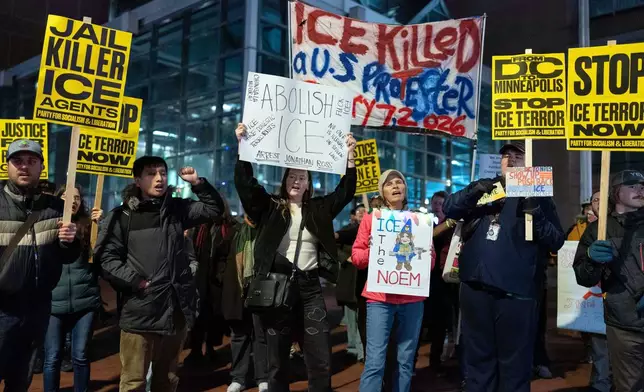
Federal agents from U.S. Immigration and Customs Enforcement and U.S. Customs and Border Protection walk along West Wacker Drive in the Loop, Sunday, Sept. 28, 2025, in Chicago. (Ashlee Rezin/Chicago Sun-Times via AP)

FILE - Demonstrators rally before marching to the White House in Washington, Jan. 8, 2026, as they protest against the Immigration and Customs Enforcement (ICE) agent who fatally shot Renee Nicole Good in Minneapolis. (AP Photo/Jose Luis Magana, File)
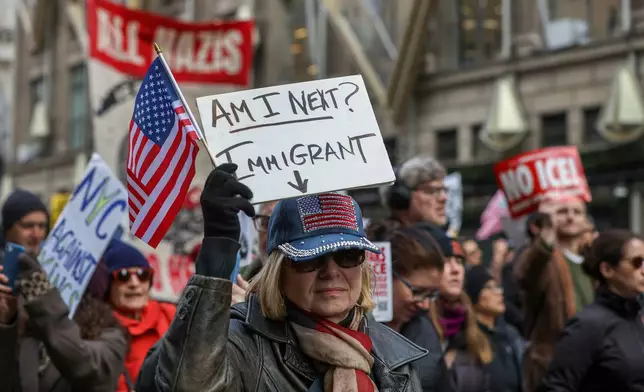
FILE - Demonstrators rally before marching to the White House in Washington, Jan. 8, 2026, as they protest against the Immigration and Customs Enforcement (ICE) agent who fatally shot Renee Nicole Good in Minneapolis. (AP Photo/Jose Luis Magana, File)

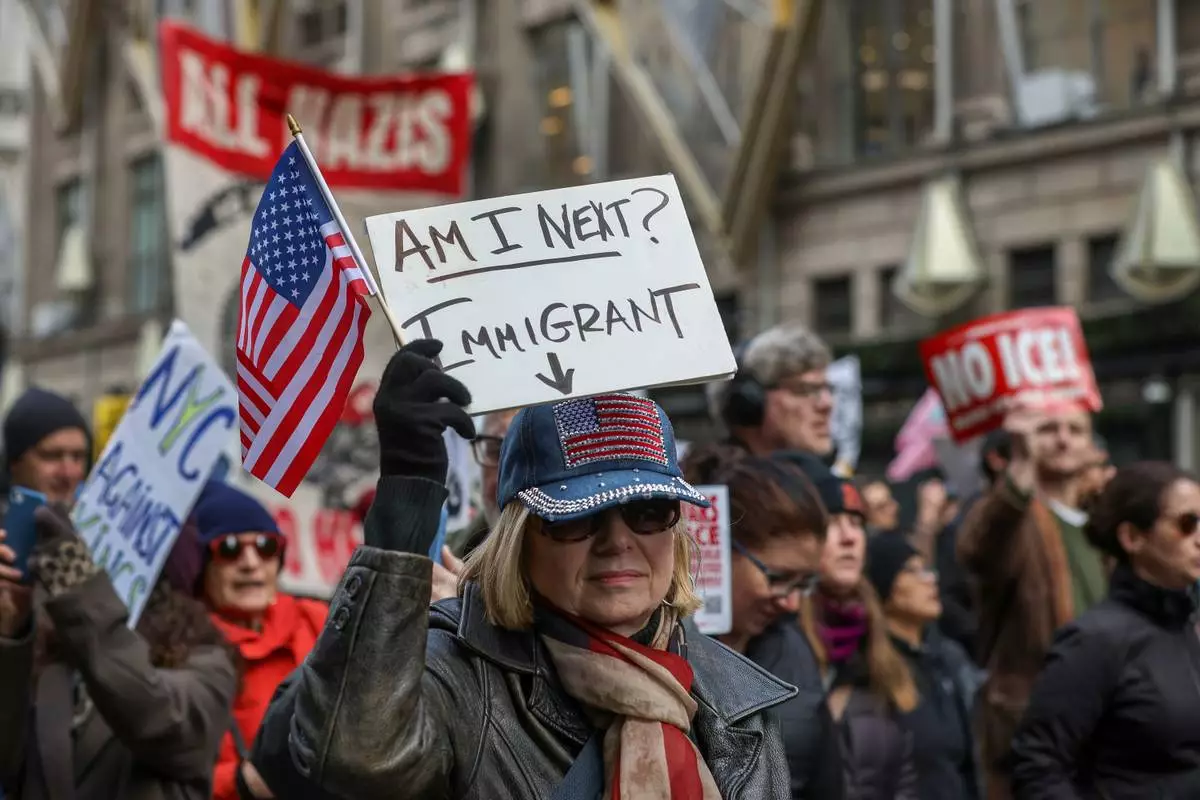
FILE - Demonstrators march down Fifth Avenue during a protest against war in Venezuela and Immigration and Customs Enforcement, Jan. 11, 2026, in New York. (AP Photo/Heather Khalifa, File)

FILE - Demonstrators march down Fifth Avenue during a protest against war in Venezuela and Immigration and Customs Enforcement, Jan. 11, 2026, in New York. (AP Photo/Heather Khalifa, File)

FILE - Federal officers stand guard after detaining people outside of Bishop Henry Whipple Federal Building, Jan. 13, 2026, in Minneapolis. (AP Photo/Adam Gray, File)

FILE - Federal officers stand guard after detaining people outside of Bishop Henry Whipple Federal Building, Jan. 13, 2026, in Minneapolis. (AP Photo/Adam Gray, File)

The Republican administration appears to be recalibrating its approach to a centerpiece policy that helped bring Trump back to the White House, moving in many ways away from aggressive, public-facing tactics toward a quieter approach to enforcement. Despite that shift, the administration insists it is not backing down from its lofty deportation goals.

“Clearly they’ve stepped back from the, for want of a better word, the Bovinoist tactics of before," said Mark Krikorian, the president of the Center for Immigration Studies, which advocates for immigration restrictions. "But it’s not clear this means they’re actually stepping back from immigration.”

The Trump administration launched a series of immigration enforcement operations last year in mostly Democratic-led cities, which drove up arrests in large-scale sweeps. The crackdown sparked clashes between protesters and enforcement officers and led to the shooting deaths in Minneapolis of two U.S. citizens.

Since then, the president’s hard-line anti-immigration agenda has lost popularity with voters and there have been no new high-profile city-based operations launched, raising questions about the administration's strategy.

“We’re still enforcing immigration laws. We’re still deporting illegals that shouldn’t be here. We’re still going after the worst of the worst — but we’re doing it in a more quiet way,” Mullin said in an interview April 16 with CNBC.

ICE arrests have fallen in recent months, and the number of people in immigration detention has dropped from a high of roughly 72,000 in January to 58,000 this week, according to data obtained by The Associated Press.

But in a sign of its continued determination, ICE in budget documents says it plans to remove 1 million people this fiscal year and the next compared with roughly 442,000 people last year. The agency also has plenty of money to carry out its mission, with Congress granting the Department of Homeland Security more than $170 billion for Trump's immigration agenda last year.

The administration aims to have enough space to detain roughly 100,000 people this fiscal year, which would more than double the average daily number held in ICE detention last year. The administration has already expanded its detention capacity with the purchase of 11 warehouses across the country.

“They are working really on building a juggernaut of a system,” said Doris Meissner, who headed the U.S. Immigration and Naturalization Service, a predecessor to ICE, during President Bill Clinton's Democratic administration and is now a senior fellow at the Migration Policy Institute.

White House spokesperson Abigail Jackson said there had been no change to Trump's strategy.

"President Trump’s highest priority has always been the deportation of illegal alien criminals who endanger American communities,” Jackson said.

ICE did not respond to repeated requests for comment.

Advocates for immigrants are bracing for the Trump administration to turn its attention more intently to stripping away protections for migrants with temporary legal status to remain in the U.S. while their cases are being adjudicated.

In one example of this, the number of green cards approved by U.S. Citizenship and Immigration Services dropped by half over the course of a year under the Trump administration, according to an analysis by the Cato Institute, which supports immigration into the U.S. Humanitarian visas for refugees or people who qualified for asylum saw the biggest declines.

USCIS spokesman Zach Kahler said the drop was due to increased vetting of applicants by the administration.

The Trump administration has also pushed to strip Temporary Protected Status from hundreds of thousands of people, with a key case weighing whether it's overstepped its power to do so being heard at the Supreme Court this week.

Advocates see it as a way to send a chilling message to immigrant communities and make more people vulnerable to deportation. It also enables the department to operate without the public spectacle of workplace raids or home arrests.

ICE has also focused over the past year on creating agreements with jurisdictions around the country that allow local and state law enforcement to carry out an expanding array of immigration enforcement tasks, ranging from checking the immigration status of people in their jails to incorporating immigration checks during routine traffic stops.

These agreements, known as 287g, have grown from 135 in 20 states before Trump took office to more than 1,400 in 41 states and territories now.

Some states, most noticeably Florida and Texas, have mandated various forms of cooperation between local law enforcement and ICE.

Meissner, from MPI, said Trump’s border czar, Tom Homan, is likely to prioritize further discussions about how cities and states can cooperate with ICE.

“At the end of the day, some of this may very well succeed in increasing the numbers,” Meissner said.

Conservatives who want more deportations say the only way to truly crack down on illegal immigration is to make it so difficult for the migrants to work that they’ll leave on their own.

The Trump administration has already taken steps to make life harder for people in the country illegally including limiting who can live in public housing by immigration status, sharing Medicaid information with ICE and requiring people in the country illegally to register with the federal government.

Krikorian, of the Center for Immigration Studies, said the Social Security Administration could send out letters alerting employers when an employee's name doesn't match their Social Security number. Authorities could repeatedly and consistently carry out audits of I-9 forms, which companies are supposed to fill out and submit to the federal government showing that new hires are legally able to work. And they could require banks to collect citizenship information on customers.

Whatever the strategy going forward, the administration is facing heavy pressure not to back away from its goals.

“The numbers are too low," said Mike Howell, part of the Mass Deportation Coalition, which launched a playbook for how the administration can actually get to a million deportations a year by using tactics such as worksite enforcement.

“The deportation numbers are just too low," Howell said, "and they need to be much higher, and they can be much higher.”

Associated Press writers Lisa Mascaro and Will Weissert contributed to this report.

FILE - A federal agent approaches a vehicle on Jan. 29, 2026, in Minneapolis. (AP Photo/Adam Gray, File)

FILE - A federal agent approaches a vehicle on Jan. 29, 2026, in Minneapolis. (AP Photo/Adam Gray, File)

Federal agents from U.S. Immigration and Customs Enforcement and U.S. Customs and Border Protection walk along West Wacker Drive in the Loop, Sunday, Sept. 28, 2025, in Chicago. (Ashlee Rezin/Chicago Sun-Times via AP)
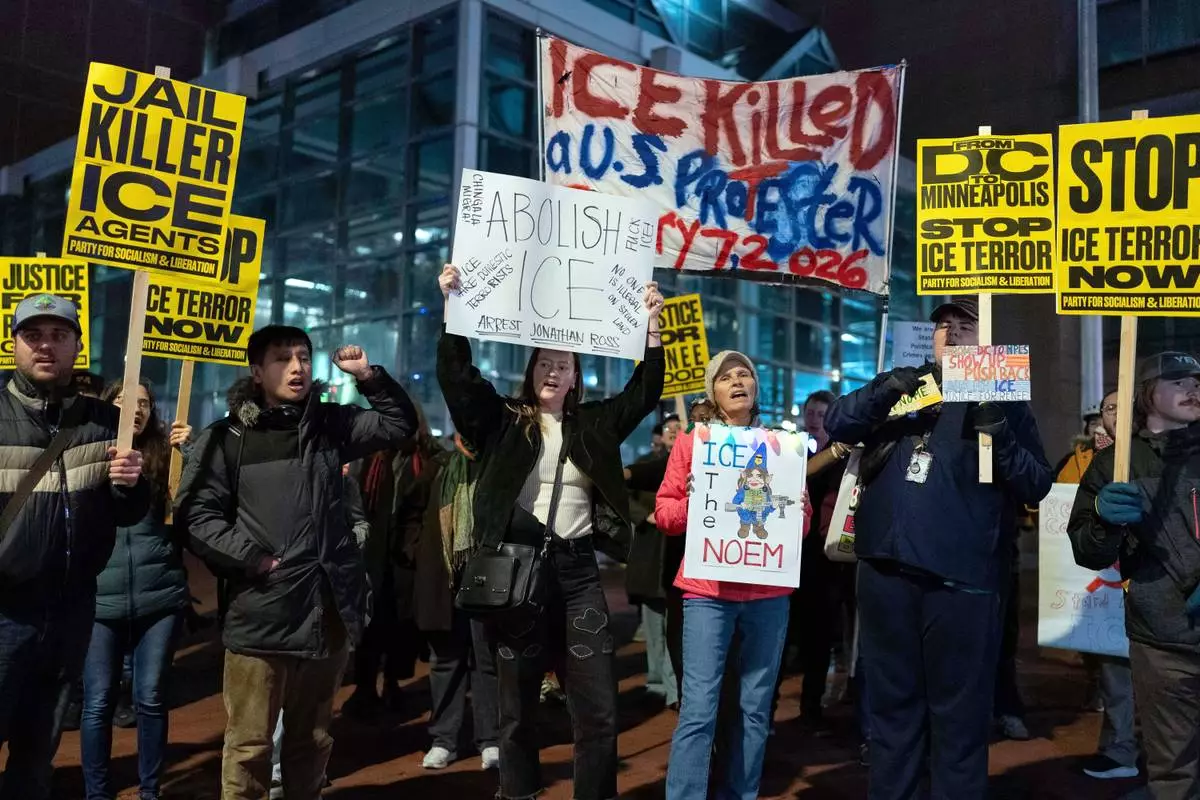
Federal agents from U.S. Immigration and Customs Enforcement and U.S. Customs and Border Protection walk along West Wacker Drive in the Loop, Sunday, Sept. 28, 2025, in Chicago. (Ashlee Rezin/Chicago Sun-Times via AP)

FILE - Demonstrators rally before marching to the White House in Washington, Jan. 8, 2026, as they protest against the Immigration and Customs Enforcement (ICE) agent who fatally shot Renee Nicole Good in Minneapolis. (AP Photo/Jose Luis Magana, File)
FILE - Demonstrators rally before marching to the White House in Washington, Jan. 8, 2026, as they protest against the Immigration and Customs Enforcement (ICE) agent who fatally shot Renee Nicole Good in Minneapolis. (AP Photo/Jose Luis Magana, File)

FILE - Demonstrators march down Fifth Avenue during a protest against war in Venezuela and Immigration and Customs Enforcement, Jan. 11, 2026, in New York. (AP Photo/Heather Khalifa, File)

FILE - Demonstrators march down Fifth Avenue during a protest against war in Venezuela and Immigration and Customs Enforcement, Jan. 11, 2026, in New York. (AP Photo/Heather Khalifa, File)

FILE - Federal officers stand guard after detaining people outside of Bishop Henry Whipple Federal Building, Jan. 13, 2026, in Minneapolis. (AP Photo/Adam Gray, File)


FILE - Federal officers stand guard after detaining people outside of Bishop Henry Whipple Federal Building, Jan. 13, 2026, in Minneapolis. (AP Photo/Adam Gray, File)

TOLEDO, Ohio--(BUSINESS WIRE)--May 1, 2026--

Owens Corning (NYSE: OC), a branded building products leader, today announced that Todd Fister has been promoted to Executive Vice President and Chief Financial and Operating Officer, effective today. This expanded role reflects Owens Corning’s continued focus on operational discipline and integrated execution to accelerate organic growth, enhance margins, and strengthen market‑leading positions, in line with the company’s most recent Investor Day.

This press release features multimedia. View the full release here: https://www.businesswire.com/news/home/20260430262827/en/

In this role, Fister will assume responsibility for executing key enterprise initiatives that drive growth and performance. By leveraging The OC Advantages™ – including Owens Corning’s iconic brand, unparalleled commercial strength, leading technology, and winning cost position – he will enhance the execution of the company’s integrated go-to-market strategy while simplifying and standardizing work across the enterprise. These efforts support the company’s ability to structurally lower costs, improve capital efficiency, and redeploy savings to fund organic growth and disciplined capital allocation.

Fister has served as Owens Corning’s Executive Vice President and Chief Financial Officer since 2023, and will operate in a combined role providing both operational and financial leadership as the company conducts an external search for a Chief Financial Officer.

“Over the past few years, we have reshaped Owens Corning into a focused, branded building products leader in North America and Europe. With the sale of our glass reinforcements business, we are now positioned to operate as a more integrated company and capture the full value of our complementary product platforms,” said Brian Chambers, Chair and Chief Executive Officer. “With over 11 years of service at Owens Corning, Todd is a proven and respected leader. His deep strategic and operational expertise, combined with his knowledge of our people and the building products industry, will be critical as we capture the benefits of a more focused company by unlocking efficiencies, strengthening execution, and accelerating our organic growth to create more value for customers and shareholders.”

Fister served as President of the company’s Insulation business from 2019 to 2023 where he led the transformation of the business to deliver growth and stronger margins. More recently, he was a key architect of the enterprise strategy that positions Owens Corning for organic growth and market‑leading margins. Fister joined Owens Corning in 2014 after holding leadership roles across finance, corporate development, and strategy at MeadWestvaco, now part of Smurfit Westrock, as well as Kimberly‑Clark and Procter & Gamble.

About Owens Corning

Owens Corning is a branded building products leader with three complementary market‑leading businesses providing roofing, insulation, and doors primarily for residential markets in North America and Europe. The company operates with an integrated go‑to‑market strategy and a unique set of OC Advantages™ – including its iconic brand, unparalleled commercial strength, leading technology, and winning cost position – to help customers win and grow in the market. Owens Corning is committed to helping build better and achieve more through winning partnerships, leading performance, and engaging people. Founded in 1938 and headquartered in Toledo, Ohio, Owens Corning is listed on the New York Stock Exchange (NYSE: OC). For more information, visit www.owenscorning.com.

Forward-Looking Statements

This news release contains forward-looking statements within the meaning of Section 27A of the Securities Act of 1933 and Section 21E of the Securities Exchange Act of 1934. These forward-looking statements are subject to risks, uncertainties and other factors and actual results may differ materially from those results projected in the statements. These risks, uncertainties and other factors include, without limitation: levels of residential and non-residential construction activity; demand for our products; industry and economic conditions including, but not limited to, supply chain disruptions, recessionary conditions, inflationary pressures, and interest rate and financial markets volatility; additional changes to tariff, trade or investment policies or laws by the United States, or similar actions, including reciprocal actions, by foreign governments; availability and cost of energy and raw materials; competitive and pricing factors; relationships with key customers and customer concentration in certain areas; our ability to achieve expected synergies, cost reductions and/or productivity improvements; issues related to acquisitions, divestitures and joint ventures or expansions; climate change, weather conditions and storm activity; legislation and related regulations or interpretations in the United States or elsewhere; domestic and international economic and political conditions, policies or other governmental actions, as well as war and civil disturbance; uninsured losses or major manufacturing disruptions, including those from natural disasters, catastrophes, pandemics, theft or sabotage; environmental, product-related or other legal and regulatory liabilities, proceedings or actions; research and development activities and intellectual property protection; issues involving implementation and protection of information technology systems; foreign exchange and commodity price fluctuations; our level of indebtedness; our liquidity and the availability and cost of credit; the level of fixed costs required to run our business; levels of goodwill or other indefinite-lived intangible assets; loss of key employees and labor disputes or shortages; defined benefit plan funding obligations; and factors detailed from time to time in the company’s filings with the U.S. Securities and Exchange Commission. The information in this news release speaks as of May 1, 2026, and is subject to change. The company does not undertake any obligation to update or revise any forward-looking statements, whether as a result of new information, future events or otherwise, except as required by federal securities laws. Any distribution of this news release after that date is not intended and should not be construed as updating or confirming such information.

Owens Corning Company News / Owens Corning Investor Relations News

Owens Corning has promoted Todd Fister to Executive Vice President and Chief Financial and Operating Officer. In this role, he will be responsible for executing key enterprise initiatives that drive growth and performance.

Owens Corning has promoted Todd Fister to Executive Vice President and Chief Financial and Operating Officer. In this role, he will be responsible for executing key enterprise initiatives that drive growth and performance.

Recommended Articles