Skip to Content Facebook Feature Image

Defensive-minded Frost forward Kelly Pannek rediscovers offensive touch to lead PWHL in scoring

Sport

Defensive-minded Frost forward Kelly Pannek rediscovers offensive touch to lead PWHL in scoring
Sport

Sport

Defensive-minded Frost forward Kelly Pannek rediscovers offensive touch to lead PWHL in scoring

2026-05-01 23:19 Last Updated At:23:20

Kelly Pannek was so determined to carve out a future in hockey while still at college, the forward made the conscious decision to sacrifice offense to focus on her shutdown skills.

The choice led to Pannek becoming a U.S. national team fixture as a three-time Olympian, beginning in 2018, and establish herself as one of women's hockey's best defensive forwards.

Some eight years later, Pannek discovered she hasn’t lost her scoring touch in closing her third PWHL season with Minnesota.

In a league featuring proven offensive stars in Hilary Knight and Marie-Philip Poulin, and teammates Taylor Heise and Kendall Coyne Schofield, Pannek topped them all as the two-time defending Walter Cup champion Frost open the playoffs at Montreal on Saturday.

Pannek led the PWHL with 16 goals and a league-record 33 points, and was one assist from completing what would have been rare hockey triple crown — for men or women.

“I think more than anything, it’s reassuring and confidence-building to know that I used to be someone who was often relied on to provide offense for teams, and I still am that player,” Pannek said by phone this week. “I just needed to kind of re-find it, I guess.”

Her 33 points in 30 games this year surpassed her total production in her first two seasons, when she combined for seven goals and 27 points in 54 games.

And the offensive output didn’t hinder Pannek’s defensive play.

She finished sixth in the PWHL with a plus-13 plus-minus rating. She also won 341 of 575 faceoffs for a 59.3% success rate, third among players with 200 or more attempts.

“I don’t want to say no, because I think she’s a great player,” Frost coach Ken Klee said when asked whether he expected this much production from Pannek.

“From the beginning of the year, she seemed different. Our very first coach’s meeting, we had her in the office, and she just seemed lighter, she seemed more energetic," Klee added. “I really think she just said, ‘Hey, I’m going to play free, and if it's time to play offense, I'm going to play offense.' She's just really taken a next step.”

There are several reasons behind Pannek flipping the offensive switch.

An offseason roster shake-up caused by Minnesota losing talent in the expansion process led to Pannek realizing she was going to have to contribute more offensively.

Another factor was Pannek growing in confidence while turning 30 in December.

In her early Team USA days, Pannek stuck to defense and shied away from opening up on offense in fear of making mistakes that could cost her ice time or even her roster spot.

In the PWHL, Pannek came to realize she had more job security and, with it, the leeway to make a mistake or two over a 30-game season, as opposed to the pressure that comes with competing in two-week international tournaments where miscues are magnified.

“There’s a lot of implications with points and stuff on the line, but you also accept that you’re going to make mistakes, and goals are going to go in and it’s not life or death,” Pannek said of PWHL play. “I’ll still be on the team if I have a bad game and if I have a great game. ... So I think a lot of it was a little bit of a mentality shift.”

She's had far more good games than bad, and called this season “invigorating.”

Former U.S. star Meghan Duggan is not surprised by Pannek’s development: “She always had it in her, but it just started to come out as of late.”

What stood out to Duggan was the maturity and reliability Pannek brought to the ice even as a 22-year-old.

“Kelly Pannek is a player I would choose 10 times out of 10 to go into the biggest game with right by my side, because I know what she’s going to bring: stability, predictability, high character,” said Duggan, now the New Jersey Devils' player development director. “Kelly to me is the type of player that you win championships with, and she's done that multiple times.”

Pannek was a two-way star during her four college seasons at Minnesota, where she won two national titles and finished with 72 goals and 186 points in 157 career games. At the Olympics, she won gold in 2018 and 2026, along with a silver in 2022.

“I’ve changed as a player over these last almost eight years, but also my role has changed,” Pannek said. “I pride myself on being someone who can do any role up and down the lineup.”

Today, her sole focus is on the upcoming playoffs.

“Whatever it takes," Pannek said. “If I have zero points the rest of the playoffs and we win — it’s all about the winning.”

AP women’s hockey: https://apnews.com/hub/womens-hockey
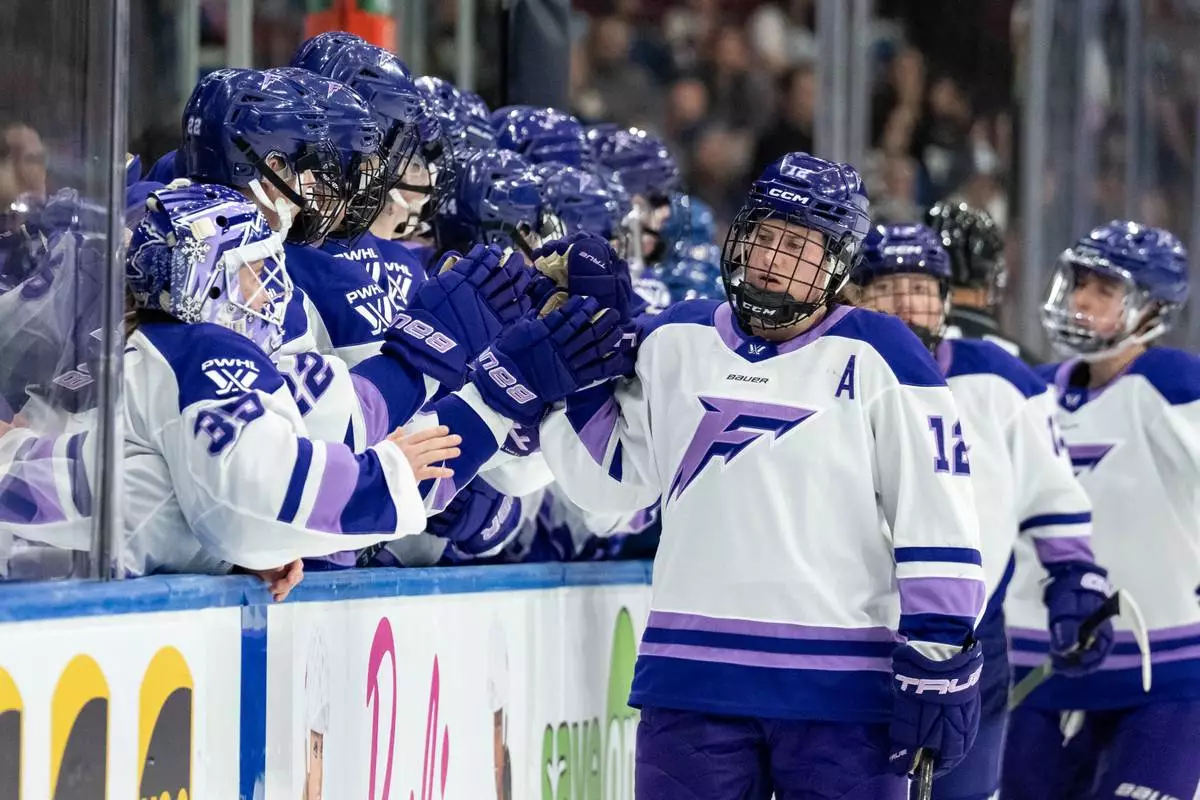
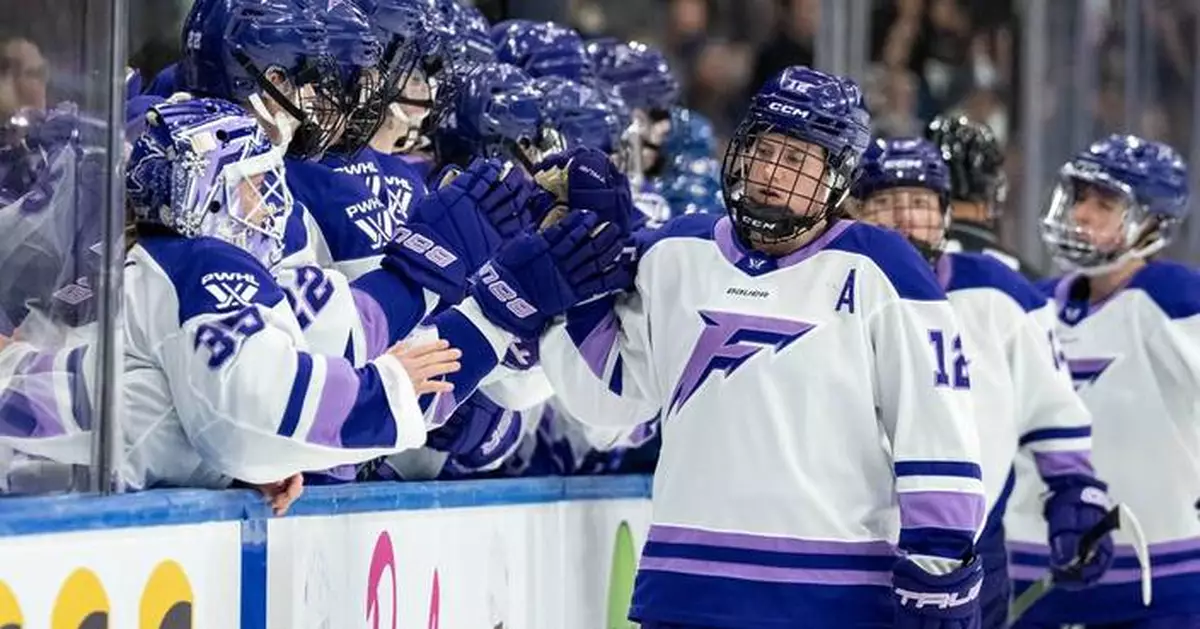
Minnesota Frost's Kelly Pannek (12) celebrates with teammates after her goal against the Vancouver Goldeneyes during the third period of a PWHL hockey game in Vancouver, British Columbia, Saturday, April 25, 2026. (Ethan Cairns/The Canadian Press via AP)

Minnesota Frost's Kelly Pannek (12) celebrates with teammates after her goal against the Vancouver Goldeneyes during the third period of a PWHL hockey game in Vancouver, British Columbia, Saturday, April 25, 2026. (Ethan Cairns/The Canadian Press via AP)
Georg Baselitz, an acclaimed German artist prominent in the Neo-Expressionalist movement who had a penchant for provocation and was known for painting images upside down, has died. He was 88.

The Thaddaeus Ropac Gallery, which represented Baselitz, said the artist died on Thursday, citing his family. It said he died “peacefully,” but did not give a cause of death.

Born Hans-Georg Kern, Baselitz took his artistic name from the village of Deutschbaselitz in the eastern Saxony region, where he was born on Jan. 23, 1938, in Nazi-ruled Germany before the outbreak of World War II. After growing up in the ruins of the war, he left the then-East Germany in 1957 at a time of rising political pressure, and emigrated to the West.

“I was born into a destroyed order, into a destroyed landscape, into a destroyed people, into a destroyed society,” he told German news agency dpa before his 85th birthday.

The gallery called him “a titan of contemporary painting, sculpture, drawing and printmaking" and “one of the most important artists of our time," who influenced fellow artists and the international art world.

His first exhibition in 1963 reportedly caused a stir, with a vice squad identifying pornography in at least two of his paintings, and confiscating them.

He was often described as an “artist of rage,” and had a motto of "contradiction," according to dpa.

His works hang in some of the world's top galleries and have fetched millions at auction. In 2017, German police announced they had recovered 15 stolen paintings and drawings by Baselitz worth around 2.5 million euros ($2.9 million).

Baselitz recalled that some of his earliest recognition came in the 1960s through his series of golden-colored “Hero” paintings, based on fictional characters from Russian civil war novels. The works depicted broken figures staggering toward the viewer in ragged uniforms — in distorted sizes, giant hands and small heads. His battle-weary hero, “Der Hirte (The Shepherd)” from 1966 won international acclaim.

In 1969, Baselitz created “Der Wald auf dem Kopf,” (The Forest on its Head), his first “inverted” painting — featuring trees upside down, a theme that would become one of his trademarks.

“Georg Baselitz did not just turn his paintings upside down; he also turned our thinking routines upside down,” German President Frank-Walter Steinmeier said. “Having experienced the destruction and suffering of the Second World War as a child, the collapse of all order forced him to question everything around him.”

Baselitz mused about his long career in a recent video, commenting that “typical paining has never appealed to me.”

“I actually wanted to be more of a black-and-white painter, and above all, I didn’t want to work spatially, perspectively, with shadows and light and such things that arise with the imitation of nature," he said while seated in a wheelchair in a paint-smudged jacket.

“I must say that throughout my life, I was not aware that I was a painter of color, even though I am constantly told that I have such wonderful colors,” Baselitz said.

Baselitz said he sought to “construct my connection to the world, to myself and to my wife,” using the most “simple and ordinary" means possible. He spoke in a video from the Giorgio Cini Foundation in Venice, which is hosting an exhibition of Baselitz's “Golden Heroes” works from May 6 to Sept. 27.

A “Naked Masters” exhibit at the Kunsthistorisches Museum in Vienna in 2023 spanned his half-century career and dealt with controversial themes of nudity — notably of the painter and his wife, Elke — displayed alongside oil paintings by old masters also evoking nudity.

He is survived by his wife and sons, Daniel Blau and Anton Kern, the gallery said.

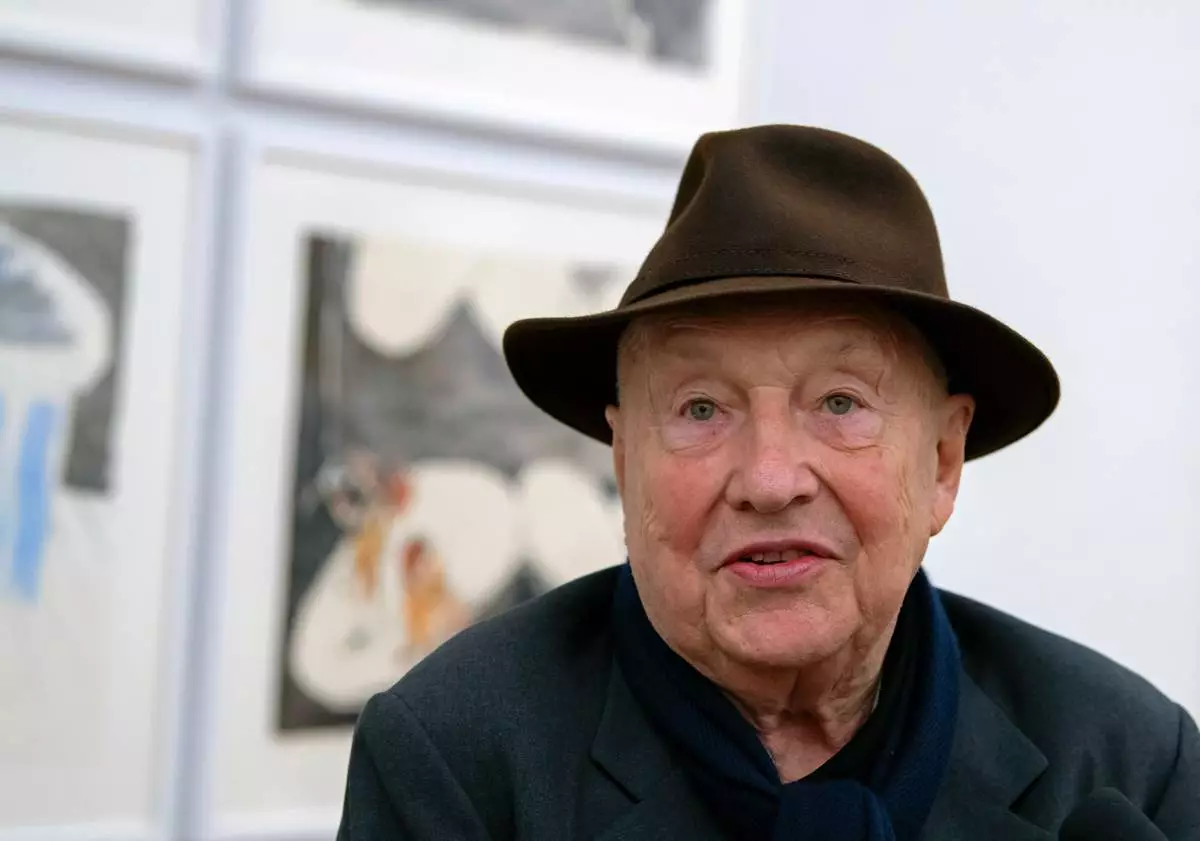
FILE - German artist Georg Baselitz talks with journalists during the press preview of the exhibition 'Georg Baselitz' in the Kunstsammlungen in Chemnitz, Germany, on April 16, 2018. (AP Photo/Jens Meyer, File)

FILE - German artist Georg Baselitz talks with journalists during the press preview of the exhibition 'Georg Baselitz' in the Kunstsammlungen in Chemnitz, Germany, on April 16, 2018. (AP Photo/Jens Meyer, File)

Recommended Articles