More than 180 days into their mission aboard China's space station Tiangong, the Shenzhou-21 astronauts, Zhang Lu, Wu Fei, and Zhang Hongzhang, have conducted various in-orbit experiments, facility maintenance, and health checks.
In a video released by the China Manned Space Agency (CMSA) on Sunday, three astronauts are seen conducting a variety of in-orbit tasks, all remaining in good physical condition and working with high efficiency and strong coordination.
The crew conducted on-orbit electroencephalogram (EEG) research. Using EEG acquisition devices, VR glasses, and other equipment, they conducted multiple experiments, providing relevant data for ground-based researchers for further study.
In the field of behavioral and psychological research, the astronauts performed executive function training by observing images on a laptop and responding via keyboard inputs. They also completed emergency decision-making assessments and emotional state tests, providing valuable data for studying the effects of long-duration spaceflight on decision-making abilities and mental well-being.
The three astronauts also conducted rendezvous and docking simulation training to maintain operational proficiency.
Following the schedule, the crew replaced the filters and sampling covers in the combustion science experiment cabinet, conducted research on space fluid storage and transportation and completed tasks such as sample cleaning, and electricity component maintenance.
For space station maintenance, the astronauts inspected and serviced the life support systems, measured cabin noise levels, cleaned the living areas, and organized supplies.
On the health front, they completed routine medical checks such as hearing tests and muscle ultrasound examinations while continuing regular physical exercises.
The Shenzhou-21 crewed spacecraft blasted off from the Jiuquan Satellite Launch Center in northwest China on Oct 31, 2025.
The Shenzhou-21 crew’s stay in space has been officially extended by approximately one month.
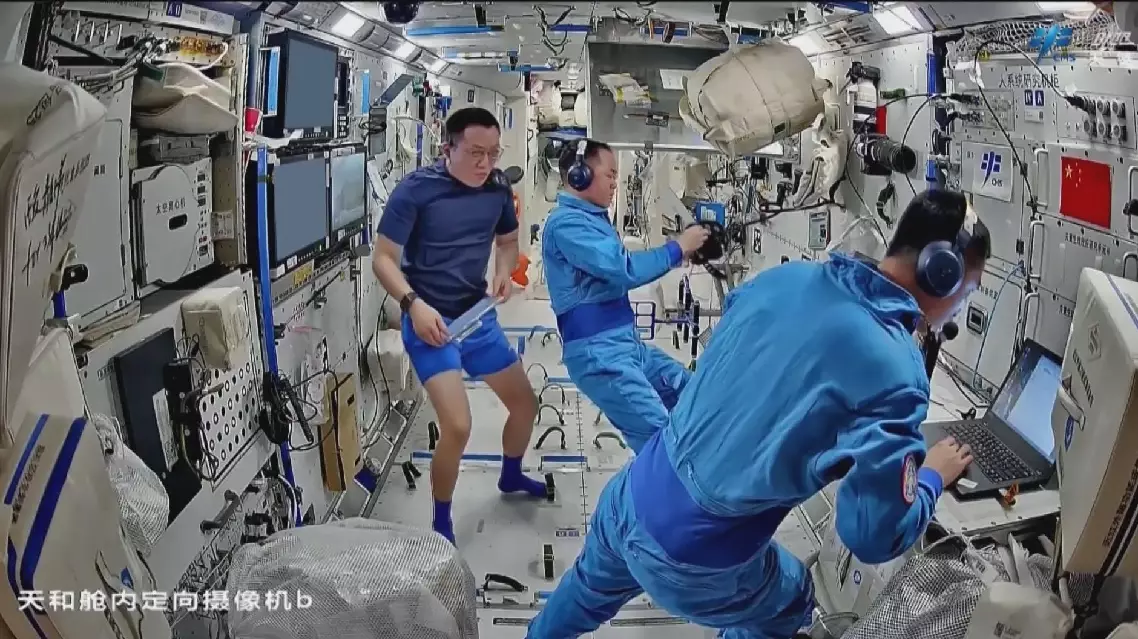
China's Shenzhou-21 crew conducts in-orbit experiments after more than six months into mission