A top Iranian parliament official said Monday that any U.S. interference in Iranian new maritime management rules for the Strait of Hormuz would be seen as a ceasefire violation.
Ebrahim Azizi, chairman of the Iranian parliament's national security and foreign policy committee, made the remarks in a social media post.
That warning came alongside other sharp condemnations from Tehran.
According to Iranian media reports, Ali Akbar Velayati, adviser to Iran's supreme leader, said on Sunday that the United States, ignoring the fact that global food and fertilizer supply chains pass through the Strait of Hormuz under Iranian control, has threatened Iran with famine, which reflects the U.S. side's lack of understanding of the global economic and political situation.
Also on Sunday, according to Iran's Press TV, Mohsen Rezaee, a military adviser to Iran's supreme leader, said that Iran has prepared a grave for U.S. forces and aircraft carriers. He called the United States the only pirate state that possesses aircraft carriers and said that if tensions escalate, those carriers will face destruction. He also said that Iran has the capability to counter pirates and sink warships.
As Iranian officials issued those warnings, the U.S. began its operation.
U.S. President Donald Trump said Sunday in a social media post that the United States will begin guiding ships out of the Strait of Hormuz on Monday morning, Middle East time.
Calling the action "Project Freedom," Trump said it is "a humanitarian gesture."
Trump also said in his post that U.S. representatives are in very positive discussions with Iran that could bring very positive results. Iran had not officially responded.
The U.S. Central Command (CENTCOM) said its forces would start supporting the "Project Freedom" on Monday to restore commercial shipping through the strait.
Brad Cooper, commander of the CENTCOM, said the support is critical to regional security and the global economy while the United States maintains a maritime blockade.
According to Iranian sources on Sunday, oil-shipping monitor TankerTrackers.com reported that 25 crude oil tankers left Iran in April. Seven returned due to the U.S. blockade in the Arabian Sea, two were seized by the United States in the Indian Ocean, and one sailed to the Far East. Most of the remaining 15 arrived at their destinations in the first half of April.
The United States and Israel launched large-scale military operations against Iran in late February, and Iran launched counterattacks. After U.S.-Iran talks in Islamabad, Pakistan, ended without results in April, the United States began imposing a maritime blockade on Iran. The aircraft carriers, USS Abraham Lincoln and the USS George H.W. Bush strike groups are operating in the Arabian Sea to enforce the maritime blockade on Iranian ports.
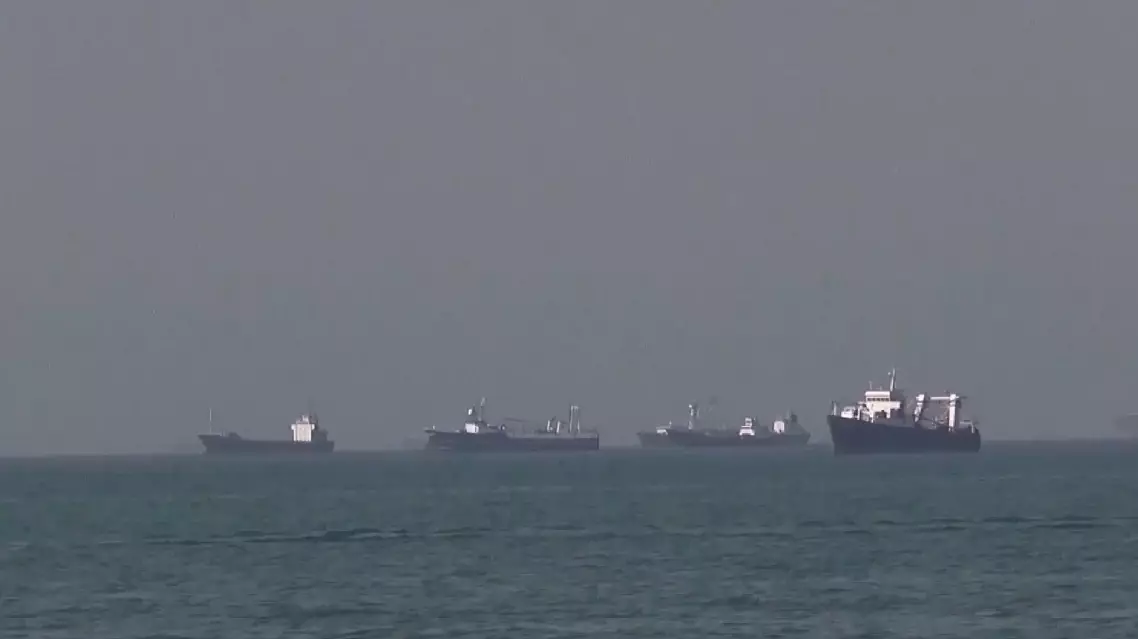
Iran warns U.S. interference in Strait of Hormuz violate ceasefire