SEATTLE--(BUSINESS WIRE)--May 4, 2026--
Amazon (NASDAQ: AMZN) today announced the launch of Amazon Supply Chain Services (ASCS), which extends the company’s entire portfolio of freight, distribution, fulfillment, and parcel shipping solutions to businesses of all types and sizes. These services were originally developed to power Amazon’s own retail operations and to support independent selling partners worldwide. Over the past three years, hundreds of thousands of Amazon sellers have trusted the company’s logistics network to move, store, and deliver hundreds of millions of packages across third-party facilities, warehouses, and sales channels beyond the Amazon store. The launch of ASCS builds on this momentum, now supporting third-party logistics for businesses in industries such as healthcare, automotive, manufacturing, and retail.
This press release features multimedia. View the full release here: https://www.businesswire.com/news/home/20260504242139/en/
“Amazon is bringing the infrastructure, intelligence, and scale of its supply chain services—proven over decades—to businesses everywhere, much like Amazon Web Services did for cloud computing,” said Peter Larsen, vice president of Amazon Supply Chain Services. “Supply chain wasn’t just a function at Amazon—it was core to providing an exceptional shopping experience. Our differentiator. The reason we could offer fast, dependable delivery that nobody else could. And with the launch of ASCS, we’re confident we can give any other business access to the same cost efficiency, reliability, and speed that we’ve built for Amazon customers.”
Amazon offers flexible, scalable solutions that grow with businesses as their needs evolve. From moving goods into warehouses to package delivery and everything in between, leading brands have already started to leverage Amazon’s supply chain services. Announced today, Procter & Gamble is using Amazon’s freight services to transport raw materials to production facilities and move finished goods across its distribution network; 3M is leveraging Amazon’s freight services to move products from its manufacturing sites to distribution centers worldwide; Lands’ End is using a unified inventory pool within Amazon’s network to fulfill orders across multiple sales channels; and American Eagle Outfitters, Inc. is using Amazon’s parcel shipping network to deliver online orders from its American Eagle and Aerie website directly to customers nationwide.
Drawing on decades of experience running Amazon’s own operations, ASCS helps businesses improve speed, reliability, and efficiency, even through peak demand and unexpected disruptions. Businesses can also benefit from Amazon’s AI forecasting models and vast supply chain data set, which help optimize inventory placement. Core offerings include:
Starting today, businesses can access a centralized console to discover, select, and sign up for the various ASCS solutions. Businesses can visit https://supplychain.amazon.com to get started.
About Amazon Supply Chain Services
Amazon Supply Chain Services gives businesses of all types and sizes access to the freight, distribution, fulfillment, and parcel shipping capabilities Amazon has built, refined, and proven at scale over decades—supporting Amazon sellers and other businesses, regardless of where they sell. By extending the global infrastructure, technology, and operational expertise behind Amazon’s own supply chain, ASCS helps businesses improve performance, reduce complexity, and operate more efficiently. ASCS is a major growth opportunity for Amazon, supported by continued investment in forecasting, automation, and AI to enhance the speed and accuracy of its supply chain solutions.

Amazon Supply Chain Services

Amazon Supply Chain Services

Amazon Supply Chain Services
KYIV, Ukraine (AP) — Authorities in Ukraine and Russia said their emergency alert mobile apps had been targeted by cyberattacks with users in Ukraine receiving false warnings of an imminent nuclear threat.
It was not clear if the attacks late Sunday were related. Ukraine said its service, which residents rely on to seek safety amid daily Russian missile and drone strikes, was up and running again after being suspended due to the attack.
Russian authorities said Monday that hackers had sent fake emergency alerts after gaining access to the Russian Emergency Situations Ministry’s mobile app, and that efforts were ongoing to restore the app's functionality.
A Russian Telegram channel said a hacking group, Hitcore, had claimed responsibility for the breach of the Ukrainian system, but that could not be independently verified. Any affiliations or other details surrounding the identities or motivations of the purported hackers were unclear.
The alerts received by Ukrainians — making false claims of high radiation levels, a chemical threat and public disturbances in Kyiv — were written in English with spelling and grammatical errors as well as in a mix of Russian and Ukrainian.
One of the messages, written in Russian, said: “Hi! There will be a nuclear threat across Ukraine. Do not worry, the Oreshnik is incoming,” a reference to a Russian intermediate-range ballistic missile.
In a Telegram post late Sunday following the breach, Ukraine’s air raid alert channel said “unauthorized parties” had interfered with the app’s operation and warned users not to click on links in “suspicious notifications.”
Ukraine's state-run Center for Countering Disinformation reported the breach and urged users to monitor other emergency channels on social media and rely on physical alerts while the cyberattack was being addressed.
Yurii Ihnat, a spokesman for Ukraine’s air force command, said the cyberattack had no impact on Ukraine’s security and defense operations because the app is separate from military command systems.
Ihnat told Ukraine’s private 1+1 television that the air force continues to report real-time threats through independent communication channels, including popular social media platforms.
In a statement, Russia’s Emergency Ministry said that hackers had used its mobile app to send a false alert across 33 of Russia’s 89 regions at approximately 2:45 a.m. Moscow time (11:45 p.m. GMT). It did not name who it believed carried out the attack.
The ministry said that the digital vulnerability exploited by the attackers had been identified and that “necessary measures” were being taken to prevent a similar breach. It also reassured Russians that the wider public alert system was working normally through SMS messages, media broadcasts and municipal sirens and loudspeakers.
Kremlin spokesperson Dmitry Peskov said that all of Russia’s state agencies were under the constant threat of cyberattacks, including a growing number that use artificial intelligence.
“All government bodies must take steps to improve the cybersecurity of our digital resources,” Peskov said.
Ukrainian authorities in the war-divided Kherson region reported multiple Russian drone attacks early Monday, hours after a humanitarian ceasefire expired.
The regional administration said a 62-year-old woman and a 73-year-old man were hospitalized with blast injuries in the city of Kherson, across the Dnipro River from Russian-occupied territory.
The localized ceasefire ended at midnight at the start of Monday. The brief pause in fighting was tied to a humanitarian aid mission in the Russian-occupied city of Oleshky.
The ceasefire, which began Oct. 27, marked the most significant truce between Kyiv and Moscow since Russia’s full-scale invasion of Ukraine began nearly five years ago.
The White House said U.S. first lady Melania Trump helped broker the limited truce. Civilian negotiators from Russia and Ukraine also helped secure the pause, which allowed besieged residents of Oleshky to be evacuated in a rare joint operation that ended Saturday.
An estimated 2,000 civilians were in Oleshky when the temporary truce took effect. They could evacuate to territory controlled by either Ukraine or Russia, or remain in the city with replenished food and medical supplies. Exact evacuation totals were withheld to protect those who stayed.
Ukraine’s general staff said Monday that Russia’s military had bolstered its drone defenses and replenished ammunition supplies in the area during the ceasefire.
Elsewhere in Ukraine, emergency services reported that drone strikes injured 12 people in the eastern Kharkiv region and damaged a refrigeration facility, greenhouses and residential buildings.
Five people were also reported injured in the Black Sea port city of Odesa, where a warehouse was targeted and homes were damaged.
Russia’s Ministry of Defense said Monday that it had shot down 212 Ukrainian drones overnight, while the head of Russia’s Samara region, Gov. Vyacheslav Fedorishchev, said in a statement that local air defenses were repelling an aerial attack, but did not give further details.
Independent Russian media outlets later reported that Ukrainian drones had targeted one of Europe’s largest oil transport hubs in Russia’s Samara region.
Katie Marie Davies contributed to this report from Manchester, England.
Follow the AP’s coverage of the war in Ukraine at https://apnews.com/hub/russia-ukraine
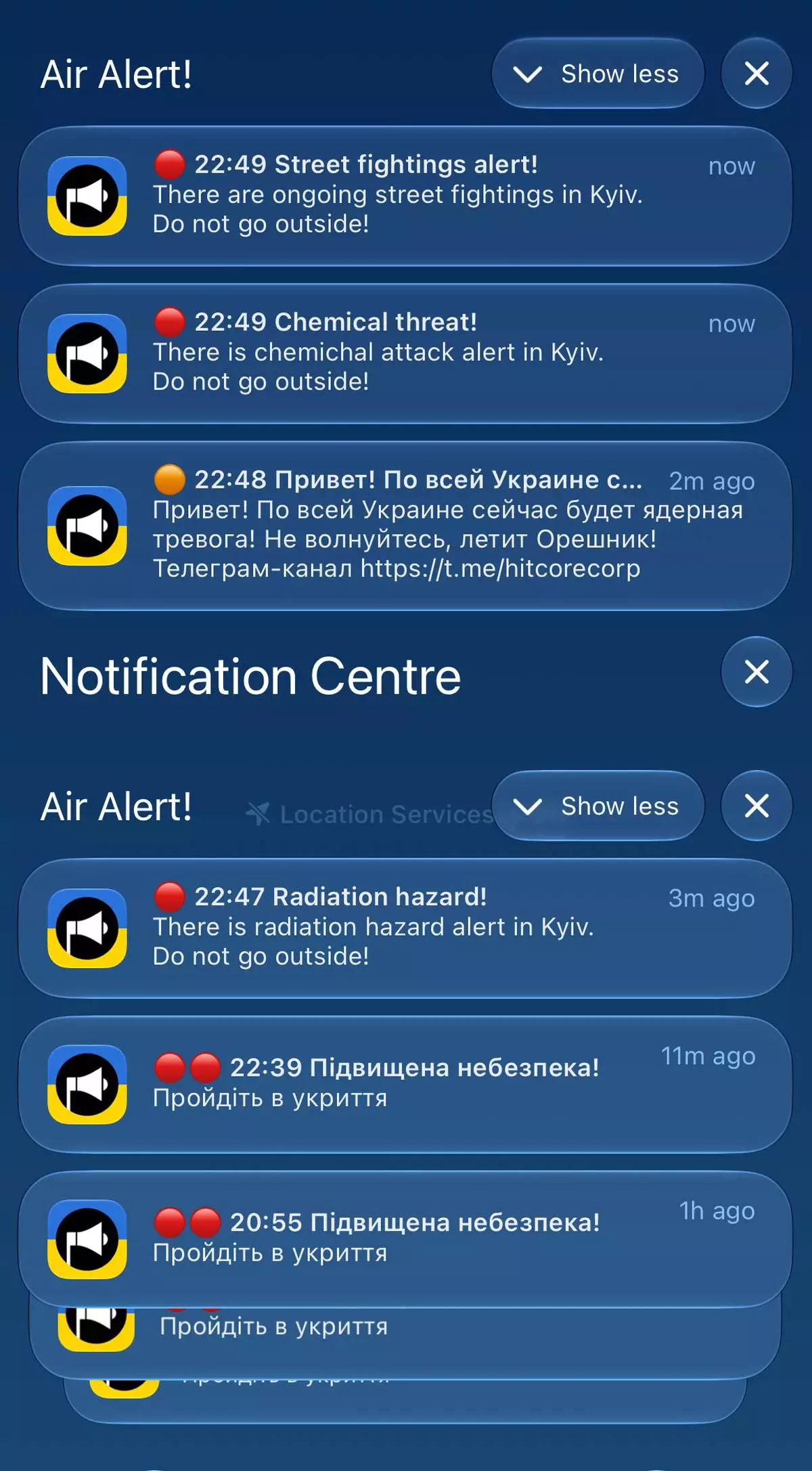
This screenshot made on a smartphone shows a series of false alerts received late Sunday, Nov. 1, 2026 from an emergency alert mobile application that was subject to a cyberattack, in Kyiv, Ukraine. Third message in Russian reads "Hi! There will be a nuclear threat across Ukraine. Do not worry, the Oreshnik is incoming. Telegram channel: [link]", Fifth and sixth messages in Ukrainian read "Increased danger, Go to the shelter". (AP Photo) Photo taken with a smartphone.
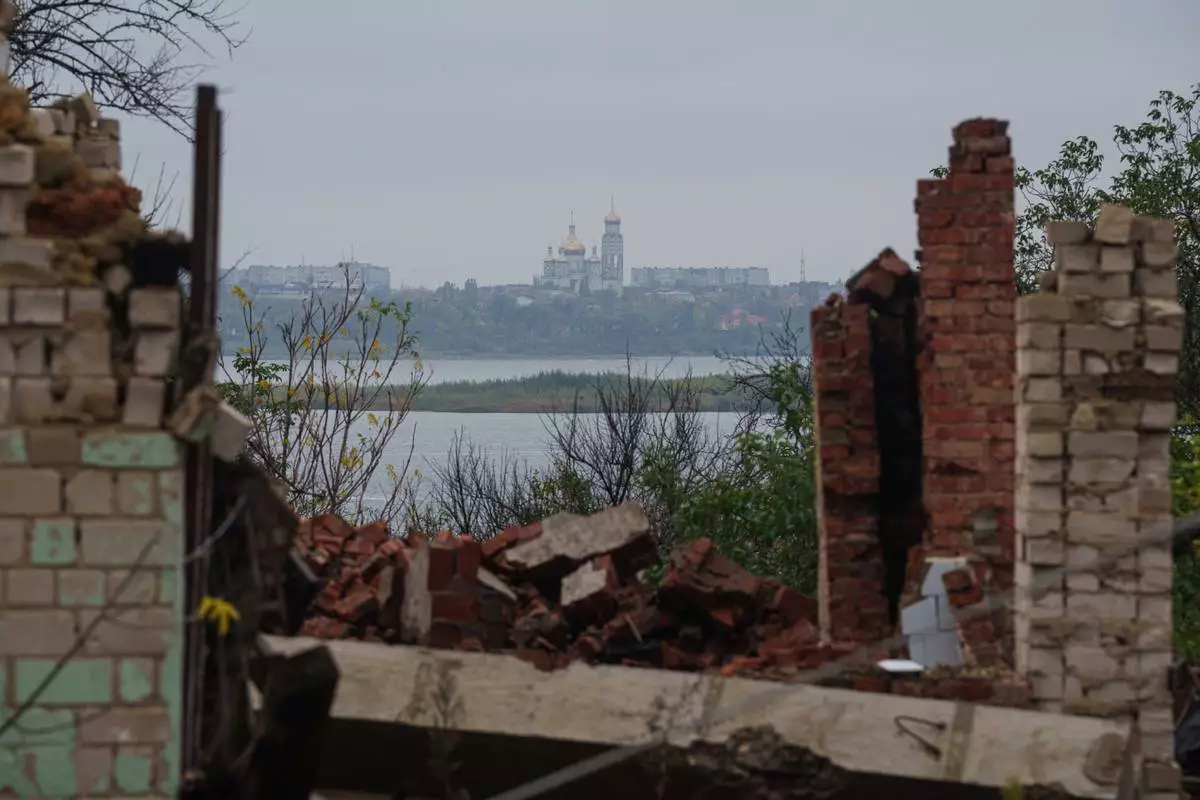
St. Andrew's Cathedral in Russian-occupied Nova Kakhovka, is seen across the Dnipro River from the village of Kozatske, during a localized ceasefire linked to a humanitarian aid mission to Oleshky, Kherson region, Ukraine, Saturday, Oct. 31, 2026. (AP Photo/Evgeniy Maloletka)
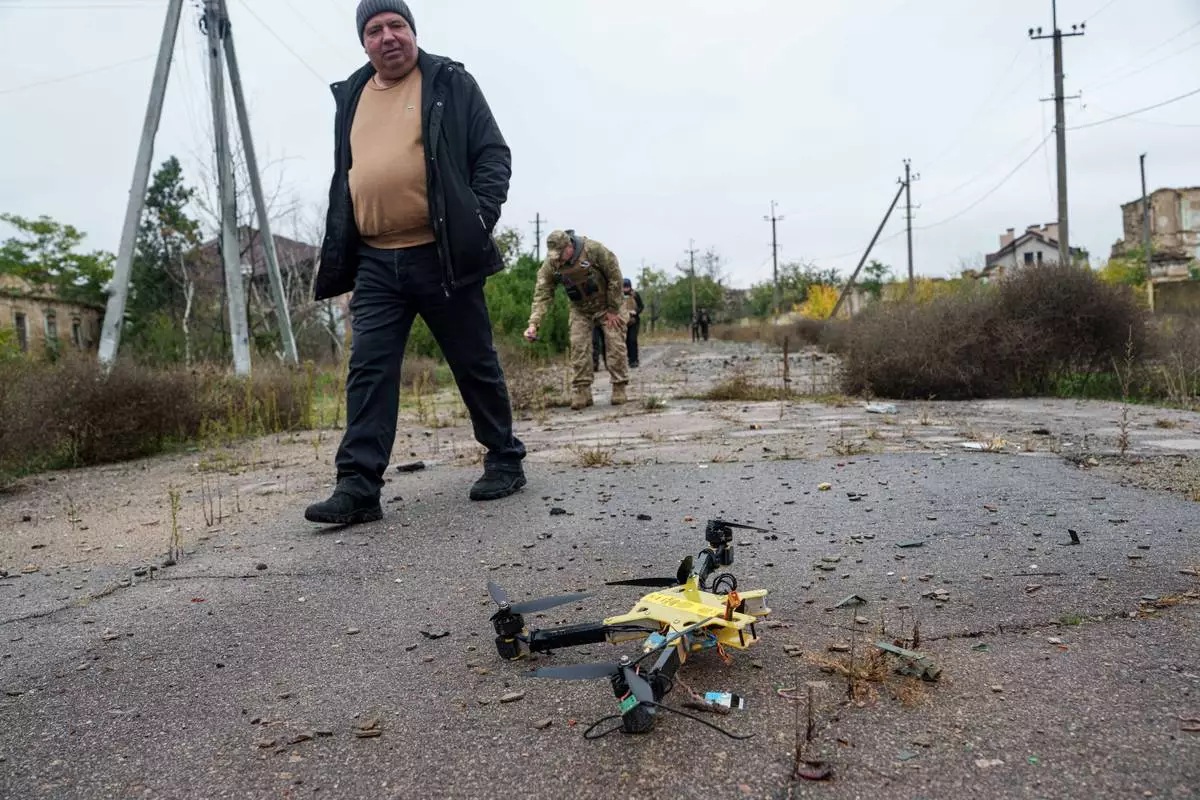
A representative of the Nova Kakhovka administration walks past an unexploded Russian FPV drone during a localized ceasefire linked to a humanitarian aid mission to Oleshky, in the village of Kozatske, Kherson region, Ukraine, Saturday, Oct. 31, 2026. (AP Photo/Evgeniy Maloletka)
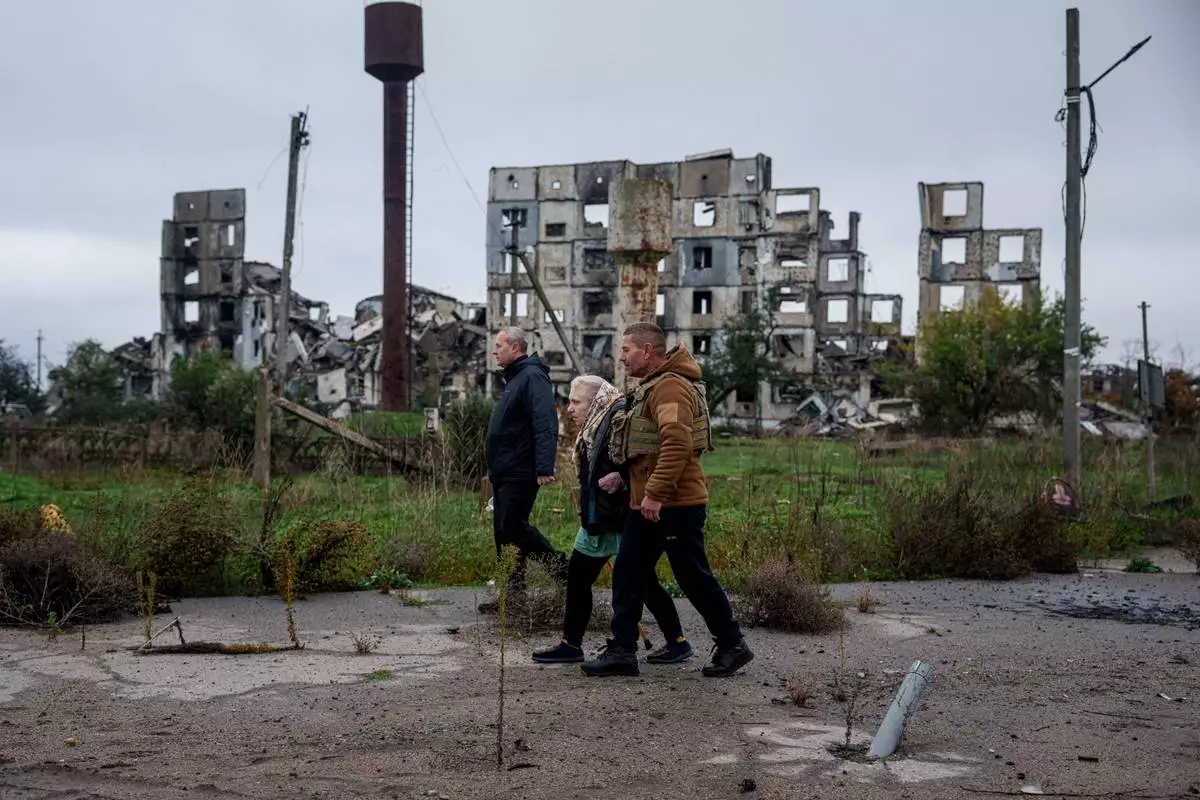
Oleh Tarabaka, head of the Nova Kakhovka military administration, left, and Vadym, a Ukrainian sergeant of the 42nd Marine Brigade, right, help evacuate Antonina, a local resident, as they walk past a destroyed residential building in an area contaminated with anti-personnel mines, during a localized ceasefire linked to a humanitarian aid mission to Oleshky, in the village of Kozatske, Kherson region, Ukraine, Saturday, Oct. 31, 2026. (AP Photo/Evgeniy Maloletka)
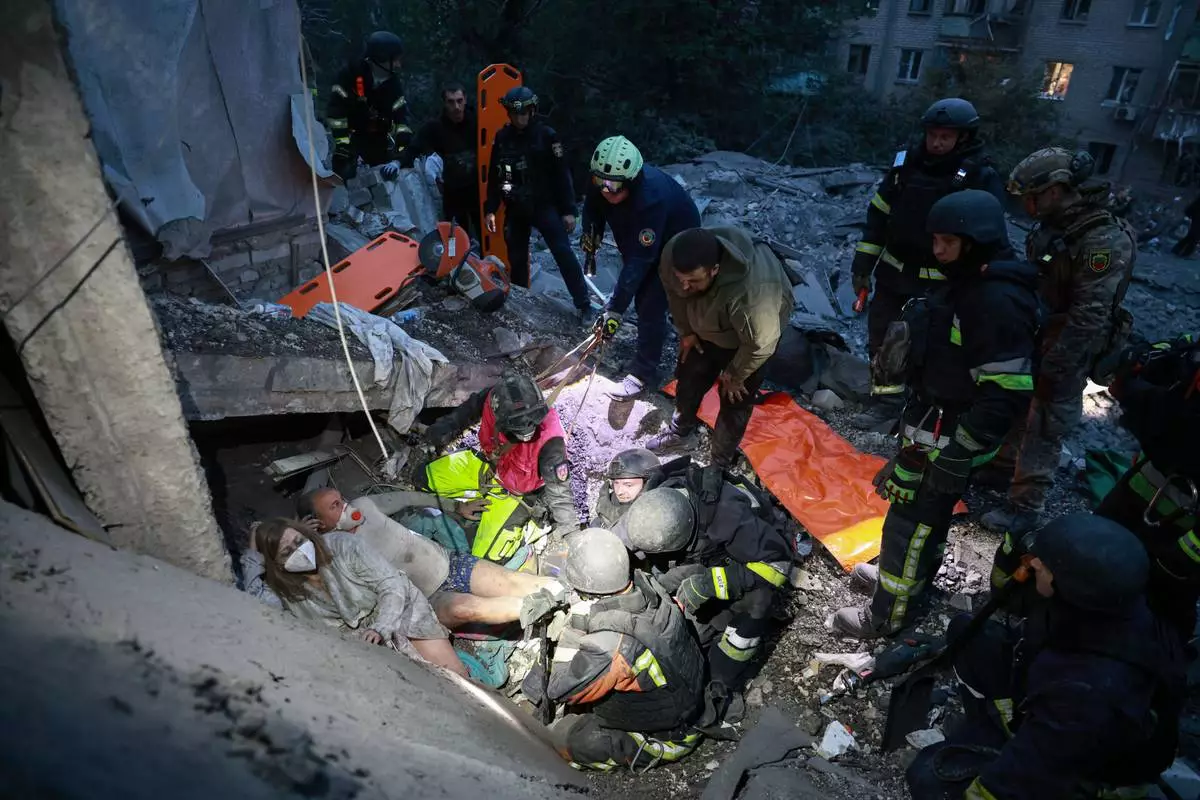
Rescue workers pull a family from the rubble of a residential building destroyed by a Russian airstrike in Zaporizhzhia, Ukraine, Saturday, Oct. 10, 2026. (AP Photo/Kateryna Klochko)