Skip to Content Facebook Feature Image

China‑Laos railway sees May Day tourism surge, Mohan port traffic up 8.8 pct

China

China

China

China‑Laos railway sees May Day tourism surge, Mohan port traffic up 8.8 pct

2026-05-04 16:54 Last Updated At:21:07

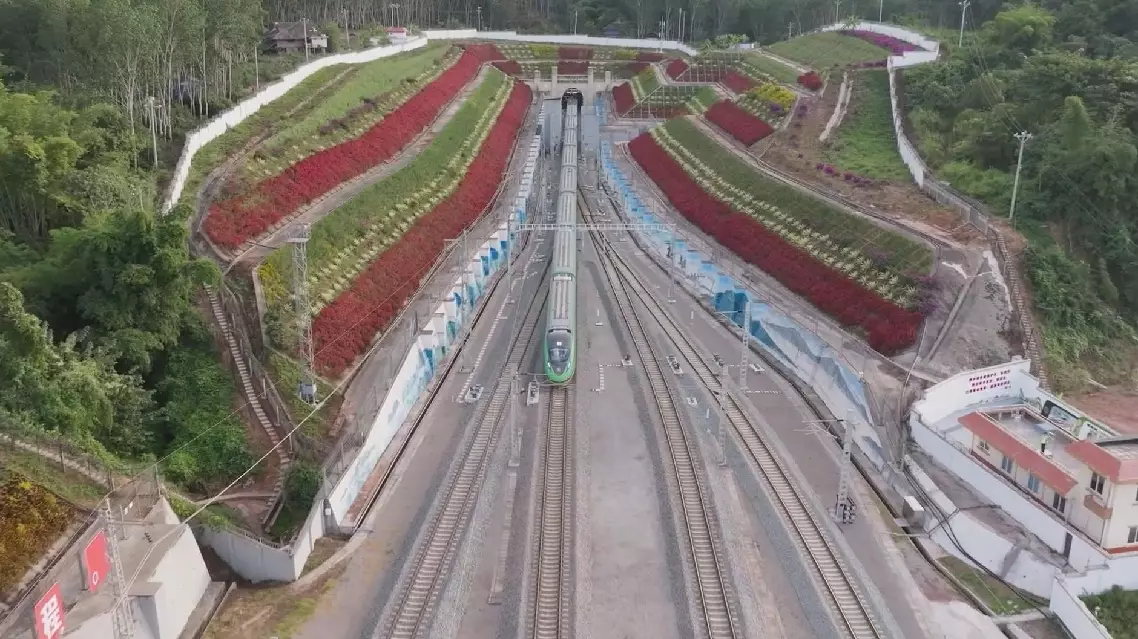
The China-Laos Railway is seeing a surge in cross‑border tourism during the five-day May Day holiday, with passenger traffic through Mohan port up 8.8 percent year on year in the first three days, local border inspection authorities said Monday.

The port processed more than 3,300 border crossings during the first three days of the holiday. A combination of favorable entry policies and the extended holiday period has fueled the steady rise in rail-based cross-border travel, with the port experiencing a smooth but notable holiday peak, authorities said.

The holiday period has seen a clear diversification of cross-border travelers, with a marked increase of foreign nationals. Over the three days, the Mohan railway port recorded nearly 400 foreign travelers from 24 countries and regions. Notably, visa-free foreign arrivals accounted form more than 63 percent, reflecting the continued positive impact of China's visa-free policies.

"I'm taking Chinese railway abroad for the first time, and I feel really proud. The ride was very smooth and fast. I can go from Kunming to Vang Vieng in just one day," said Li Zhonghan, a student at Harbin Institute of Technology.

Several factors are behind the surge. This year marks the first implementation of a primary and secondary school spring break system in Yunnan. The spring break coincides with the May Day holiday to create an extended vacation period, making study tours and family trips a major trend in outbound tourism.

Meanwhile, a range of visa policies, including mutual visa exemptions, China's unilateral visa waivers, the 240-hour visa-free transit, and the 144-hour visa free entry for tour groups from the 10 member countries of the Association of Southeast Asian Nations (ASEAN) to Yunnan's Xishuangbanna Dai Autonomous Prefecture, have taken effect successfully, continuing to attract international visitors,

"[We] want to visit Yunnan, a bit everywhere, Sichuan, Meishan, Xi'an and Beijing. The feeling is it's a very interesting culture for us to discover. We want the children to see China with their eyes, to see how it has changed a lot in 14 years [since] last time we came," said French tourist Alexis Paul Drzemczewski.

The travel surge has been further boosted by the ongoing celebration of distinctive Yunnan ethnic festivals, including the Mojiang International Twins Festival and the Dali March Fair. Combined with holiday homecomings by overseas Chinese, these events have pushed border crossing volumes even higher.

To handle the holiday crowds, the Mohan border inspection station has introduced targeted measures to streamline customs clearance procedures. These include pre-registration and pre-screening for large tour groups and real-time passenger flow updates. The station has also added bilingual guidance officers, dedicated lanes and green channels for special-needs travelers, aiming at ensuring safe and efficient customs clearance.
China‑Laos railway sees May Day tourism surge, Mohan port traffic up 8.8 pct


China‑Laos railway sees May Day tourism surge, Mohan port traffic up 8.8 pct

A Japanese scholar on Friday called on people to remain vigilant against de facto constitutional amendments, as the government led by Prime Minister Sanae Takaichi moves to advance constitutional amendments and ease military and security restrictions.

Japan's Constitution, which took effect in 1947, is often referred to as the pacifist constitution because its Article 9 renounces war as a sovereign right and prohibits Japan from possessing "war potential."

However, according to local media reports, Takaichi is pursuing constitutional revision, seeking what would be the first-ever amendment to Japan's Constitution since it came into force.

Talking to China Media Group about the current political situation in Japan, Kenji Utsunomiya, former president of the Japan Federation of Bar Associations, warned that the "exclusively defense-oriented policy" under Article 9 is being undermined.

"Some have indeed voiced the opinion that Japan should go nuclear -- something not allowed under Article 9 of the Constitution. Yet those making such statements don't seem to face proper penalties. So, I believe the 'exclusively defense-oriented policy' under Article 9 is being gradually and substantively eroded and undermined. That's Japan's reality today," said Utsunomiya.

The scholar pointed out that recent moves by the Takaichi administration are all de facto constitutional amendments that could endanger peace.

"Regarding the government's lifting of a lethal weapons export ban, increasing the share of defense spending in GDP, and pushing for the establishment of a national intelligence committee, I believe it is necessary to conduct broader national discussions on these matters and to effectively organize opposition campaigns. However, even if we manage to block a formal constitutional amendment, it does not mean we are safe. Actually, a de facto constitutional amendment is already moving ahead. Therefore, we must remain even more vigilant about this," said Utsunomiya.

The Japanese government officially revised its guidelines to allow the export of lethal weapons on April 21.

Also in April, Japan's parliament approved the fiscal 2026 budget, with defense expenditures exceeding nine trillion yen (about 56.3 billion U.S. dollars) for the first time, a historic high.

Japan's House of Representatives on April 23 passed a bill to establish a national intelligence committee. The legislation is expected to be enacted after passing the House of Councillors, where approval is highly likely. Following its enactment, the Takaichi administration aims to launch the committee by summer, according to local media.

Japanese scholar warns of de facto constitutional amendments

Japanese scholar warns of de facto constitutional amendments

Recommended Articles