HAVANA (AP) — Cuba has unveiled Havana’s first two modular homes using repurposed shipping containers, a critical step in a capital where once-majestic residences are collapsing.
Government officials including President Miguel Díaz-Canel gathered this weekend in front of the homes awarded to two single mothers: one had spent more than a dozen years living in a shelter and the other dwelled in a single room with two teenage children, according to state media.
The media reported that crews built the homes in one month using surplus material from tourism investment projects, technologies developed by Cuba’s Revolutionary Armed Forces and containers previously used to import parts from China for solar panel farms.
Officials said Saturday that Cuba has a housing deficit of more than 800,000 homes. The most pressing need is in Havana.
Yurieska Artunet Martí, a 29-year-old beautician who lives in the historic part of Havana, was forced to move out of her last apartment because it disintegrated. She still lives on the same floor and in the same building, but the back part of it, which is standing — for now.
“Everybody here in Havana lives in fear,” she said as she looked up at her rotting ceiling and disintegrating walls. They shelter Artunet Martí, who is four-months pregnant, and her three children, ages 7 months, 1 and 5.
Plaster from the wall falls on their bed while they sleep, she said.
Artunet Martí can’t afford to live elsewhere. Two months ago, she was forced to close the beauty business she ran out of her home, where clients were forced to climb eroded steps, side-step splintered wood and avoid a gaping hole where an elevator once operated.
“People stopped coming because of the building’s condition,” she said.
The widely admired homes in Old Havana that range in style from Spanish Colonial to Cuban Baroque are known to collapse, especially after heavy rains, sometimes killing their occupants.
Government data from 2020 found that the island of nearly 10 million people had 3.9 million homes, with nearly 40% in only fair or poor condition. Lack of maintenance, a deep economic crisis and adverse weather are to blame.
No one lives in the upper floors of Artunet Martí's building anymore; they were all evacuated and placed in shelters for safety.
“What are we going to do?” she said. “We know we’re in danger, but we have to accept reality.”
In another area of historic Havana, 60-year-old Carlos Sablón recalled how a portion of his building’s third floor collapsed at night. Sablón was watching TV at that moment but knew what had happened.
“It’s quite damaged by time,” he said of the building’s infrastructure as he looked out his second-story window and onto a tiny, crumbling courtyard.
No one was on the third floor when the collapse occurred, but firefighters evacuated everyone else. Unable to afford to live elsewhere, Sablón, an engineer, returned to his apartment. It wasn’t damaged, so he hooked up power and water for himself and a handful of other residents who stayed.
“You’re always going to be afraid,” he said as he lamented that no one ensures the safety of homes in Havana.
“This is the one I fear the most,” Sablón said of his apartment building, which he believes will keep collapsing. “I hope it’s not when someone is walking by.”
Several blocks from Sablón lives 63-year-old Magalys Caro. She is confined to a single room, a makeshift kitchen and a bathroom in the front part of her building. It used to house a company that let her move in when her home next door disintegrated during a hurricane.
But the building where she lives now poses a threat.
“The back there has collapsed,” Caro said as she pointed to a spacious, open-air area behind her.
“I’ve been living here in these poor conditions for about 10 years,” Caro said. “Nothing gets resolved. The Housing Department does nothing.”
At Saturday’s event to unveil Havana’s first two modular homes, Cuban Prime Minister Manuel Marrero Cruz acknowledged that the program of converting shipping containers into homes could be sped up.
“It is not moving at the desired pace,” he said, adding that the work is underway.
Delilah Díaz Fernández, housing director general at Cuba’s Ministry of Construction, said that more than 2,000 containers destined to become homes have been approved, and that some 700 are currently being converted.
“The program … holds immense potential and is here to stay,” she said, adding that as new containers arrive, they will be considered for eventual housing.
Díaz Fernández said the program’s main beneficiaries will include people who lost their homes to extreme weather events or were destroyed by structural collapses.
Follow AP’s Latin America coverage at https://apnews.com/hub/latin-america

FILE - View of San Lazaro street in Havana, Cuba, Tuesday, March 21, 2023. (AP Photo/Ramon Espinosa, File)
NEW ORLEANS (AP) — A Louisiana man who spent decades in prison for a wrongful conviction briefly began work Monday overseeing the criminal court in New Orleans after a judge blocked the state from eliminating the position.
Yet Calvin Duncan's day soon got messy: A higher court stepped in about 9:30 a.m. and froze that decision at the state's request.
Duncan won 68% of the vote to serve as Orleans Parish criminal court clerk. But at the urging of Republican Gov. Jeff Landry, the GOP-controlled state Legislature raced to pass legislation eliminating the position days before Duncan's term was to start, transferring the duties to another official.
U.S. District Judge John deGravelles intervened on Sunday, saying the law eliminating the clerk position was unconstitutional because it replaced an elected office with a political appointee. He granted a restraining order while the litigation continues.
“The Court is not ruling that the state lacks the authority to abolish an agency or office writ large," said deGravelles, noting he was “simply holding” that Louisiana's approach violated Duncan's constitutional rights to due process.
Louisiana quickly responded with an appeal, saying the order “accomplishes nothing other than threaten chaos." The 5th U.S. Circuit Court of Appeals granted a stay.
Seated inside the clerk's office, Duncan told The Associated Press after the stay: “I am the clerk of the criminal district court, that will never change."
A spokesperson for Duncan, Emily Ratner, later told the AP in a text message that Duncan had “ceased acting” as clerk to comply with the latest court ruling.
“He has always done his best to comply with the law and he continues to do exactly that during these unprecedented and evolving legal developments,” Ratner added.
Alanah Odoms, director of the American Civil Liberties Union of Louisiana, told reporters that Duncan's term began at midnight and it cannot be cut short under the state's constitution. Odoms said the ACLU would continue to make this argument before the appeals court and to the U.S. Supreme Court, if necessary.
“The state moved too slow,” Odoms said. “We don’t believe that his term can be diminished now.”
Duncan’s supporters say the attempt by a majority white conservative Legislature to eliminate Duncan’s job thwarts the will of voters in New Orleans, a predominantly Black Democratic hub in a red state. Civil rights groups warn that Duncan's case is a preview of a coming wave of the disenfranchisement of minority voters now that the Supreme Court dismantled a key provision of the Voting Rights Act in an effort led by Louisiana.
The governor signed a law Thursday to have the Orleans Parish clerk of civil court take over the responsibilities of the clerk of criminal court.
Chelsea Richard Napoleon, the civil clerk, said she is monitoring the legal case and her goal is to “adhere to the duties entrusted with me under Louisiana law.”
Landry and Republican allies said the measure consolidating the clerk’s offices improved government efficiency and aligned the parish with the rest of the state. New Orleans leaders said they were never consulted and opposed the changes.
The nonpartisan office of the legislative auditor found that eliminating the criminal clerk of court role saves the state an estimated $27,300 but the long-term costs or savings of the consolidation were unclear. The legislation also shifted about $1.1 million in state expenditures to Orleans Parish.
In April, Republican lawmakers refused to consider an amendment to the law that would have allowed Duncan to serve out his term before eliminating the criminal clerk position.
At the start of the day, when he was still inside the clerk's office, Duncan told the AP that he believed he would win the legal battle in the long run. He said he planned to spend the day getting to know employees and others at the court.
“I’m not just elated but overelated and happy that this day finally came,” Duncan said. “It’s something I’ve been working toward a very long time. This is a testament that God is still in control.”
Duncan, whose murder conviction was vacated in 2021, taught himself law behind bars and later became a licensed attorney. He ran for the clerk position vowing to improve access to court records, electrifying many voters with his personal experience fighting to clear his name.
Duncan said that despite the legal turbulence, the office’s employees will continue to process cases and oversee elections, “no matter who is the clerk.”
Brook is a corps member for The Associated Press/Report for America Statehouse News Initiative. Report for America is a nonprofit national service program that places journalists in local newsrooms to report on undercovered issues.
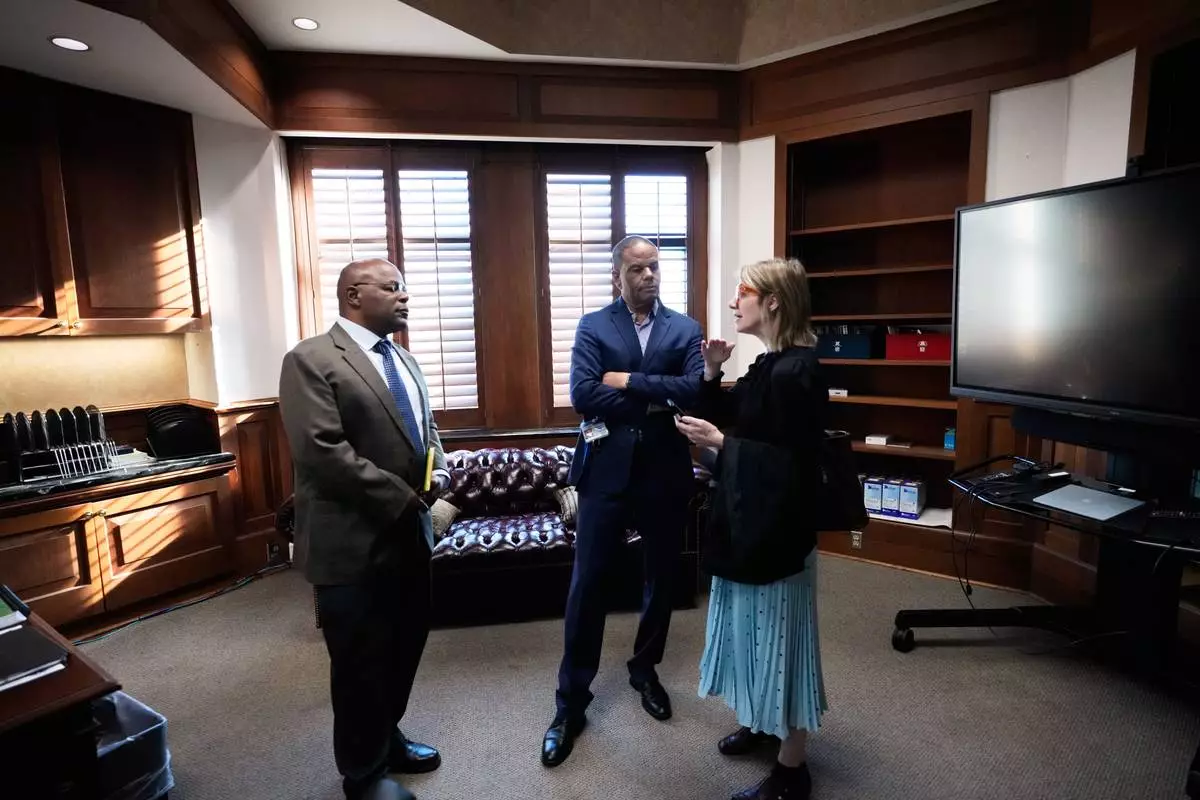
Calvin Duncan, left, an exoneree who was elected Orleans Parish clerk of criminal court, talks in his office with outgoing clerk Darren Lombard, center, and legal advisor Emily Rattner, on the first day of his term, Monday, May 4, 2026, in New Orleans. (AP Photo/Gerald Herbert)
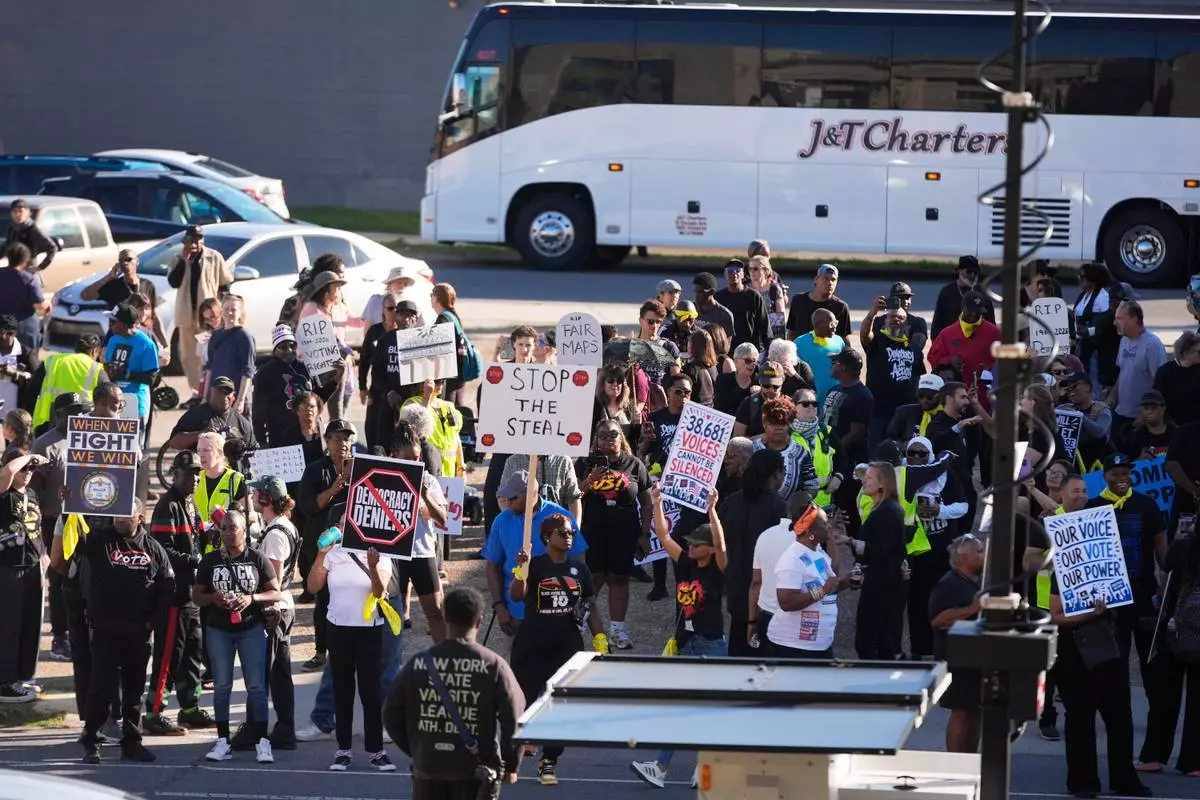
People protest Louisiana Gov. Jeff Landry's effort to eliminate the Orleans Parish criminal court clerk position, outside Orleans Parish criminal court where Calvin Duncan, an exoneree who was elected clerk started his first day in office, Monday, May 4, 2026, in New Orleans. (AP Photo/Gerald Herbert)
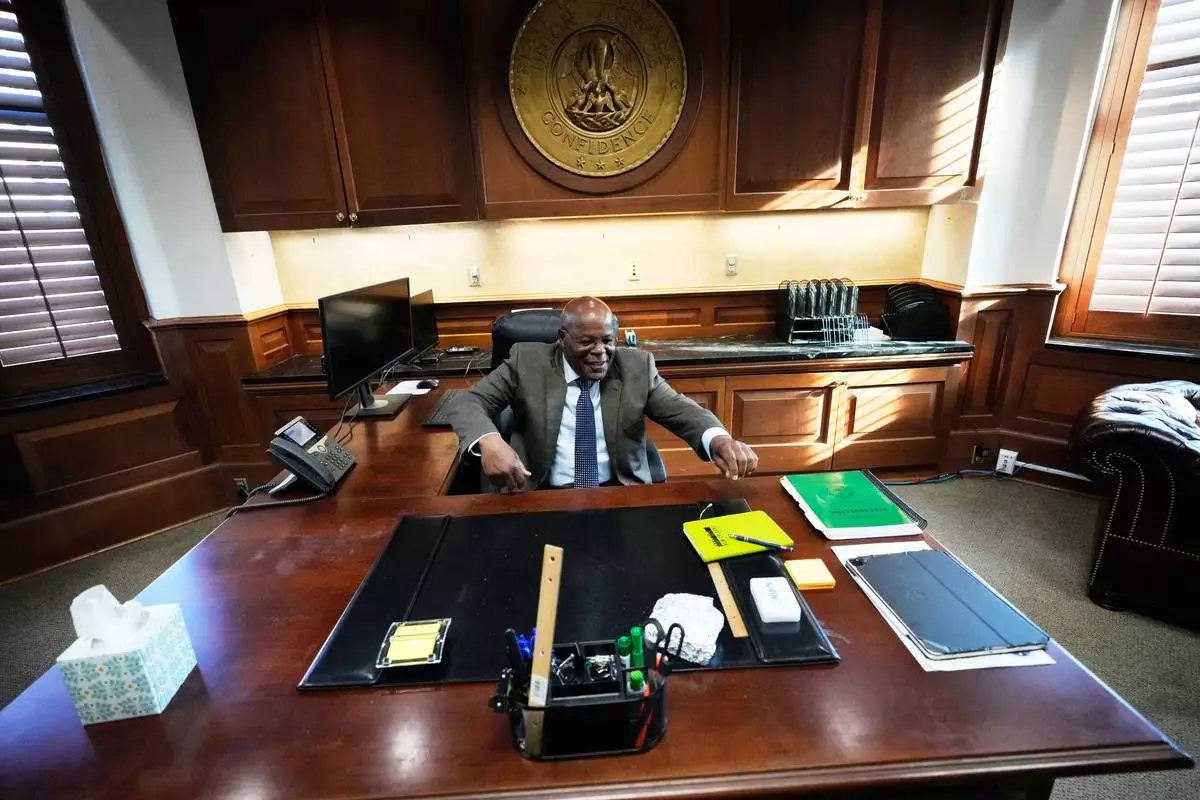
Calvin Duncan, left, an exoneree who was elected Orleans Parish clerk of criminal court, gets behind his desk on the first day of his term, Monday, May 4, 2026, in New Orleans. (AP Photo/Gerald Herbert)
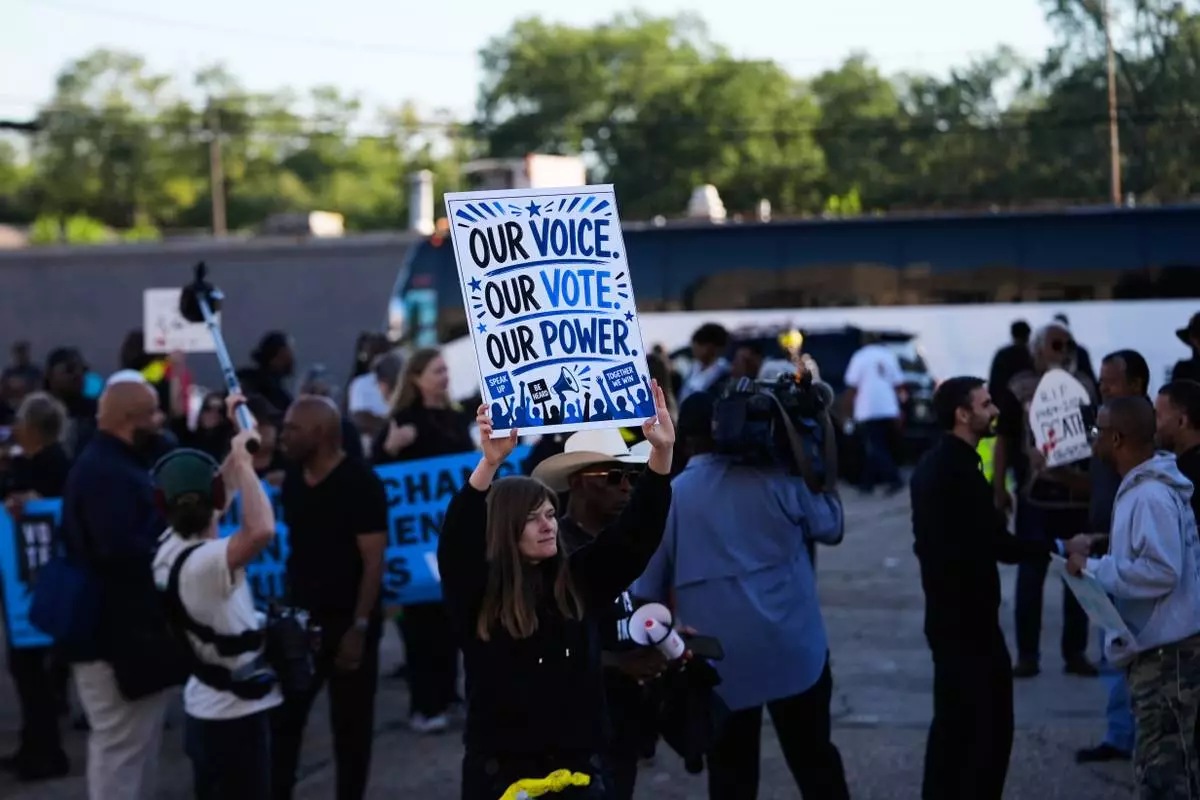
People protesting against Louisiana Governor Jeff Landry gather outside Orleans Parish criminal court on the day Calvin Duncan, an exoneree who was elected Orleans Parish clerk of criminal court, took his first day in office, Monday, May 4, 2026, in New Orleans. (AP Photo/Gerald Herbert)
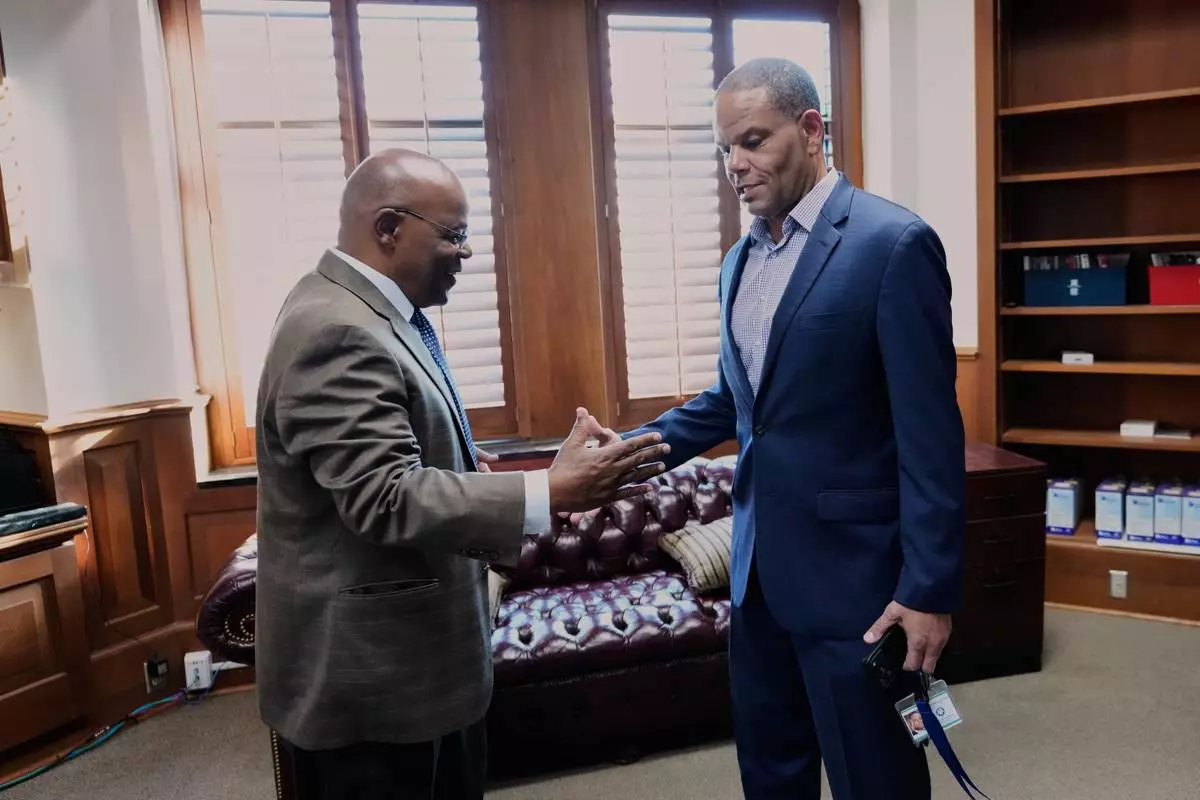
Calvin Duncan, left, an exoneree who was elected Orleans Parish clerk of criminal court, greets outgoing clerk Darren Lombard in his office on the first day of his term, Monday, May 4, 2026, in New Orleans. (AP Photo/Gerald Herbert)
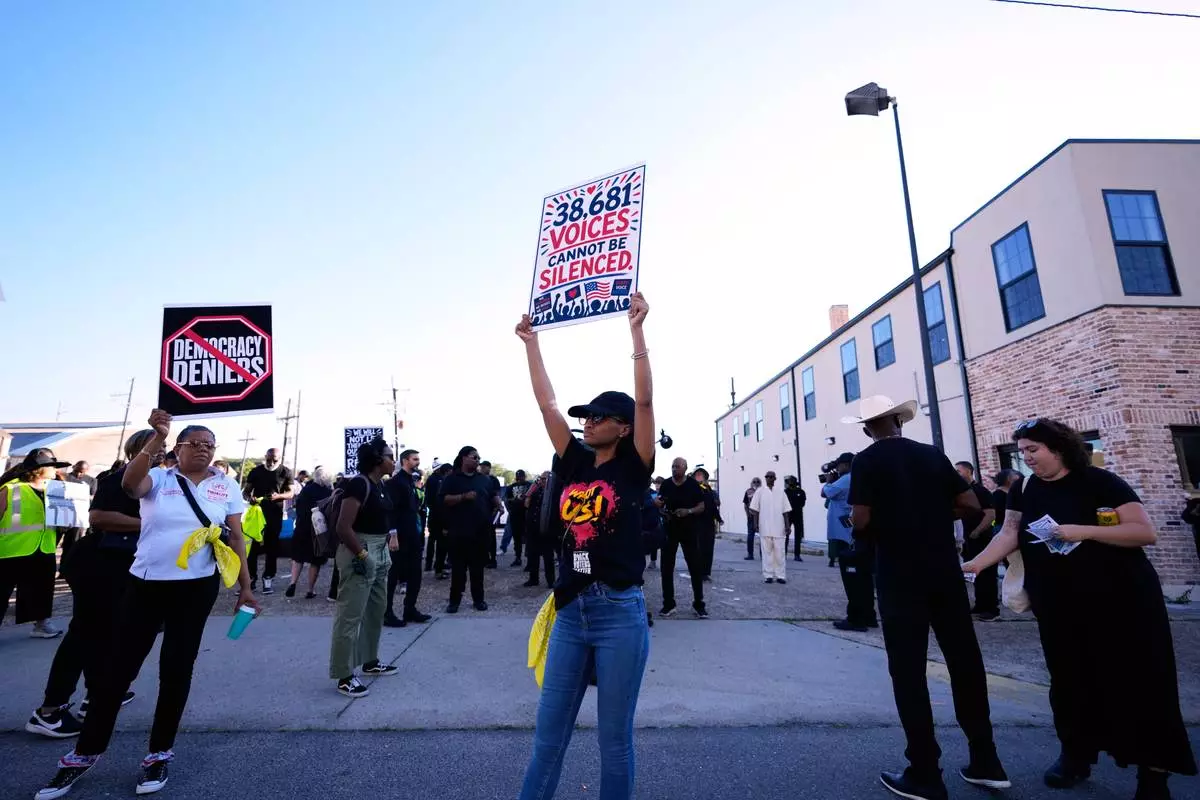
People protesting against Louisiana Governor Jeff Landry gather outside Orleans Parish criminal court on the day Calvin Duncan, an exoneree who was elected Orleans Parish clerk of criminal court, took his first day in office, Monday, May 4, 2026, in New Orleans. (AP Photo/Gerald Herbert)
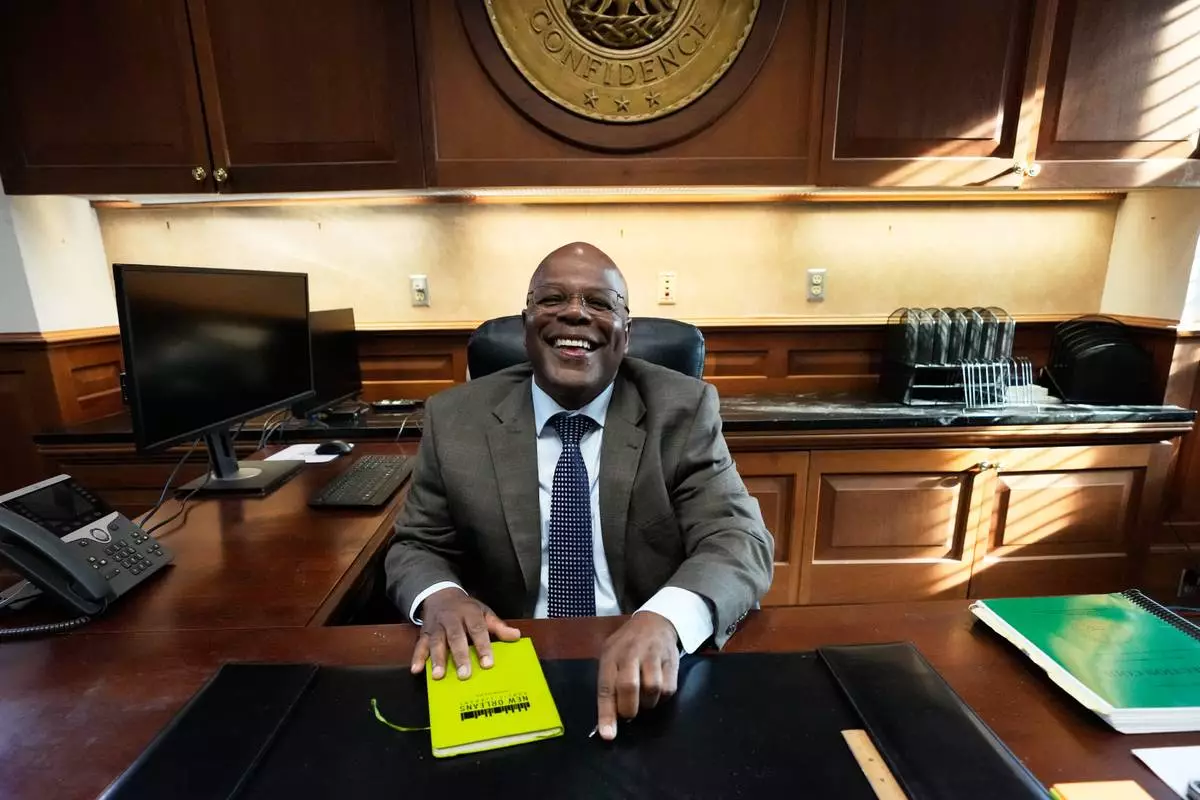
Calvin Duncan, left, an exoneree who was elected Orleans Parish clerk of criminal court, gets behind his desk on the first day of his term, Monday, May 4, 2026, in New Orleans. (AP Photo/Gerald Herbert)