NEW YORK (AP) — Dolly Parton has canceled her previously postponed Las Vegas residency due to health challenges that leave her feeling “swimmy headed” — but has assured fans her ailments are treatable.
“The good news is I'm responding really well to meds and treatments and I'm improving every day,” the 80-year-old country superstar said in a short video posted to her official Instagram account. “Now the bad news is, it's going to take me a little while before I'm up to stage-performance level because some of the meds and treatments make me a lit bit swimmy headed, as my grandma used to say.”
“And of course, I can’t be dizzy carrying around banjos, guitars, and such on five-inch heels — and you know that I’m going to be wearing them,” she joked. “Not to mention, all those heavy rhinestone outfits, the big hair, my big … uh, personality. Lord, those — that would make anybody swimmy headed!”
She didn’t share too many details about her health but clarified that she’s always “had problems with my kidney stones,” and that her immune system and digestive system “got all out of whack over the past couple three years and they’re working real hard on rebuilding and strengthening those.”
She also clarified that her doctors have assured her “that everything I have is treatable, so I'm going with that.”
She said that she is still working on opening her museum and hotel in Nashville as well as her forthcoming Broadway musical, “Dolly: A True Original Musical,” opening in New York later this year.
In September, Parton announced her first Las Vegas residency in 32 years was going to be postponed due to “health challenges.” She was scheduled to perform six shows at The Colosseum at Caesars Palace for “Dolly: Live in Las Vegas” in December, overlapping with the National Finals Rodeo. Her dates were moved to this September, before being canceled on Monday.
“Don’t worry about me quittin’ the business because God hasn’t said anything about stopping yet,” she said at the time of the postponement. “But I believe he is telling me to slow down right now so I can be ready for more big adventures with all of you.”
Last September, Parton also was unable to attend the announcement of a new ride at her Tennessee theme park Dollywood due to health issues. “I had a kidney stone that was causing me a lot of problems, turned out it’d given me an infection, and the doctor said, ‘You don’t need to be traveling right this minute, so you need a few days to get better,’” Parton said in a video announcement at the time.
The following month, Parton posted a video to social media joking that she “ain’t dead yet,” following public speculation about her health.
“There are just a lot of rumors flying around. But I figured if you heard it from me, you’d know that I was OK,” she said in a two-minute video posted on Instagram. “I’m not ready to die yet. I don’t think God is through with me. And I ain’t done working.”
Parton performs on occasion but hasn’t toured since her “Pure & Simple Tour” ended in 2016.
A representative directed The Associated Press' back to Parton's video message when asked for comment.

FILE - Dolly Parton performs in Overland Park, Kan., on Aug. 14, 2023. (AP Photo/Charlie Riedel, File)
MONTGOMERY, Ala. (AP) — Lawmakers in several southern states are meeting this week to consider plans that could upend their congressional primaries and redraw U.S. House districts ahead of the November elections, as Republicans move quickly to capitalize on a U.S. Supreme Court ruling that weakened a key provision of the Voting Rights Act.
A special legislative session responding to the court ruling began Monday in Alabama and is to start Tuesday in Tennessee. Louisiana lawmakers, who already are in session, also are looking at how to redraw their congressional districts.
Civil rights activists have countered with rallies, protests and lawsuits challenging the new redistricting efforts. Several hundred protesters gathered outside the Alabama Statehouse on Monday, carrying signs declaring “No new map” and “We fight back! Black Voters Matter.”
Last week’s Supreme Court decision striking down a majority-Black congressional district in Louisiana has unleashed “a wave of nefarious actions” across states that threatens to disenfranchise Black voters, Alanah Odoms, executive director of the American Civil Liberties Union of Louisiana, said Monday.
Trump on Sunday encouraged more states to join in redistricting, saying in a social media post that Republicans could gain 20 House seats. But South Carolina Gov. Henry McMaster’s office on Monday said the Republican would not call a special session to redraw the state’s only Democratic-occupied House seat.
The high court's ruling said Louisiana relied too heavily on race when creating a second Black majority House district as it attempted to comply with the Voting Rights Act. The ruling significantly altered a decades-old understanding of the law and provided grounds for Republicans in various states to try to eliminate majority-Black districts that have elected Democrats to Congress.
As Republicans forge ahead, U.S. House Democratic Leader Hakeem Jeffries touted a redistricting effort in his home state of New York. But that isn’t expected to result in a new map until 2028. To adopt new districts, New York lawmakers must pass a constitutional amendment twice in two years, and voters would also have to approve it.
Legislative voting districts typically are redrawn only once a decade, after a census, to account for population changes. But Trump urged Texas Republicans last year to redraw U.S. House districts to give the party an advantage. Democrats in California responded by doing the same, and then other states joined in.
On Monday, Florida became the eighth state to enact new House districts ahead of midterm elections, as Republican Gov. Ron DeSantis announced he had signed a redrawn map passed by lawmakers last week that could help Republicans win as many as four additional House seats. The new map was immediately challenged in court as a partisan gerrymander that violates a state constitutional provision against drawing districts that favor one political party over another.
All told, Republicans think they could gain as many as 13 seats from new congressional districts in five states, while Democrats think they could pick up as many as 10 seats from new districts adopted in three states. The newly proposed redistricting in southern states could add to the Republicans' tally.
After last week's Supreme Court decision, Louisiana moved quickly to delay its May 16 congressional primary to allow time for lawmakers to approve new U.S. House districts. But Republicans have yet to unveil their planned revisions to district lines.
Democrats and civil rights groups have filed several lawsuits challenging the election suspension, including another suit filed Monday in federal court. They are encouraging people in Louisiana — where early voting already is underway — to go ahead and cast votes in the congressional primaries in case courts later allow them to be counted.
Rather than canceling the state's May 19 primaries, Republican Gov. Kay Ivey called legislators into a special session to consider contingency plans for special primary elections in hopes the U.S. Supreme Court will let Alabama switch congressional maps ahead of the November midterms.
Federal judges previously ordered Alabama to use a court-selected map — with a second district that has a substantial number of Black voters — until a new map is drafted after the 2030 Census. Alabama appealed that decision and has asked the court, in light of the Louisiana ruling, to let it revert to a 2023 map drawn by Republican state lawmakers. That map would substantially alter the district now represented by Rep. Shomari Figures, a Black Democrat.
Redistricting opponents rallied Monday across the street from the historic Alabama Capitol, where the Confederacy was formed in 1861 and where the Rev. Martin Luther King addressed a crowd of thousands after the 1965 Selma-to-Montgomery voting rights march.
“Much blood, sweat and tears was shed in an effort for us to gain the right to vote,” said Sheyann Webb-Christburg, who as a child participated in the 1965 Bloody Sunday voting rights march in Selma. “In 2026, there are still people who are still not exercising that right to vote, and we are still fighting today, even in an effort to keep our right to vote.”
In Tennessee, Republican Gov. Bill Lee announced a special session starting Tuesday for the GOP-controlled Legislature to break up the state’s one Democratic-held House district, centered on the majority-Black city of Memphis.
The move comes after a pressure campaign by Trump and other Republicans to reconfigure the state’s 9th Congressional District. Previous precedent in Voting Rights Act cases had prevented Republicans from spreading the district’s Democratic voters among neighboring conservative districts and making it winnable. But the law may no longer be an impediment.
“We owe it to Tennesseans to ensure our congressional districts accurately reflect the will of Tennessee voters,” Lee said.
Clergy members concerned about plans to split Memphis’ congressional district came together Monday to denounce the move.
“This latest attempt at redistricting is not just about lines on a map, it is about misrepresentation,” said the Rev. Earle Fisher, a pastor at the Abyssinian Missionary Baptist Church and the founder of Up the Vote 901, referring to the Memphis area code. “It’s about whether the voices of Black people in this state will be heard or hidden.”
The candidate qualifying period in Tennessee ended in March, and the primary election is scheduled for Aug. 6.
Loller reported from Nashville and Lieb from Jefferson City, Missouri. Associated Press writers Jack Brook in New Orleans, Anthony Izaguirre in New York and Nicholas Riccardi in Denver contributed to this report.
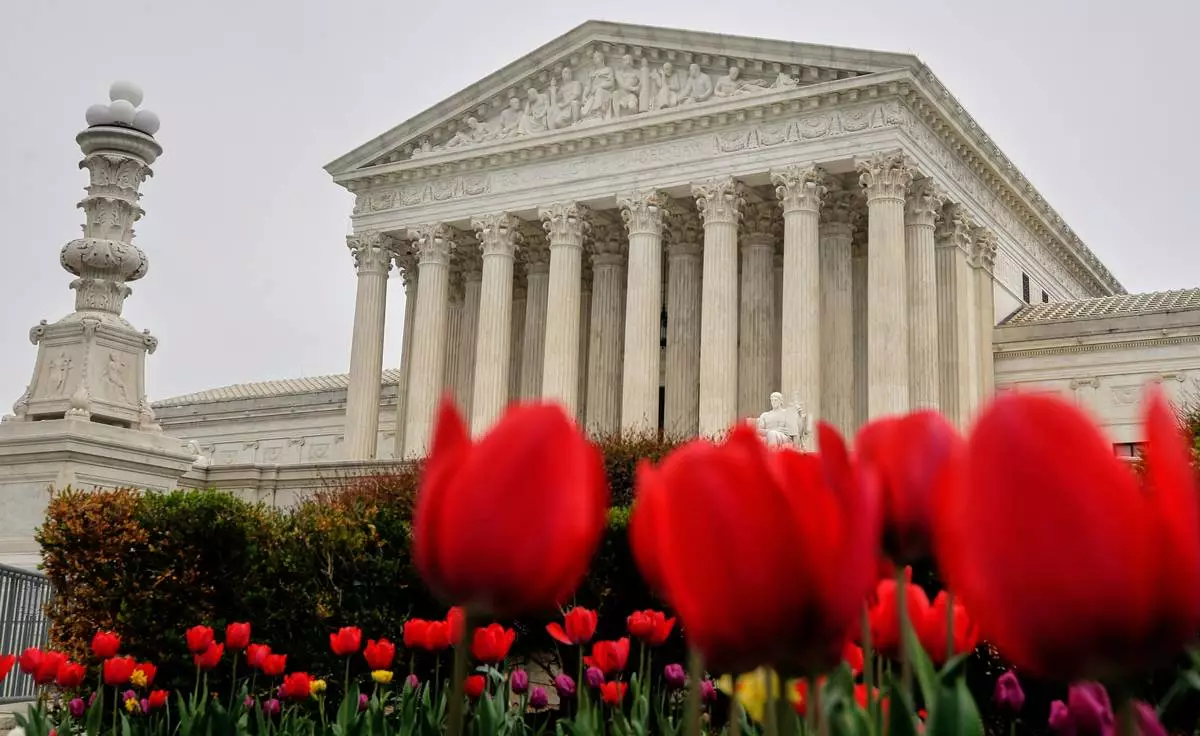
FILE - The U.S. Supreme Court is seen in Washington, Friday, April 3, 2026. (AP Photo/Rahmat Gul, File)