DENVER (AP) — Kirill Kaprizov arrived in the banquet room Monday for media availability wearing a pair of hotel slippers.
The Minnesota forward's attitude about the series, even after a wild 9-6 loss to Colorado in Game 1, proved just as chill as his footwear choice.
"We need better,” Kaprizov said. “We know this.”
Precisely what changes, if any, might be in store for the Wild before Game 2 on Tuesday night will be revealed in due time. Wild coach John Hynes is still weighing lineup decisions, including who might be in net.
Jesper Wallstedt had a rough evening, surrendering eight goals, in a crazy game where the Wild fell behind 3-0 early and rallied to take the lead before letting it slip away. The Avalanche scored their most playoff goals in team history.
“I think last night was a bit of an anomaly,” Hynes said. "I’m not worried about Wally. He’s got a great track record. He’s played really well. He has playoff experience and he has positive playoff experience.
“Everyone has to reboot. We all have to be better and we’re planning on doing that (Tuesday).”
Immediately after the game, Wallstedt was turning the page.
“That’s done. There’s nothing we can do about that,” said Wallstedt, who allowed a total of 14 goals in six games during a first-round series win over Dallas. “Now it’s just about analyzing, looking through that one and then let it go. ... Focus on the next one.”
His teammates deflected the blame.
“Clean up some stuff and be better for Wally,” forward Mats Zuccarello said after the loss. “We gave them too many easy chances and hopefully it’s a one-off for us because we haven’t really played like that as of late.
“It doesn’t matter if it is (8-0) or (1-0) or whatever. It’s Game 1, they’re up and we have to be better as a team defensively.”
Waiting in the wings for the Wild is Filip Gustavsson, who went 28-15-6 with a 2.69 goals-against average this season. He hasn’t played since allowing five goals at St. Louis on April 13.
The Wild remain without forward Joel Eriksson Ek and defenseman Jonas Brodin due to lower-body injuries. They are expected to be reevaluated before Game 3.
Hynes referred to Sunday's goal-fest as “helter-skelter,” with 14 different players scoring. Colorado defenseman Cale Makar, who returned from a first-period injury to score twice in the third period, labeled the high-scoring contest a “one-off,” given that both teams were among the top defensive units in the regular season.
“It was a very, very unique game, the way pucks were going in the net,” Avalanche defenseman Brett Kulak said of the 10th playoff game in NHL history to feature 15 or more goals. “You’ve just got to laugh a little bit now — we’re able to anyways — that we came out on the right side of it.”
For Minnesota, it's all about finding a way to slow the speed of Nathan MacKinnon & Co.
“You have to try to stop giving them easy offense,” Wild forward Vladimir Tarasenko said. “There’s a game plan, which will be provided to us.”
Any sneak peeks?
“I don’t think I want to talk about it right now,” Tarasenko said. “If we try to play as a unit of five, help each other, everything is possible.”
AP NHL playoffs: https://apnews.com/hub/stanley-cup and https://apnews.com/hub/nhl
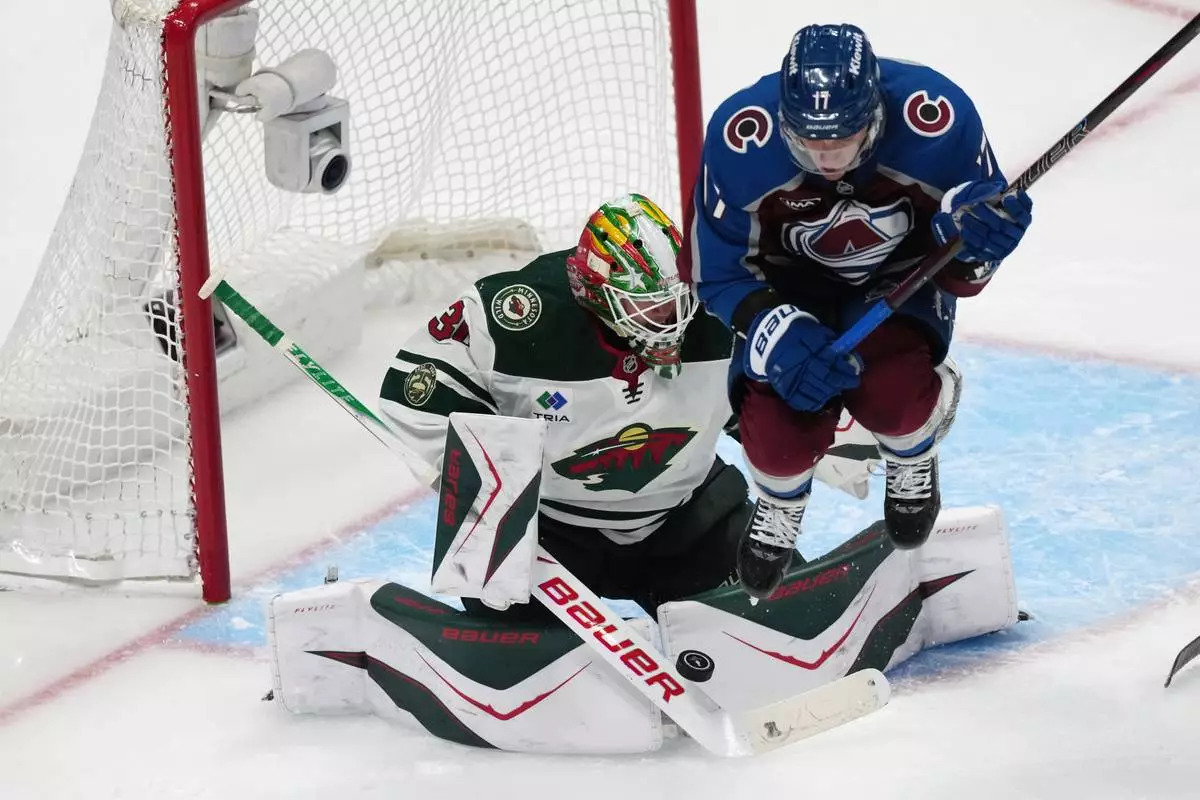
Colorado Avalanche center Parker Kelly, right, jumps as Minnesota Wild goaltender Jesper Wallstedt makes a stick save of a shot in the third period of Game 1 of an NHL hockey Stanley Cup second-round playoff series Sunday, May 3, 2026, in Denver. (AP Photo/David Zalubowski)

Colorado Avalanche center Nathan MacKinnon, front left, drives past Minnesota Wild defenseman Jared Spurgeon, right, to put a shot on goaltender Jesper Wallstedt in the first period of Game 1 of an NHL hockey Stanley Cup second-round playoff series, Sunday, May 3, 2026, in Denver. (AP Photo/David Zalubowski)
NEW YORK (AP) — The Washington Post won the Pulitzer Prize for public service for scrutinizing the Trump administration’s sweeping, choppy overhaul of federal agencies, and The Associated Press won the award Monday for international reporting about surveillance.
In a year when several prize-winning projects zoomed in on the Trump presidency, the Post's coverage illuminated the administration's fast-moving, sometimes opaque drive to reshape the national government and what the cuts and changes meant for individual Americans.
The Miami Herald’s Julie K. Brown was given a special citation for her reporting, nearly a decade ago, that drew attention to Jeffrey Epstein ’s abuses. The New York Times won three of the coveted prizes, the Post and Reuters each won two, and less widely known outlets ranging from The Connecticut Mirror to the podcast “Pablo Torre Finds Out” also were recognized in a challenging year for American journalism.
“This is always a day of celebration in our communities, but perhaps never more so than today as we face tremendous political and economic pressures,” prize administrator Marjorie Miller said in a livestream announcement.
In the last few months, the Post cut a third of its staff, CBS News announced it would shutter its nearly century-old radio service, The AP offered buyouts to over 120 journalists and some regional newspapers also publicly struggled. CBS parent Paramount’s acquisition of CNN has raised questions about what’s next for those networks. Meanwhile, President Donald Trump continued to bash, and sometimes sue, outlets whose coverage he finds objectionable.
Spanning three years, thousands of pages of documents and numerous interviews, the AP project found that American companies help lay the foundations of the Chinese government’s system for monitoring and policing its citizens.
“This was sweeping and deeply impactful reporting, the kind of work that highlights the unique strengths of AP’s global, multiformat newsroom,” executive editor Julie Pace said in an email to staffers. She is among the Pulitzer Board's new members.
Some of The Washington Post's winning work was by reporter Hannah Natanson, whose home was searched and devices were seized in what federal authorities say was an investigation into a Pentagon contractor’s handling of classified documents. The Post says the seizure violated the First Amendment.
Two winning entries focused on Trump's pulverizing approach to norms and constraints. Reuters, which won for national reporting, looked at how Trump has used the federal government and his supporters’ influence to expand presidential authority and target foes, the award judges noted. The Times took the investigative reporting prize for exploring the Republican president’s boundary-pushing approach to the notion of conflicts of interest.
Joseph Kahn, executive editor of the Times, said its reporters have been threatened over their work. “We have not, and will not” bow to the pressure, he said in a statement.
Reuters' reporting on scam ads, AI chatbots and the social media giant Meta — which owns Facebook, Instagram and WhatsApp — won the beat reporting prize, last given two decades ago.
Reuters' wins spotlighted "fearless, deeply reported, original work that holds powerful institutions to account,” editor-in-chief Alessandra Galloni said in a statement.
The prize for breaking news went to The Minnesota Star Tribune’s coverage of last year’s deadly mass shooting during Mass at a Minneapolis Catholic school. Judges praised the thoroughness and compassion of the newspaper’s reporting on a scene of carnage in its hometown.
“To me, it’s really a moment to appreciate the power of local journalism,” Kathleen Hennessey, the Star Tribune's editor and senior vice president, said in an interview. One Tribune reporter who lives in the neighborhood heard the gunshots and called 911 before running to the scene, she noted; an editor at the paper has children who attend the school.
“It feels really gratifying to be recognized, but for this newsroom, this is also just still a really painful event,” Hennessey said.
The San Francisco Chronicle received the award for explanatory reporting, which means work that makes a complex topic comprehensible to everyday readers and viewers. The Chronicle's series laid out how insurers, aided by algorithmic tools, undervalued and denied rebuilding claims for fire-destroyed homes, the judges said.
In visual journalism, The Times got a breaking news photography award for depicting devastation and starvation in Gaza resulting from Israel's war in the territory. The Post won the feature photography prize, for a visual essay on a family welcoming a firstborn as the child’s father grappled with terminal cancer. The award for illustrated reporting and commentary — a category that includes editorial cartoons and more — went to Bloomberg for a graphic novel about online scams that threaten “digital arrest.”
In a statement, Bloomberg Editor-in-Chief John Micklethwait called it "deeply reported public service journalism, published in an inventive format.”
While several prizes reflected the year’s biggest news stories, others highlighted work that wasn’t pushed to everyone’s phones.
One of two local reporting awards went to The Connecticut Mirror and ProPublica for a series on how towing companies profited off Connecticut laws, at the expense of poor car owners; the state soon changed the laws. The Chicago Tribune also was honored for its coverage of the Trump administration’s intense immigration crackdown in the Windy City.
Texas Monthly won the feature writing award for an editor's first-person story of flooding that killed his toddler nephew and swept his home away. Also in Texas, The Dallas Morning News' architecture critic won the criticism award; judges praised Mark Lamster's wit and expertise. The New York Times' M. Gessen won the opinion writing award for essays on authoritarianism.
The audio award went to “Pablo Torre Finds Out” for probing financial arrangements between Los Angeles Clippers superstar Kawhi Leonard and an environmental startup in which the team owner invested. The judges called the project a “pioneering and entertaining form of live podcast journalism.” It's produced by Meadowlark Media and licensed by the New York Times Co.-owned sports site The Athletic.
The Pulitzer announcement — usually followed by a dinner later in the year — came little more than a week after an armed man rushed a security checkpoint and exchanged gunfire with Secret Service agents outside another big event for U.S. journalists, the White House Correspondents’ Association dinner in Washington. The man is now charged with trying to assassinate Trump, who was attending the event for his first time as president.
Separately, Monday’s awards also honored books, music and theater.
The prizes were established in newspaper publisher Joseph Pulitzer’s will and were first awarded in 1917. Winners receive $15,000, and the public service award carries a gold medal. Decisions are made by the Pulitzer Board, based at Columbia University in New York.
Associated Press writer Sarah Raza contributed from Canton, Michigan.
FILE - Signage for The Pulitzer Prizes appear at Columbia University, May 28, 2019, in New York. (AP Photo/Bebeto Matthews, File)