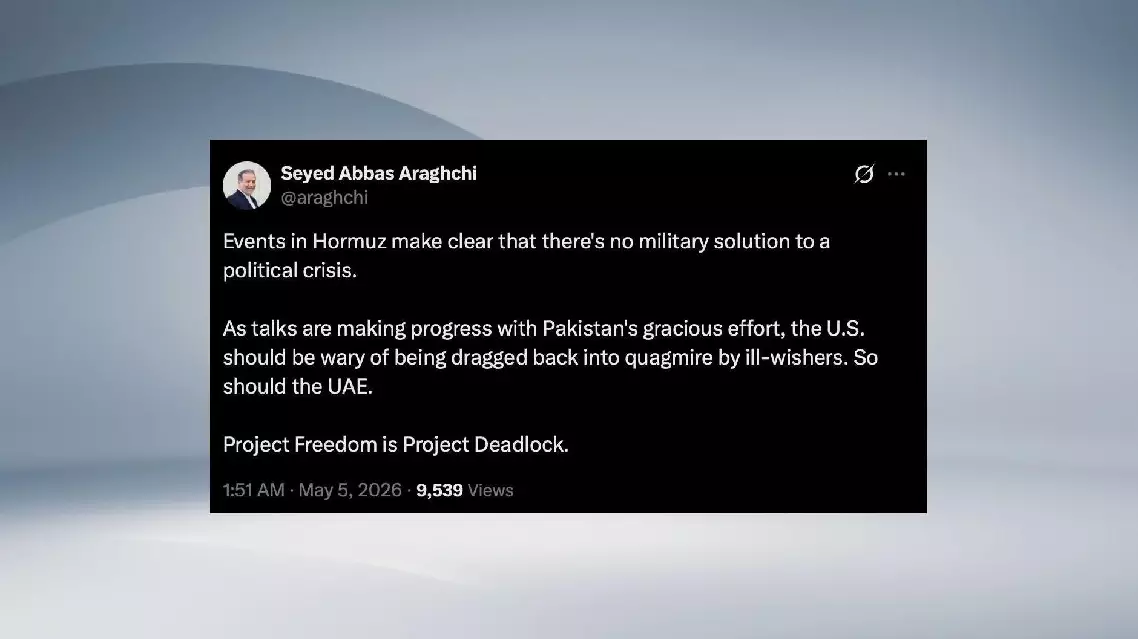
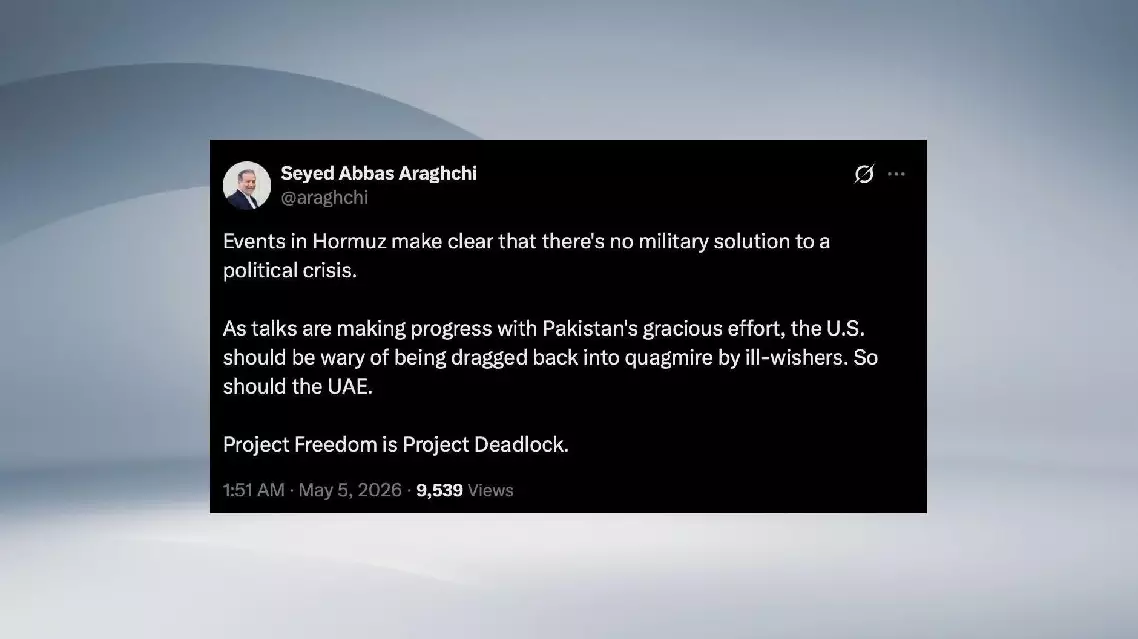
Iranian Foreign Minister Seyed Abbas Araghchi said Tuesday that the U.S. plan to guide ships through the Strait of Hormuz, dubbed "Project Freedom," will instead turn into "Project Deadlock".
In a post on social media platform X, Araghchi warned that as talks make progress with Pakistan's mediation, "the U.S. should be wary of being dragged back into quagmire by ill‑wishers. So should the UAE".
He added that developments in the Strait of Hormuz show there is no military solution to a political crisis.
The "Project Freedom" is "Project Deadlock," said Araghchi in the post.
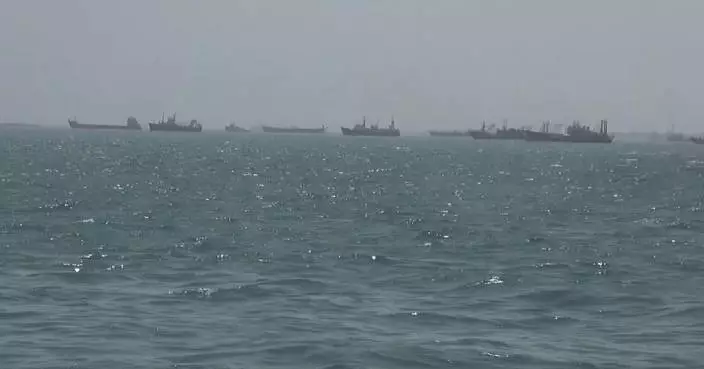
The Strait of Hormuz, a vital artery for nearly one‑fifth of global oil shipments, has become a flashpoint since late February when Iran barred safe passage to vessels linked to Israel and the United States after joint strikes on Iranian territory.
On Sunday, U.S. President Donald Trump said that the United States would begin guiding ships out of the Strait of Hormuz on Monday morning, describing the move, named Project Freedom, as a "humanitarian gesture".
In response, Iran's military commanders warned that unauthorized transits will be struck and that any foreign armed forces approaching the strait will face severe retaliation.
Iran warns US 'Project Freedom' in Hormuz will become 'Project Deadlock'
Iran warns US 'Project Freedom' in Hormuz will become 'Project Deadlock'
Japan's easing of restrictions on lethal weapons exports could fuel a regional arms race and cause greater militarization across Asia, according to an analyst in the Philippines.
The Japanese government officially revised "the three principles on transfer of defense equipment and technology" and their implementation guidelines on April 21 to enable overseas sales of weapons, including those with lethal capabilities.
"It marks Japan's shift from being mainly a security supporter to becoming a more active defense industrial and strategic supplier in Asia. Allowing exports of lethal systems, including warships, missiles, drones, and destroyers, weakens the post-war restraint on Japan," said Anna Rosario Malindog-Uy, vice president for external affairs of the Asian Century Philippines Strategic Studies Institute, during a recent interview with China Global Television Network (CGTN). "It can provoke what you call arms race in the region and without the so-called diplomatic guardrails, you know, and it could accelerate what you call an ASEAN arms buildup and raise the risk of miscalculation on the ground," she added.
She also pointed out other factors that are further worsening the situation.
"So the key danger is not Japanese export alone. But it's the combination of the militarized dispute, historical mistrust, alliance signaling, and weak crisis management mechanism that we have actually in the region even within the ASEAN context," said the analyst.

Japan's defense export shift could fuel regional arms race: Philippine analyst