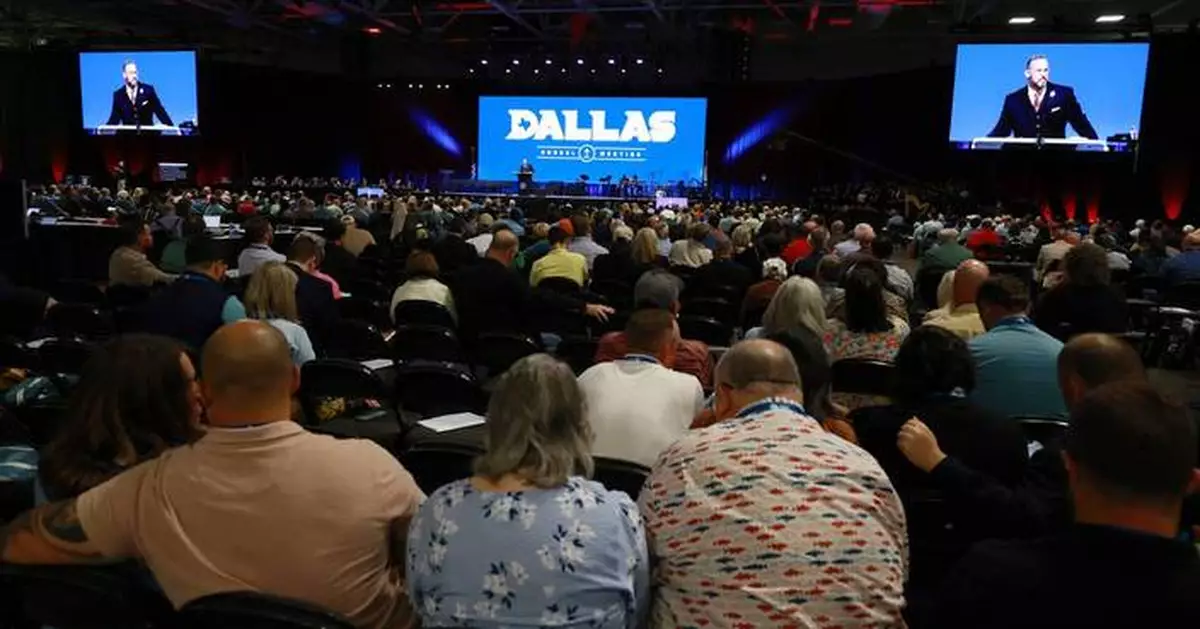
Southern Baptist membership sank last year to its lowest level since 1973, even as the United States' largest Protestant denomination saw increases in baptisms and attendance at services.
Those results for 2025 were released Tuesday by Lifeway Research, the denomination's research affiliate.
Membership fell by 3% to 12.3 million, continuing a nearly two-decade decline. At the same time, weekly worship attendance was up by nearly 4% to 4.5 million.
The number of baptisms increased 5% to 263,075. It was the second consecutive year in which the number of baptisms exceeded those before the COVID-19 pandemic.
The denomination often uses baptism as a key spiritual vital sign, a measure of how many people are being brought into the faith.
“We are grateful Southern Baptists continue to show growth in key metrics like baptisms, worship attendance and Bible study participation,” Jeff Iorg, president of the SBC Executive Committee, said in a statement.
Scott McConnell, executive director of Lifeway Research, attributed the membership dip in part to church closures and to congregations cleaning up their membership rolls.
The SBC numbers are based on self-reporting by congregations. Most members are in the denomination's traditional base of the South, where it was founded by a pro-slavery faction before the Civil War, though it has since developed a presence throughout North America.
The numbers are closely watched by scholars because the SBC has long represented the single-largest body of evangelical Christians and keeps meticulous records.
The SBC remains by far the largest Protestant denomination in the U.S. in part because many other large denominations have been declining even more. The ranks of nondenominational churches — many of them with evangelical beliefs and independent governance similar to Baptists — have been growing. So have the ranks of the “ nones,” people with no religious affiliation, although that decades-long growth has stalled in recent years, according to a survey released last year by the Pew Research Center.
Political scientist Ryan Burge, who studies religious demographics, said that despite the baptism and attendance statistics, the SBC faces a likely future of continued declines The 3% membership decline amounts to nearly 400,000 people — the size of some small denominations.
"We’ve got to put that in perspective. Losing that many people is still losing a lot of people," said Burge, a professor at the John C. Danforth Center on Religion and Politics at Washington University in St. Louis.
He said the SBC is probably losing members to a combination of factors, including people joining nondenominational churches or leaving the faith. And it’s losing members to deaths, something that will accelerate in a church with many older members.
“The SBC has a baby boomer problem,” he said. “Structurally speaking, it’s hard to outrun that demographic cliff. I just don’t think there's anything structurally in the data that says the SBC is going to go back to where it was 20 years ago.”
Associated Press religion coverage receives support through the AP’s collaboration with The Conversation US, with funding from Lilly Endowment Inc. The AP is solely responsible for this content.
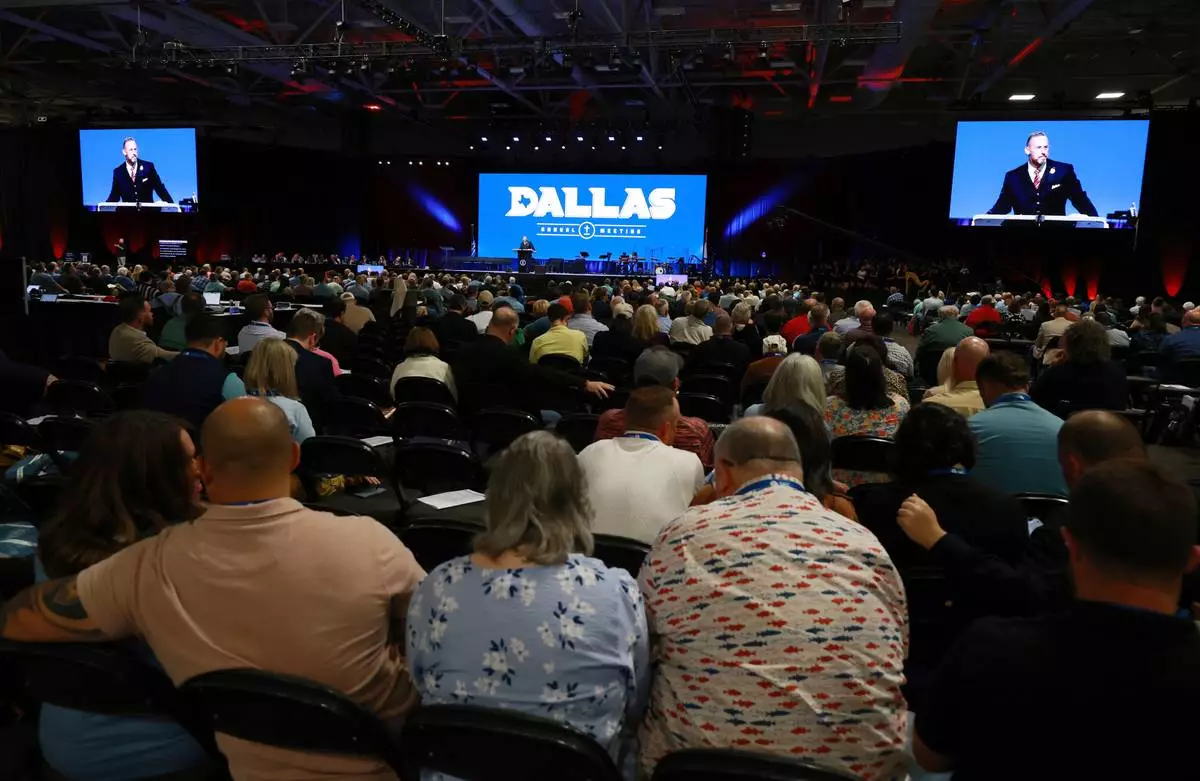
FILE - Messengers attending the Southern Baptist Convention listen to remarks by president Clint Pressley during the 2025 SBC Annual Meeting, June 10, 2025, in Dallas. (AP Photo/Richard W. Rodriguez, File)
WASHINGTON (AP) — President Donald Trump says that he has paused the U.S. effort to guide stranded vessels out of the Strait of Hormuz to finalize an Iran deal.
Trump announced the decision in a social media post on Tuesday evening, saying he was pausing the effort for a short period to give space for U.S. efforts to finalize a settlement with Iran to end the war.
Trump in the post said he was making the move based “on the request of Pakistan and other Countries, the tremendous Military Success that we have had during the Campaign against the Country of Iran and, additionally, the fact that Great Progress has been made toward a Complete and Final Agreement with Representatives of Iran.”
He added that the U.S. blockade of the strait would remain in place.
The White House did not immediately respond to a request for comment offering further detail about the progress in negotiations that Trump alluded to in his posting.
The announcement came after military leaders and Secretary of State Marco Rubio insisted on Tuesday that a ceasefire in the Middle East was still holding and that — while the conflict is not resolved — the initial major U.S. military operation against Iran has concluded.
THIS IS A BREAKING NEWS UPDATE. AP’s earlier story follows below.
DUBAI, United Arab Emirates (AP) — U.S. military leaders and Secretary of State Marco Rubio insisted on Tuesday that a ceasefire in the Middle East is still holding and that — while the conflict is not resolved — the initial major U.S. military operation against Iran has concluded.
Rubio told a White House press briefing on Tuesday that for peace to be achieved, Iran must agree to U.S. President Donald Trump’s demands on its nuclear program and also agree to reopen the Strait of Hormuz, a vital waterway for global energy.
He spoke as the United Arab Emirates said it came under attack from Iranian drones and missiles for a second day.
“We would prefer the path of peace,” Rubio said. He also expressed hope that during the expected visit to China by Iranian Foreign Minister Abbas Araghchi on Wednesday, Beijing would reiterate to Tehran the need to release its chokehold on the strait.
“It is in China’s interest that Iran stop closing the strait,” Rubio said.
The United States pressed on for a second day Tuesday with its effort to reopen the strait to maritime traffic — an operation Rubio described as defensive and aimed at helping thousands of civilian sailors stranded there by the war.
“They’re sitting ducks, they’re isolated, they’re starving, they’re vulnerable,” Rubio said. “At least 10 sailors have already died as a result.”
On Monday, the U.S. said it had opened a lane and sunk six small Iranian boats that had threatened commercial ships. So far, only two merchant ships are known to have passed through the new U.S.-guarded route, with hundreds more bottled up in the Persian Gulf.
Iran’s effective closure of the strait, through which major oil and gas supplies passed before the war, along with fertilizer and other petroleum products, has sent fuel prices skyrocketing and rattled the global economy. Breaking Iran's grip would deny its main source of leverage as U.S. President Donald Trump demands a major rollback of its disputed nuclear program.
Earlier on Tuesday, U.S. Defense Secretary Pete Hegseth and Gen. Dan Caine, the U.S. military’s top officer, told a news conference that Iran’s renewed attacks had not reached the threshold of what Caine called “major combat operations.” He said Tuesday marked a “quieter” day in the strait.
“The ceasefire is not over,” Hegseth said.
At the White House, Rubio said clashes with Iran related to American efforts to reopen the straight were “defensive in nature.”
“There’s no shooting unless we’re shot at first, OK?" Rubio said. “We’re not attacking them.”
Iran’s parliament speaker and chief negotiator, Mohammad Bagher Qalibaf, signaled that Iran has yet to fully respond to the U.S. attempt to reopen the waterway.
“We know full well that the continuation of the status quo is intolerable for America; while we have not even begun yet,” he said in a post on X. His statement did not mention negotiations with the U.S. that are now in the form of passing messages via Pakistan.
Disputing Washington’s claim of sinking six Iranian boats, an Iranian military commander said two small civilian cargo boats were hit Monday, killing five civilians, Iran’s state TV reported.
Caine, the top U.S. general who serves as chairman of the Joint Chiefs of Staff, said more than 100 U.S. military aircraft are patrolling the skies over the strait. The U.S. has imposed a naval blockade on Iranian ports since April 13, depriving Tehran of oil revenue it needs to shore up its ailing economy.
The Trump administration has cited the April 8 ceasefire in asserting that the president does not have to give a formal update to Congress on the war under the War Powers Resolution. That law typically requires presidents to seek formal approval from Congress for war activities 60 days after beginning military action.
So far, just two civilian vessels, both U.S.-flagged merchant ships, are known to have passed through the strait as part of the lane the U.S. says it has created. Shipping company Maersk said one of them, a vehicle carrier that it operates, exited the strait safely Monday with U.S. military assistance.
Former military officers who have served on the strait have said opening it would be dangerous and highly challenging, even with military escorts, which the U.S. is not providing now.
There’s little room to maneuver in the waterway that is just 21 miles (34 kilometers) wide, and Iran can reach all of the strait and its approaches with cruise missiles. It also can target vessels with longer-range missiles, drones, fast attack craft and mines.
Hapag-Lloyd AG, one of the world’s largest container shipping companies, said in a statement that its risk assessment “remains unchanged” and that transits through the strait "are for the moment not possible for our ships.”
Iran has attacked ships that try to transit without going through its own route in the northern part of the strait along the Iranian coastline. That involves being vetted by Iran's Revolutionary Guard and in some cases making a payment.
The U.S.-approved route goes through territorial waters of Oman to the south.
“For shipping companies and for insurance companies, they still have to wait and see how this plays out,” said Torbjorn Soltvedt, principal Middle East analyst at risk intelligence company Verisk Maplecroft.
“This initiative alone isn’t something that looks like it’s going to open the Strait of Hormuz,” he said.
The United Arab Emirates said Monday its air defenses had engaged 15 missiles and four drones fired by Iran. Authorities in the eastern emirate of Fujairah said one drone sparked a fire at a key oil facility, wounding three Indian nationals. The British military reported two cargo vessels ablaze off the UAE, also on Monday.
On Tuesday, the UAE's Defense Ministry said it was responding to another Iranian drone and missile attack, though there were no reports of damage or casualties.
Iran denied striking the UAE “in recent days,” according to a statement by Ebrahim Zolfaghari, a spokesman for Iran’s joint military command, that was read Tuesday on state TV.
Indian Prime Minister Narendra Modi called the targeting of UAE civilians and infrastructure “unacceptable.” Pakistan and Saudi Arabia also condemned the strikes.
Tehran did not confirm or deny the attacks. But Iranian Foreign Minister Abbas Araghchi said on X that the U.S. and the UAE “should be wary of being dragged back into quagmire.”
Finley reported from Washington, and Becatoros reported from Athens, Greece. Associated Press writers Farnoush Amiri at the United Nations; Collin Binkley and Matthew Lee in Washington; Giovanna Dell'Orto in Minneapolis; Sally Abou AlJoud in Beirut; Sheikh Saaliq in New Delhi; Meg Kinnard in Columbia, South Carolina; Bill Barrow in Atlanta; David McHugh in Frankfurt, Germany; and Russ Bynum in Savannah, Georgia, contributed to this report.
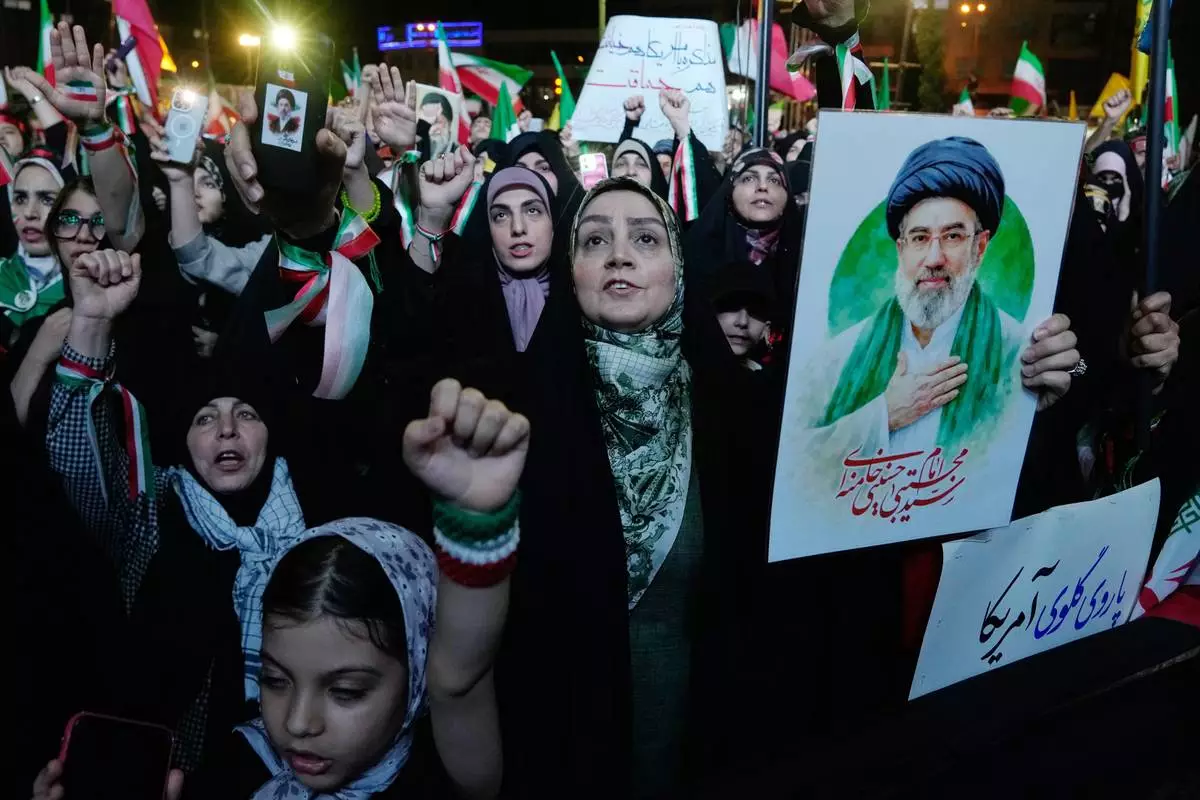
Pro-government demonstrators chant slogans as one of them holds a poster of the Iranian Supreme Leader Ayatollah Mojtaba Khamenei during their gathering at Enqelab-e-Eslami, or Islamic Revolution, square in Tehran, Iran, Monday, May 4, 2026. (AP Photo/Vahid Salemi)
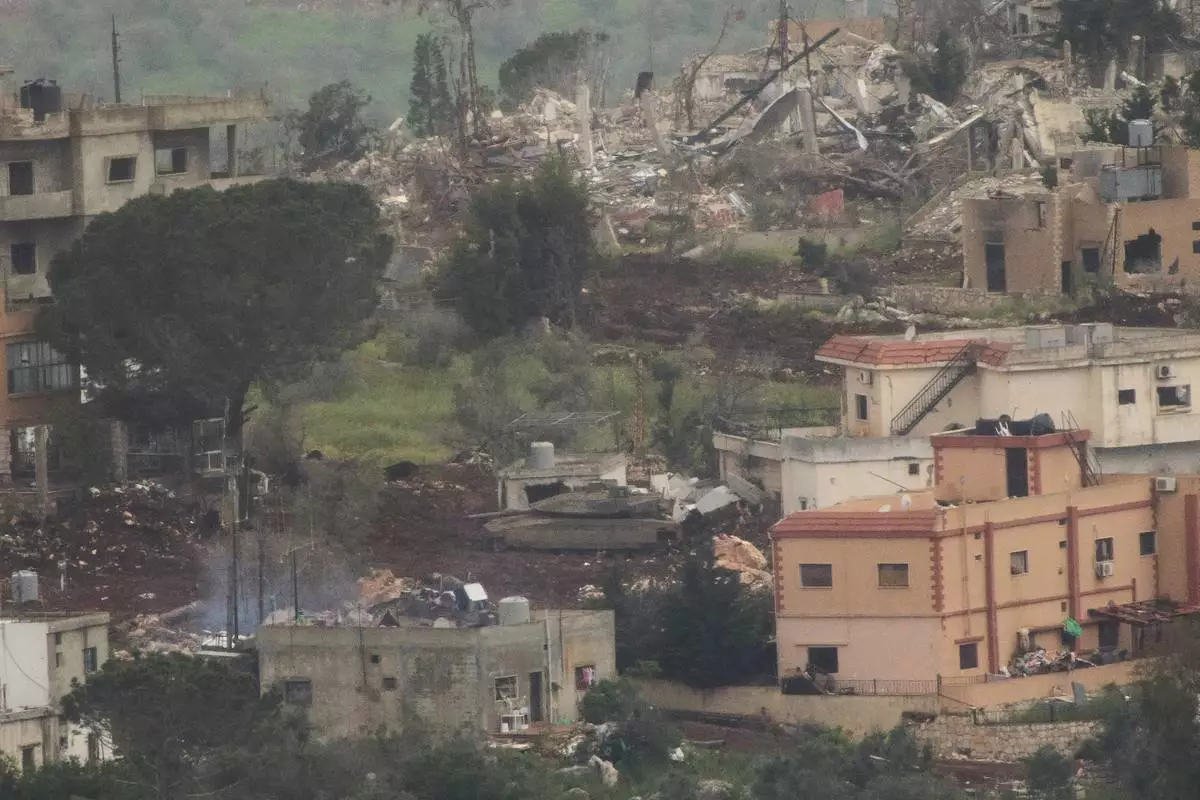
Israeli soldiers drive a tank inside a village in southern Lebanon, as seen from northern Israel, Tuesday, May 5, 2026. (AP Photo/Ariel Schalit)
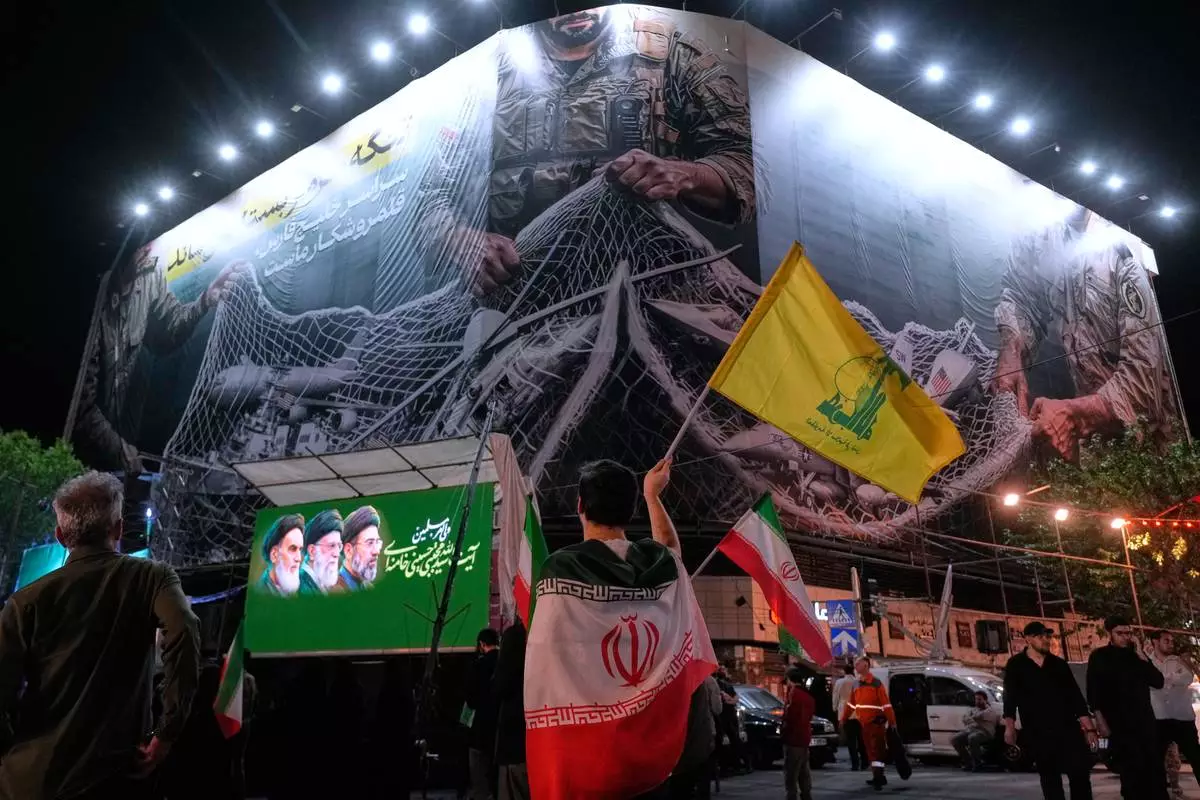
An Iranian demonstrator waves a flag of Lebanon's militant Hezbollah group under an anti-U.S. billboard depicting the American aircrafts into the Iranian armed forces fishing net with signs that read in Farsi: "The Strait of Hormuz will remain closed, The entire Persian Gulf is our hunting ground," during a pro-government gathering at Enqelab-e-Eslami, or Islamic Revolution, square in Tehran, Iran, Monday, May 4, 2026. (AP Photo/Vahid Salemi)
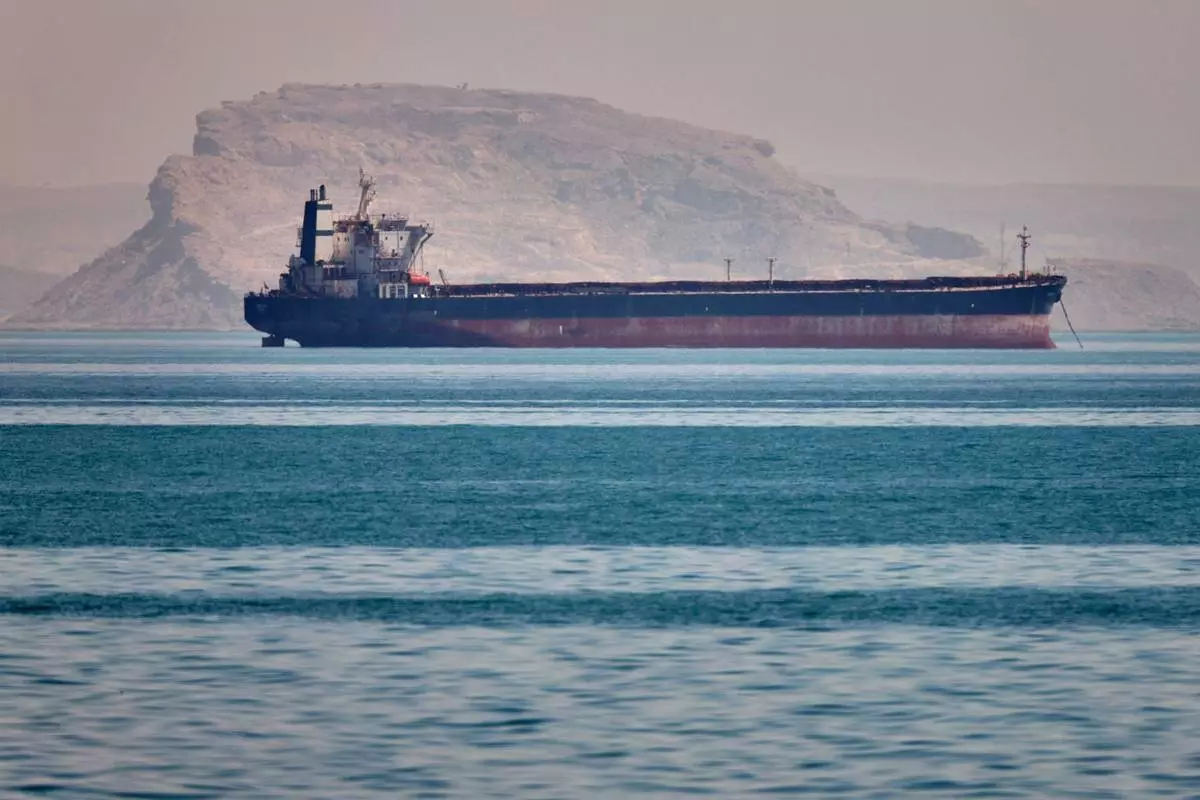
A bulk cargo ship sits at anchor in the Strait of Hormuz off Bandar Abbas, Iran, Saturday, May 2, 2026.(Amirhosein Khorgooi/ISNA via AP)