CALHOUN, Ga. (AP) — Starting in the 1970s, the textile mills of northwest Georgia relied on chemicals known as PFAS to add stain resistance to the carpets they manufactured. Some of the chemicals that didn’t stick were flushed with the multibillion-dollar industry’s wastewater into local sewer pipes and, eventually, the region’s rivers.
Decades later, the odorless, colorless chemicals are now found everywhere in the area, including in the blood of some people. Scientists have warned of health risks to humans and wildlife.
While the federal government doesn't yet have enforceable limits on PFAS, states have the authority to protect public health and the environment. Instead, Georgia’s Environmental Protection Division did little to confront the problem despite knowing about it for years, an investigation by The Atlanta Journal-Constitution, The Associated Press and FRONTLINE (PBS) has found.
Here are key takeaways from this ongoing investigation into the toxic legacy of the South’s carpet empire.
Everyone in northwest Georgia seems to know someone whose health problems, including certain types of cancer, could be caused by PFAS. This crisis was predictable.
Testing by the University of Georgia in 2008 alerted the industry and state that the local Conasauga River that supplies the region’s drinking water had “staggeringly high” levels of PFAS — an abbreviation for perfluoroalkyl and polyfluoroalkyl substances commonly known as forever chemicals because they persist in people and take decades or more to break down in the environment. The state’s own testing in 2012 and 2016 confirmed the university’s results. Federal tests still detected PFAS in 2019, the year major carpet manufacturers said they stopped using the chemicals.
PFAS end up in tap water because local utilities don’t have the advanced and costly technology that can remove them from river water.
Georgia's Environmental Protection Division issued neither fish advisories nor do-not-drink orders to the public even as concerns grew among scientists and federal regulators about the dangers of PFAS. Today, Georgia is still not regulating PFAS, in contrast to other states that have invested tens of millions of dollars in cleanups and sued polluters to recoup costs.
Deputy Director of Georgia's EPD Anna Truszczynski said her agency looked to federal regulators for guidance and waited for scientists to better understand the risks of PFAS. She said her agency helped several cities struggling with contamination by providing testing support, connecting them to potential funding sources and advising them on possible filtration technologies.
“We believe that there can be a good balance between environment and economy,” Truszczynski said. “We don’t have to sacrifice one for the other.”
At the U.S. Environmental Protection Agency, spokesperson Jake Murphy emailed that the federal agency is working to offer technical and financial support in the region.
In 2008, the leader of Georgia's EPD met privately with carpet company representatives and their trade association, the Carpet and Rug Institute, according to records of testimony given during lawsuits against the companies.
Werner Braun, then the carpet institute’s director, later informed his board about the meeting with then-Director Carol Couch, noting EPD “has no plans to initiate regulatory action” on PFAS, according to two court deposition transcripts. Braun told his board that Couch also indicated EPD “would probably look at the issue again in five years.”
The meeting with Couch went so well that one carpet executive thanked the attendees for “gaining this good outcome,” according to the transcripts.
In a text message seeking comment, Couch said PFAS were only an “emerging concern” at the time and that EPA had not established drinking water standards. EPA’s first guidance about PFAS levels came in 2009.
“To the Carpet and Rug Institute I offered no respite from state regulation of PFAS,” Couch wrote to the AJC and AP. She added that the five-year time frame was typical for new water rules and that, in 2008, EPD “had neither the sufficient science, expertise nor resources to undertake action independent of USEPA.”
A representative for the carpet institute declined to comment. Braun did not respond to a request to comment for this story.
The country’s two largest carpet companies, Shaw Industries and Mohawk Industries Inc., both based in the region, blame the contamination on their chemical suppliers, which they said for years hid the dangers of PFAS in their products. The carpet companies said they followed regulators’ guidance and pointed out there are still no enforceable limits on the chemicals.
In court filings, chemical suppliers 3M and DuPont said it was ultimately the carpet industry, not them, that put PFAS in the waters of northwest Georgia.
None of the four companies offered comment for this story.
When PFAS started showing up in Alabama’s drinking water in 2016, local water utility officials looked to Georgia for answers.
Eastern Alabama and northwest Georgia share a river system that originates in the Blue Ridge Mountains and flows through both states on the way to Mobile Bay. This watershed feeds the region’s carpet mills, which use vast amounts of water, especially in the dyeing process. It is also the source of drinking water downriver for hundreds of thousands of people.
After tests showed PFAS in water at levels exceeding EPA’s voluntary health guidelines at the time, Alabama’s environmental regulators alerted their federal counterparts and asked Georgia’s EPD for help identifying the source.
Georgia had known for years that the waters flowing from Dalton, the hub of the state’s dominant carpet industry more than 100 miles (160 kilometers) upriver, contained high levels of PFAS.
Despite Alabama’s urgent request, Georgia’s environmental regulators did not respond in kind, according to interviews and internal government records.
At the time, “EPD was very defensive,” said Jim Giattina, former director of EPA’s Water Protection Division who organized a call between the two states to coordinate. “There was certainly no commitment on their part to do any more monitoring.”
EPD’s Truszczynski, who joined the agency in 2016, said she found no record of Georgia’s response.
“We’re always very happy to work with our friends in Alabama,” she said.
Alabama’s Department of Environmental Management did not respond to multiple requests for an interview or comment.
Throughout the U.S., PFAS have been manufactured and used in a variety of products, including nonstick cookware, waterproof sunscreen, firefighting foam, dental floss and microwave popcorn bags.
With that ubiquity has come contamination hot spots elsewhere.
Some other states are taking a far more aggressive approach than Georgia.
Wisconsin, Michigan and Maine each have committed millions of dollars for cleanup, started robust testing programs and sued to hold polluters and manufacturers accountable.
A bipartisan group of Wisconsin lawmakers earlier this year approved $133 million for PFAS cleanup. That vote capped a long journey for Jill Billings, a Democratic state assembly member. In 2019, a town in her district discovered its drinking water was contaminated. Residents have been drinking bottled water provided by the state since 2021.
Billings said state-led action becomes more important as the federal government retreats from environmental regulations, including on PFAS. While EPA has still not put enforceable limits on forever chemicals, the agency’s proposed limits include the two that carpet manufacturers used most. Those limits are set to go into effect in 2031.
“I think it’s up to us to solve the problems of regular folks because the federal government seems to be struggling,” Billings said in an interview. “That’s fine. We’re ready.”
This story is part of an investigative collaboration with The Atlanta Journal-Constitution, FRONTLINE (PBS), The Post and Courier and AL.com that includes the FRONTLINE documentary “Contaminated: The Carpet Industry’s Toxic Legacy.” It is supported through AP’s Local Investigative Reporting Program and FRONTLINE’s Local Journalism Initiative, which is funded by the John S. and James L. Knight Foundation.
Watch the documentary “Contaminated: The Carpet Industry’s Toxic Legacy” on FRONTLINE’s YouTube channel and in the PBS App, on FRONTLINE’s YouTube channel or on the PBS Documentaries Prime Video Channel.
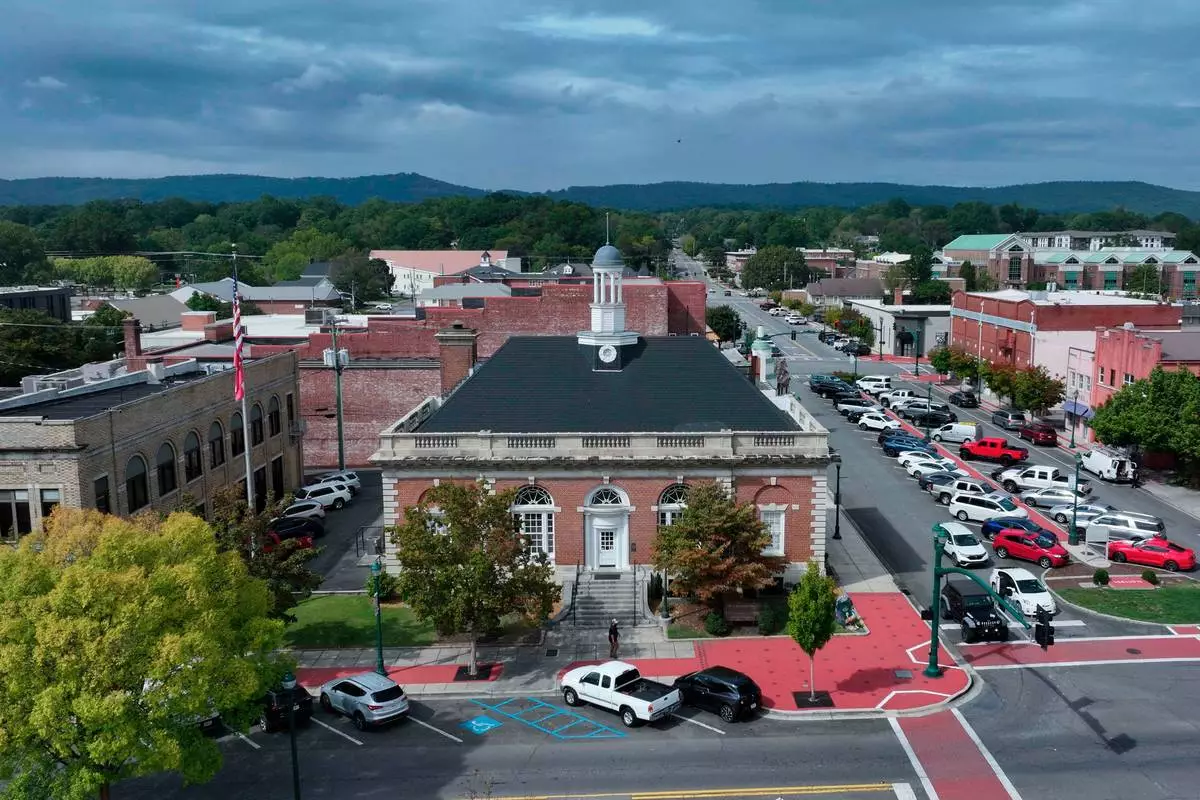
The Carpet and Rug Institute building, center, in downtown Dalton, Ga., on Sept. 30, 2025. (Miguel Martinez/Atlanta Journal-Constitution via AP)