Skip to Content Facebook Feature Image

Republicans once saw Michigan as ripe for a takeover, but the mood is shifting

News

Republicans once saw Michigan as ripe for a takeover, but the mood is shifting
News

News

Republicans once saw Michigan as ripe for a takeover, but the mood is shifting

2026-05-07 17:00 Last Updated At:17:11

DETROIT (AP) — For years, Michigan Republicans had circled 2026 as their chance to regain power in the swing state where Democrats hold all statewide offices and both U.S. Senate seats. Now, doubts are creeping in.

Surging gas prices, an unpopular war in Iran and tariffs that have hit the state’s auto industry hard have all contributed to concerns about a worsening political environment for Michigan Republicans.

The latest warning sign came Tuesday, when a Democrat won a special election by almost 20 points in a state Senate district that Kamala Harris won by less than 1 point in 2024. The previous officeholder, a Democrat, carried the seat by 6 percentage points in 2022.

“To get to this margin in that kind of a district means that Democrats and independent voters are working in tandem to send a message to the Trump administration,” Michigan pollster Richard Czuba said of Tuesday's result.

The sentiment could pose a challenge for Michigan Republicans in a midterm year when voters will decide the governor’s office, control of the Legislature and a premier U.S. Senate race. The mood of voters in Michigan also matters for a national Republican Party that sees the state — which Donald Trump flipped in 2024 — as central to its coalition and a midterm map that will again hinge heavily on the industrial Midwest.

Nationally, Trump’s approval rating on the economy fell between March and April as the Iran war sent prices higher, according to an AP-NORC poll. The April poll found that approval had eroded even among Republicans, with 62% having a positive view of the way Trump is handling the economy, down from 74% in March.

Trump’s economic approval remained low among independents, who have an outsized role in deciding elections in swing states like Michigan. About 2 in 10 independents approved of Trump’s performance on the economy in the April poll, down slightly from about 3 in 10 in March. Only about one-quarter of U.S. adults approved of his handling of the cost of living.

Michigan voters may be feeling the impacts more than those elsewhere in the U.S. Gas prices in Michigan are averaging around $4.80 per gallon, the 10th-highest in the nation, according to AAA, after they jumped by over 80 cents in a week.

Jared Kaufman, 26, is among those frustrated by rising costs and the war in Iran. He voted for Democrat Chedrick Green in Tuesday's election, saying he’s a teacher who doesn’t make much money. The sacrifices being made “for something that is nowhere near us” are unnecessary, he said.

Tariffs have also created new anxiety in a state deeply tied to the auto industry and cross-border trade with Canada. While Trump has argued the tariffs will strengthen domestic manufacturing, suppliers and smaller manufacturers in Michigan say the uncertainty has made it harder to plan investments and expansion.

“The more stability there is in the environment, the easier it is for me to make decisions to grow and expand,” said John Lytle, president of Promess Inc., a manufacturer outside Detroit. “That’s probably been the biggest impact it’s had on us.”

Jason Roe, a strategist and former executive director of the Michigan GOP, conceded that the political environment isn’t good right now, but argued Democrats have their own problems and that Trump still has time to bring costs down.

“But if they don’t get Iran figured out pretty quick, we’re screwed,” he added.

The worsening political climate is also colliding with internal divisions at the top of the GOP ticket.

With Democratic Gov. Gretchen Whitmer term-limited and leaving office at year's end, the governor's race was once viewed as Republicans' best pickup opportunity. Michigan has a long history of electing a governor from the opposite party once an incumbent leaves office.

The overwhelming favorite in the GOP primary was Rep. John James, a veteran who represents a competitive House district and has been endorsed by Trump in previous elections, including two failed bids for U.S. Senate (Trump has not endorsed in this year's GOP primary). But frustration with his campaign has steadily built within the party, spilling into public view in recent weeks.

After it was announced in April that James would miss a GOP debate in an important swing county where all other major candidates were attending, a wave of Republicans criticized him.

“The data is clear: if John James wins the Aug. 4, 2026, primary, Republicans will almost certainly lose the general election in November,” said Chris Long, a member of the Michigan GOP's leadership team, in a social media post calling for James to drop out.

James has said that he will take part in two debates in July.

Democrats have their own concerns. Secretary of State Jocelyn Benson is expected to lead the Democratic field, though Genesee County Sheriff Chris Swanson is also running. Some in the party worry that Detroit Mayor Mike Duggan, a former Democrat now running for governor as an independent, could pull votes from their nominee.

But James' campaign has also been complicated by the late entry of Perry Johnson, a millionaire businessman who mounted long-shot bids for governor in 2022 and president in 2024. Johnson has aggressively attacked James — and has the money to sustain it, announcing a $10 million television ad buy in February.

Republican strategist Dennis Lennox criticized James as running “an awful campaign,” but added that no matter who is the nominee, it will be a tough cycle.

“Anyone who isn't being paid to say otherwise will concede that 2026 is going to be a very difficult year for Republicans,” said Lennox.

In a statement, James spokesperson Hannah Osantowske dismissed the criticism as “sore losers griping,” arguing that James remains the GOP frontrunner and “the only Republican beating both Democrats in November.” She also dismissed Johnson’s campaign.

“Michiganders are not buying what he is selling,” Osantowske said. “They want a trusted Trump ally, combat veteran and proven job creator. That is John James.”

The governor's race is top of the ticket in Michigan, but national Republicans are also looking to crush Democrats' chances of winning control of the Senate by flipping Michigan's open Senate seat.

Former U.S. Rep. Mike Rogers is running again on the GOP ticket, after losing in 2024 by less than 20,000 votes to freshman Sen. Elissa Slotkin.

Democrats are in the midst of a competitive — and increasingly messy — Senate primary with three high-profile candidates vying for the party's nomination in the Aug. 4 primary.

Still, questions linger about whether Rogers can win a race he lost even with Trump on the ballot. No Republican has won a U.S. Senate race in Michigan since 1994.

Rogers maintains the most cash on hand of any Senate candidate, due to a non-competitive GOP primary, but was behind Democratic candidates Mallory McMorrow, a state senator, and Dr. Abdul El-Sayed, a former health official, in fundraising in the first quarter of 2026. The Senate Leadership Fund, the leading super PAC for Senate Republicans, announced an initial $45 million investment in the Michigan race early in April.

Czuba said the influx of outside money may not help Rogers if it further nationalizes the race.

“If the conversation is nationalized in Michigan, we see how poorly the president's numbers look right now,” said Czuba. “If undecided voters disproportionately view Donald Trump negatively, I'm not sure what the path is for Mike Rogers.”

Associated Press journalist Mike Householder in Bay City, Michigan, contributed to this report.

Chedrick Greene, Democratic candidate for 35th Senate District, takes a selfie with supporters after speaking Tuesday, May 5, 2026 in Saginaw, Mich. (AP Photo/Paul Sancya)

Chedrick Greene, Democratic candidate for 35th Senate District, takes a selfie with supporters after speaking Tuesday, May 5, 2026 in Saginaw, Mich. (AP Photo/Paul Sancya)

Chedrick Greene, Democratic candidate for 35th Senate District, speaks Tuesday, May 5, 2026 in Saginaw, Mich. (AP Photo/Paul Sancya)

Chedrick Greene, Democratic candidate for 35th Senate District, speaks Tuesday, May 5, 2026 in Saginaw, Mich. (AP Photo/Paul Sancya)
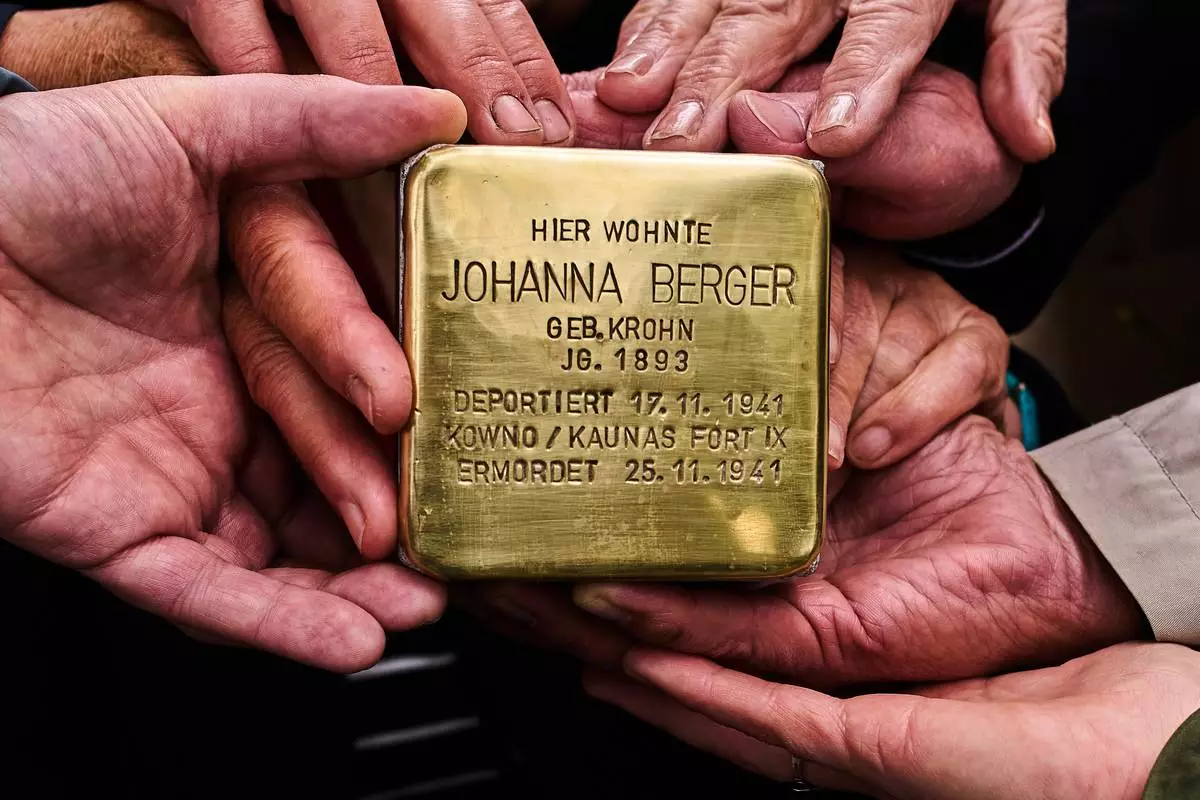
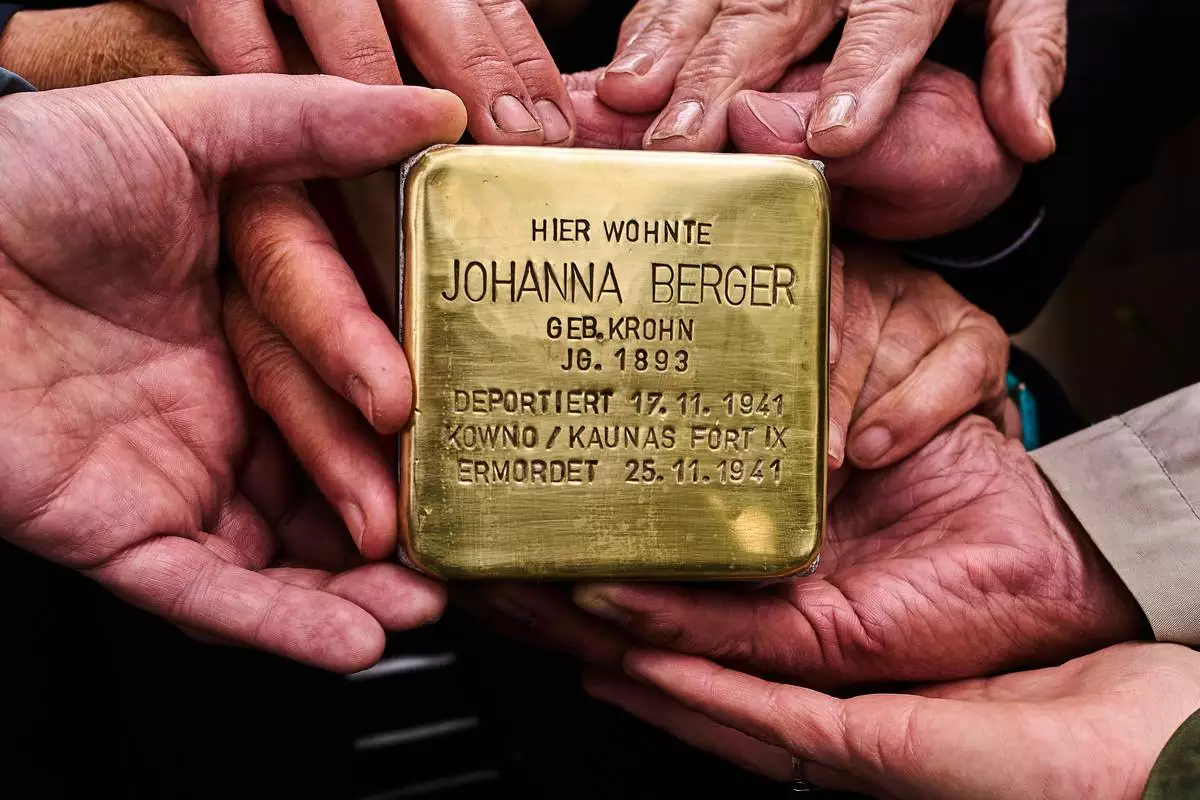
BERLIN (AP) — Artist Gunter Demnig carefully placed a palm-sized Holocaust memorial brass plaque into the sidewalk on a busy street corner of Berlin. It said: “Johanna Berger, born in 1893, lived here; deported on Nov. 17, 1941, murdered on Nov. 25, 1941.”

After Demnig had swiped the sand off Berger's memorial stone and those for her husband and two sons, a dozen relatives drew closer around the four plaques, which are called Stolpersteine, or “stumbling blocks,” in German. They put down white roses and recited the Kaddish, the Jewish prayer for the dead, while traffic roared by on a rainy spring day.

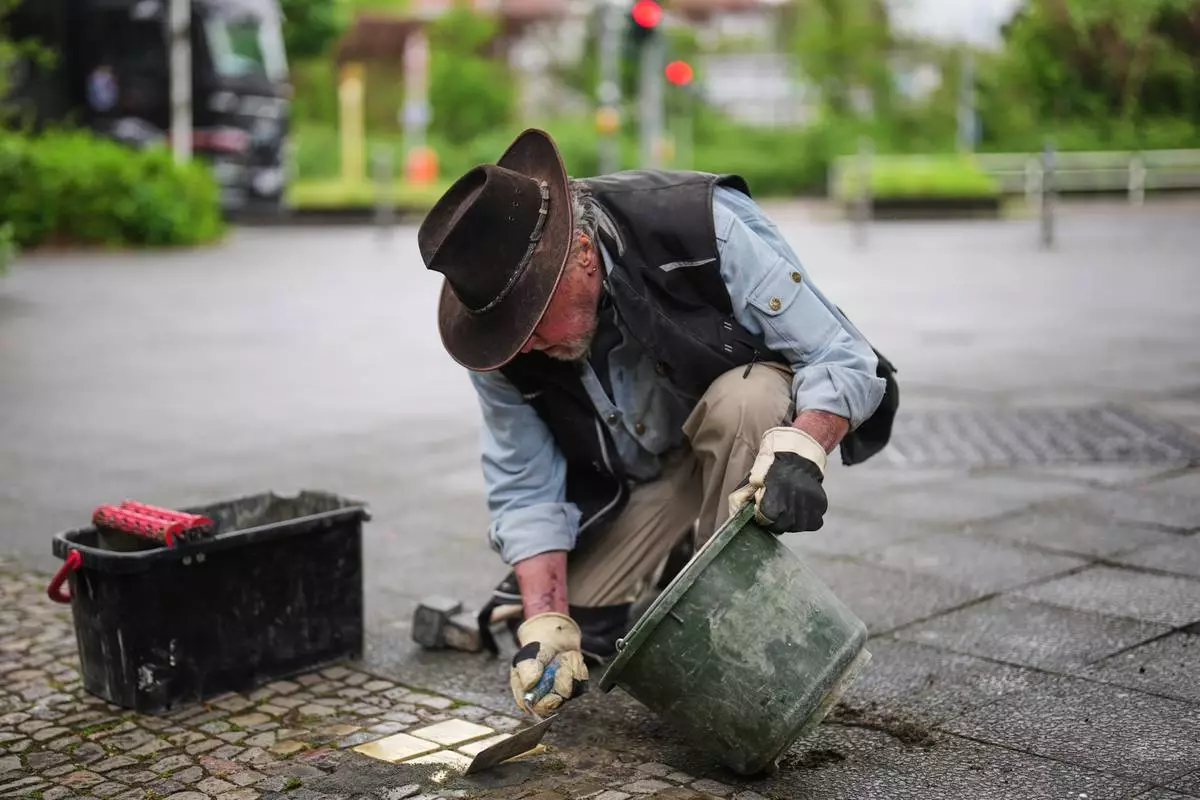
Demnig installed the first plaque in the German capital three decades ago. By now, one can find more than 11,000 of his memorial stones all over the city. But Demnig's decentralized Holocaust memorial goes much further than that — the artist and his teams of supporters have laid 126,000 stones in Germany and 31 other countries across Europe. The first stone was installed in 1992 in the western German city of Cologne.

In a unique way, the shiny brass squares that are embedded in the pavement make passersby stop and interrupt their daily lives for a moment as they bend down to read the names of those who perished. Small children can often be seen as they examine the Stolpersteine closely and demand answers from their parents.

“My basic idea behind this was that wherever in Europe the German Wehrmacht, the SS, the Gestapo, and their local collaborators committed murders or carried out deportations, symbolic stones should be placed there," the 78-year-old German artist said in an interview with The Associated Press on Wednesday.

Jewish family members oftentimes will travel from all over the world to attend the stonelaying ceremonies, because many of the victims were gassed in the Nazis' concentration camps and these memorial stones are the closest thing to a grave or a burial.

“The Stolpersteine are some kind of substitute for the missing gravestones,” Michael Tischler said after Wednesday's ceremony. The 72-year-old Berliner is a grandnephew of Berger who perished in the Holocaust like several other members of Tischler's family.

“I think this brings the family history to a certain conclusion, or at least a provisional one," Tischler said.

The memorial stones don't only bring solace to the families of the victims, but they have also created some kind of grassroots movement that brings together neighborhood initiatives, schools or religious communities to research the history of their city.

Together, old and young browse through archives and check timeworn resident lists to find out if any Jews or others who were persecuted during the Third Reich — such as communists, gays or Roma — used to live in the streets or even homes where they live today.

Once they can confirm a victim's former place of residence, they arrange for a stonelaying ceremony and make sure the brass plaque is polished periodically, so it won't lose its shine.

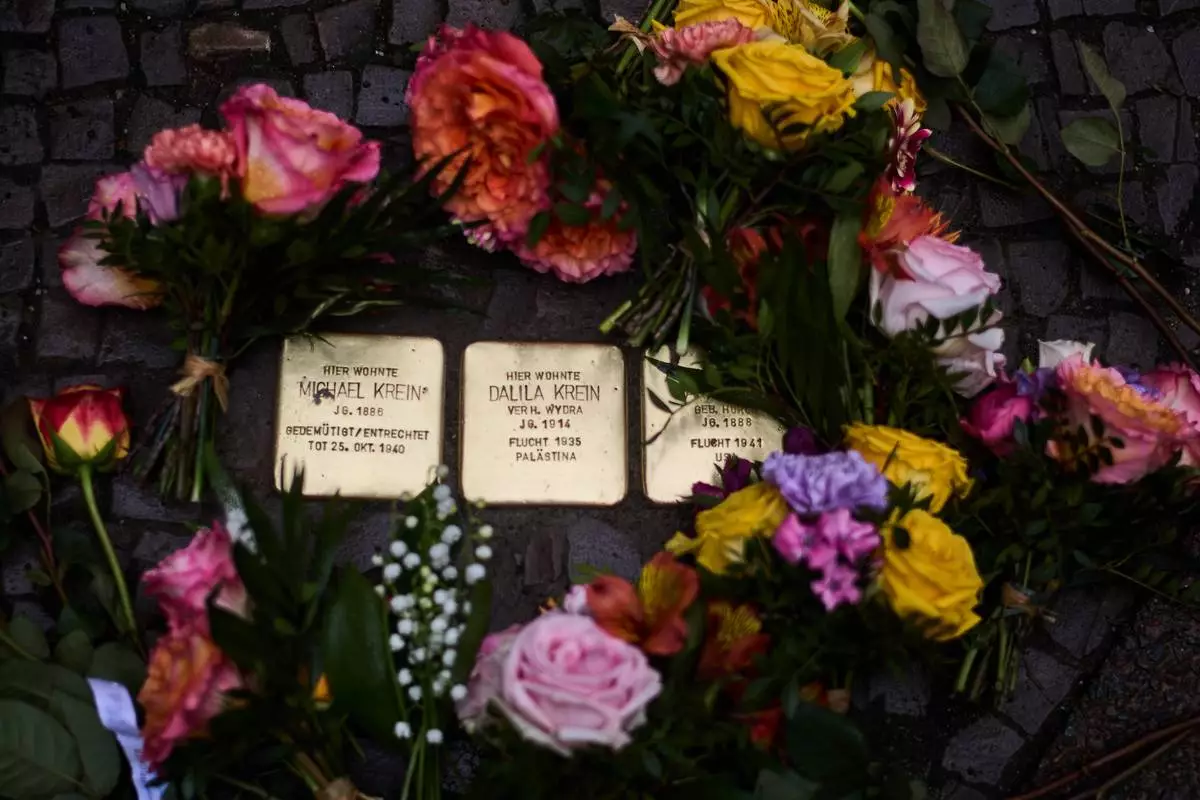
On Wednesday, several 10th graders from the Friedrich-Bergius-Schule attended another Berlin stonelaying ceremony on Stierstraße, where many Jews used to live. Demnig's three new stones for the Krein family — Michael, his wife Maria and their daughter Dalila — brought the number of Stolpersteine to 62 on this street.

While Maria and Dalila managed to escape to the U.S. and British-controlled Palestinian territory, respectively, Michael, a musician, died in Berlin in 1940 as a forced laborer under the Nazis.

High school student Sibilla Ehrlich, 16, watched as a group of violinists played solemn melodies and some elderly neighbors talked about the lives of the three Jews under Nazi dictatorship.

“It is just so horrible, all this the hatred of others," she said. “I keep thinking: what if this had been my family."

Before the Holocaust, Berlin had the biggest Jewish community in Germany. In 1933, the year the Nazis came to power, around 160,500 Jews lived in Berlin. By the time World War II ended and Nazi Germany surrendered on May 8, 1945, their numbers had diminished to about 7,000 through emigration and extermination.

All in all, around 6 million European Jews and others were killed in the Holocaust.

As Germany commemorates the Allied liberation from the Nazis 81 years ago on Friday, many people in Germany fear that the lessons of the Holocaust may be forgotten as the far right is quickly gaining influence in Germany again.

Tischler, too, worries about his country's future in times of rising antisemitism, but he says the memorial stones offer a glimpse of hope.

“I hope that these Stolpersteine will still give some people pause for thought,” he said.

Relatives pose for a photograph holding a palm-sized brass Holocaust plaque in German reading "Johanna Berger, born in 1893, lived here; deported on Nov. 17, 1941, murdered on Nov. 25, 1941 in Kowno/Kaunas Fort IX" by artist Gunter Demnig prior to the placing of the so called "Stolperstein" or "Stumbling Blocks" in front of her former home in Berlin, Germany, Wednesday, May 6, 2026. (AP Photo/Markus Schreiber)

Relatives pose for a photograph holding a palm-sized brass Holocaust plaque in German reading "Johanna Berger, born in 1893, lived here; deported on Nov. 17, 1941, murdered on Nov. 25, 1941 in Kowno/Kaunas Fort IX" by artist Gunter Demnig prior to the placing of the so called "Stolperstein" or "Stumbling Blocks" in front of her former home in Berlin, Germany, Wednesday, May 6, 2026. (AP Photo/Markus Schreiber)

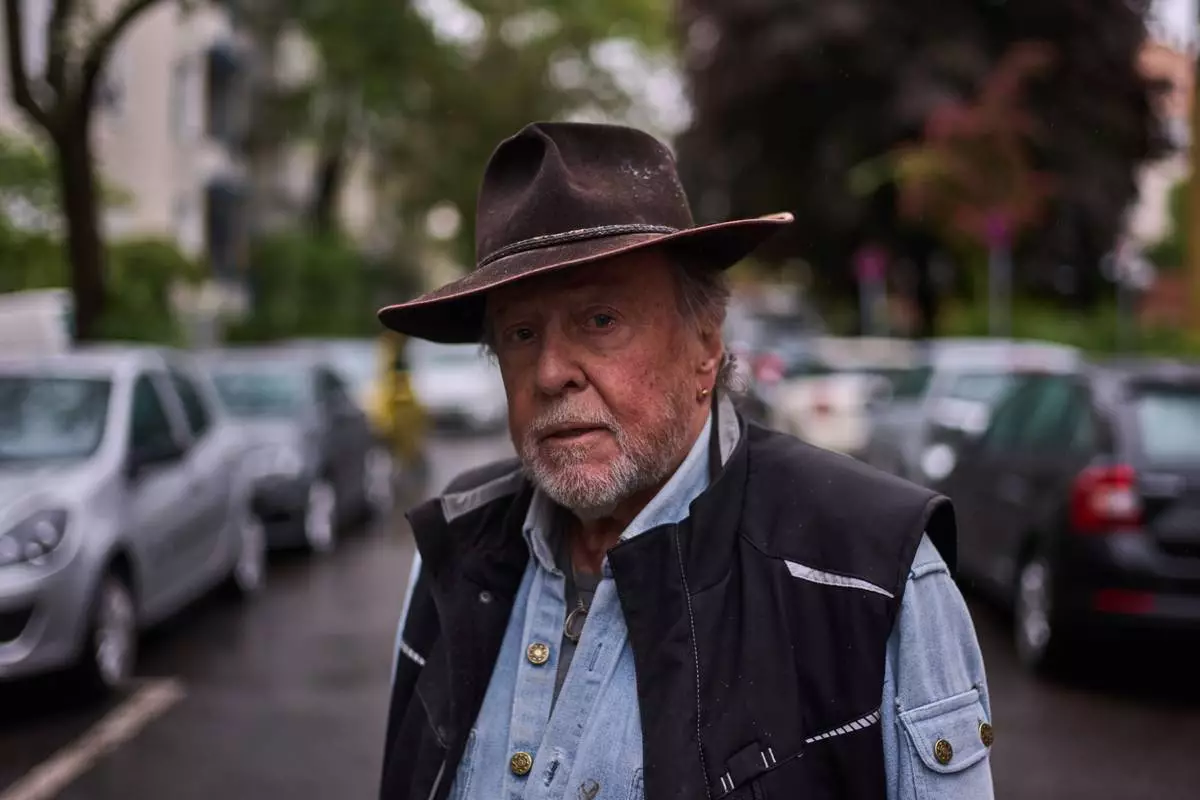
Artist Gunter Demnig poses for a portrait prior of a ceremony placing palm-sized brass Holocaust plaques called "Stolpersteine", or "Stumbling Blocks" with the names of victims of the Nazi regime in front of their former home, in Berlin, Germany, Wednesday, May 6, 2026. (AP Photo/Markus Schreiber)

Artist Gunter Demnig poses for a portrait prior of a ceremony placing palm-sized brass Holocaust plaques called "Stolpersteine", or "Stumbling Blocks" with the names of victims of the Nazi regime in front of their former home, in Berlin, Germany, Wednesday, May 6, 2026. (AP Photo/Markus Schreiber)

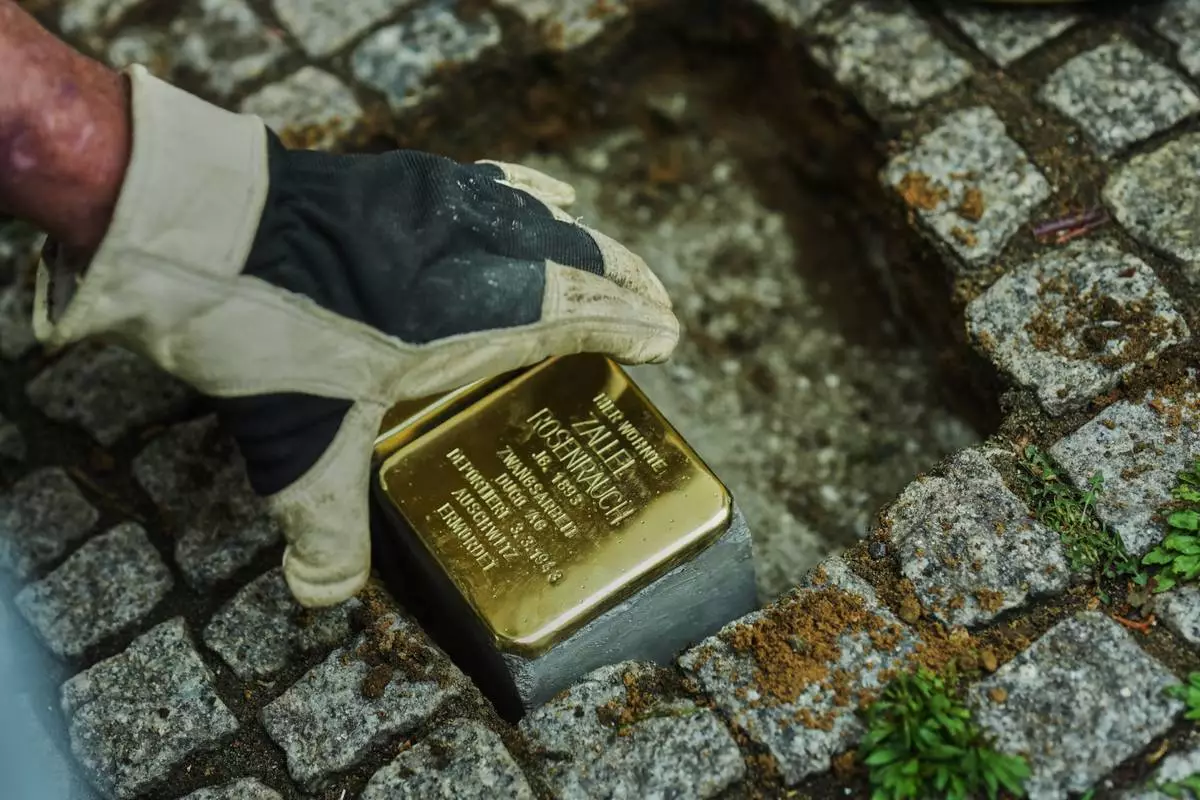
Artist Gunter Demnig places a palm-sized brass Holocaust plaque called "Stolpersteine", or "Stumbling Blocks" with the inscription " Zallel Rosenrauch, born in 1893, lived here; forced labourer at DUCO AG; deported on 3 March 1943; murdered in Auschwitz" front of her former home in Berlin, Germany, Wednesday, May 6, 2026. (AP Photo/Markus Schreiber)

Artist Gunter Demnig places a palm-sized brass Holocaust plaque called "Stolpersteine", or "Stumbling Blocks" with the inscription " Zallel Rosenrauch, born in 1893, lived here; forced labourer at DUCO AG; deported on 3 March 1943; murdered in Auschwitz" front of her former home in Berlin, Germany, Wednesday, May 6, 2026. (AP Photo/Markus Schreiber)

Artist Gunter Demnig places a palm-sized brass Holocaust plaques called "Stolpersteine", or "Stumbling Blocks" with the names of victims of the Nazi regime in front of their former home at a street in Berlin, Germany, Wednesday, May 6, 2026. (AP Photo/Markus Schreiber)

Artist Gunter Demnig places a palm-sized brass Holocaust plaques called "Stolpersteine", or "Stumbling Blocks" with the names of victims of the Nazi regime in front of their former home at a street in Berlin, Germany, Wednesday, May 6, 2026. (AP Photo/Markus Schreiber)

Flowers lay near palm-sized brass Holocaust plaques of the Krein family, after the so called "Stolpersteine", or "Stumbling Blocks" by artist Gunter Demnig, in Berlin, Germany, Wednesday, May 6, 2026. (AP Photo/Markus Schreiber)

Flowers lay near palm-sized brass Holocaust plaques of the Krein family, after the so called "Stolpersteine", or "Stumbling Blocks" by artist Gunter Demnig, in Berlin, Germany, Wednesday, May 6, 2026. (AP Photo/Markus Schreiber)

Relatives shows a photo a palm-sized brass Holocaust plaque reading "Johanna Berger, born in 1893, lived here; deported on Nov. 17, 1941, murdered on Nov. 25, 1941 in Kowno/Kaunas Fort IX" by artist Gunter Demnig prior to the placing of the so called "Stolperstein" or "Stumbling Blocks" in front of her former home in Berlin, Germany, Wednesday, May 6, 2026. (AP Photo/Markus Schreiber)

Relatives shows a photo a palm-sized brass Holocaust plaque reading "Johanna Berger, born in 1893, lived here; deported on Nov. 17, 1941, murdered on Nov. 25, 1941 in Kowno/Kaunas Fort IX" by artist Gunter Demnig prior to the placing of the so called "Stolperstein" or "Stumbling Blocks" in front of her former home in Berlin, Germany, Wednesday, May 6, 2026. (AP Photo/Markus Schreiber)

Recommended Articles