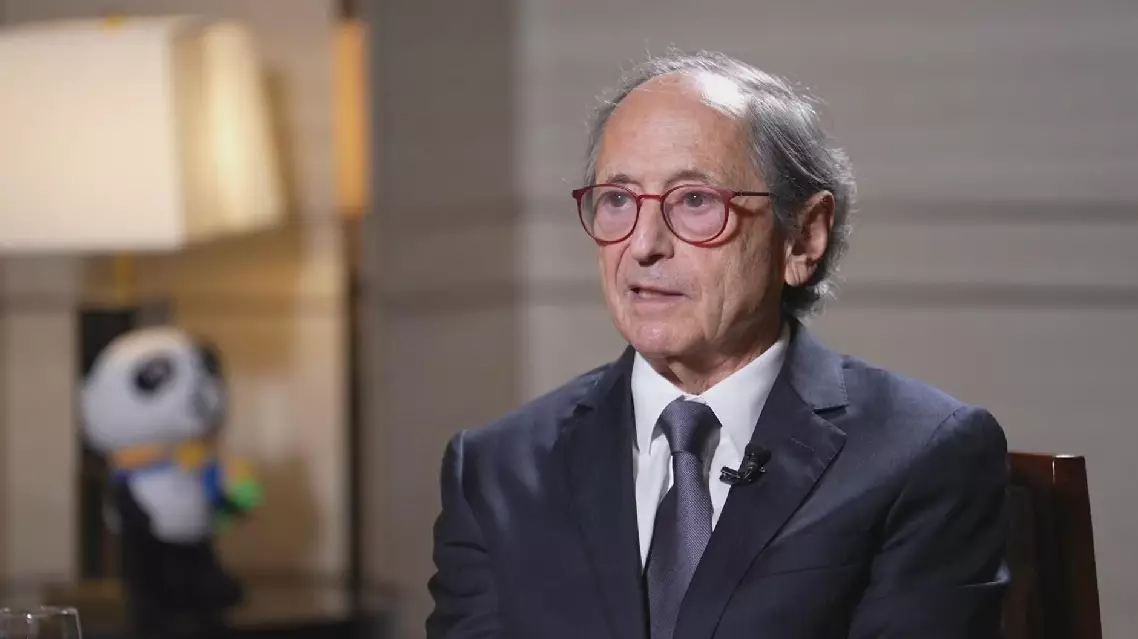
Artificial intelligence (AI) is erasing traditional academic boundaries and supporting scientific progress, Nobel chemistry laureate Michael Levitt said, highlighting AI's role in reshaping studies and research across disciplines.
Levitt, born in South Africa in 1947 and later emigrated to Britain, studied physics before turning to biology. He became one of the first scientists to apply computer technology to biochemistry, helping establish the conceptual and theoretical framework of computational biology. In 2013, he won the Nobel Prize in Chemistry together with two colleagues for developing multiscale models of complex chemical systems.
Speaking in an interview with China Media Group (CMG), which aired on Friday, Levitt said his own interdisciplinary thinking stemmed from wide-ranging interests and advanced artificial intelligence will blur the boundary of disciplines.
"I think my interdisciplinarity comes from being interested in things. I think in some ways the divisions between subjects is historical, and it's not a good idea. When you come to a new system like that, you have new insight. And it's fresh, it's diverse, but I really believe that one of the major effects of advanced AI will be to blur the disciplines. If my hobby was, let's just say, classical Chinese poetry, I'm sure I could learn in one day by talking to DeepSeek, that would be very powerful for me," said Levitt.
Drawing from his pioneering work in computational biology and decades of experience in science, he presented a framework of four distinct but interrelated forms of intelligence -- biological, cultural, artificial, and personal -- as a lens through which to understand life in the age of AI. He said that the diversity of intelligence forms provides fresh perspectives.
"It's nice to say ABC: artificial intelligence, biological intelligence, cultural intelligence, but I also added a new one, called PI, which is personal intelligence, and it's how smart we are about looking after our body. That's something personal. I wanted to highlight the importance of biological intelligence because there's so much we can learn. Biological intelligence made humans. Humans made AI, but it also faces feedback. AI can be very important in human health and in biological intelligence. So I think we have this, again, diversity. The idea was to try to combine different things to get a different viewpoint," Levitt said.
Levitt, who immerses himself in multiple AI systems every day, encouraged a wider use of artificial intelligence as today's progress is built on foundations laid by earlier generations.
"From the very first day that ChatGPT3.5 was announced, I have been using AI of many kinds, not just ChatGPT, Gemini, and Claude, and DeepSeek and Kimi. I use all of them a lot every day, maybe 100 times, I mean, really many hours each day. So I became very immersed," said Levitt.
I was very happy about the Nobel prizes. Those prizes were almost like a summary of 60 years of work by other people. Because basically machine learning needs to learn from something. And I told you about little strings of protein, so when I started my work, we knew the shape, we knew two knots. Now we know maybe 200,000 knots. And that information was fed into the computer by very clever algorithms to actually lead, so the computer could summarize it all and be very predictive. So I think it all fits together in a very nice way. They also used methods that have been pioneered by many people. In science you always want to stand on the shoulder of giants. I mean, otherwise there's no progress. In every field, you should learn and acknowledge and make higher," he said.
AI blurs academic boundaries, fostering more interdisciplinary approach to learning: Nobel laureate