Guangdong, Hong Kong and Macao in south China are joining forces to develop the Greater Bay Area (GBA) into an international center for sci-tech innovation, foster new quality productive forces, and better connect resources across the region to create a vibrant, world-class city cluster with global competitiveness.
Covering nine cities in Guangdong, as well as the Hong Kong and Macao special administrative regions, the Greater Bay Area is one of China’s most open and economically vibrant regions. Home to more than 87 million people, it generates about one-ninth of the country's economic output on less than 0.6 percent of its land area.
Science and technology innovation in the GBA has accelerated since the beginning of this year. Not long ago, a Hong Kong research team, leveraging the region's supercomputing power, successfully solved a difficult problem in the precise prediction of high-speed flow fields in aerospace, providing key support for breakthroughs in hypersonic technology.
This year, the three regions will fund the construction of the GBA Quantum Science Center and the international headquarters of the GBA National Center of Technology Innovation to establish a number of concept-validation and pilot-scale testing platforms.
"We will further deepen collaborative innovation between Guangdong, Hong Kong, and Macao. We will support pair-up cooperation between universities in Hong Kong and Macao and their branches in Guangdong with local enterprises, promote organized research and the application of search results, and strive to produce more landmark original outcomes," said Gong Guoping, Party secretary of the Department of Science and Technology of Guangdong Province.
Today's Greater Bay Area hosts 11 global lighthouse factories and 19 national-level outstanding smart factories, setting benchmarks for intelligent manufacturing. Eight national advanced manufacturing clusters and 28 national-level specialized and characteristic SME clusters form the backbone of a modern industrial system.
In Guangzhou, a new type of flying car has successfully completed its maiden real-world flight over the city's core area. It integrates multiple flight control systems and intelligent sensing obstacle-avoidance technologies, achieving industry-leading safety and stability.
This year, Guangdong will focus on industries such as intelligent connected vehicles, smart robotics, and the low-altitude economy. It will simultaneously promote innovation, infrastructure construction, technology research and development, and product iteration. Together with Hong Kong and Macao, it will explore cross-border low-altitude cooperation and accelerate the high-quality development of emerging pillar industries.
Infrastructure development is also gaining pace across the GBA to enhance hard connectivity.
Construction officially began on Guangzhou's new airport, which is designed to handle 30 million passenger trips annually. The eastern and western main towers of the Shiziyang Grand Bridge were topped out in March, marking notable progress on the Shiziyang Link, a key control project currently under construction. In the Pearl River Estuary, five cross-river and cross-sea highway bridges have been completed. The region's railway network now stretches over 3,000 kilometers, enabling one-hour travel among major cities.
The GBA is also advancing soft connectivity of rules and mechanisms. Currently, 430,000 Hong Kong and Macao residents participate in social insurance in Guangdong. Cross-border handling is available for 198 frequently used government services.
"The Greater Bay Area connects so many cities together. For any idea and any industry, we can find a stage and opportunity in every city here," said Terence Chan, a Hong Kong entrepreneur in the Greater Bay Area.
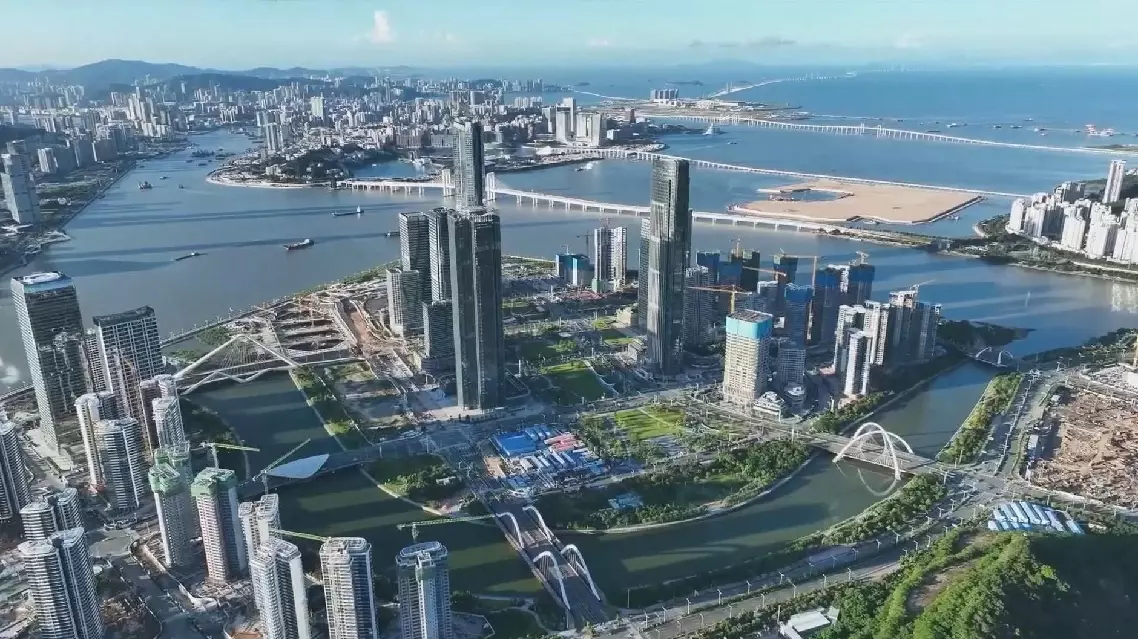
Guangdong-Hong Kong-Macao Greater Bay Area gathers pace in building world-class city cluster