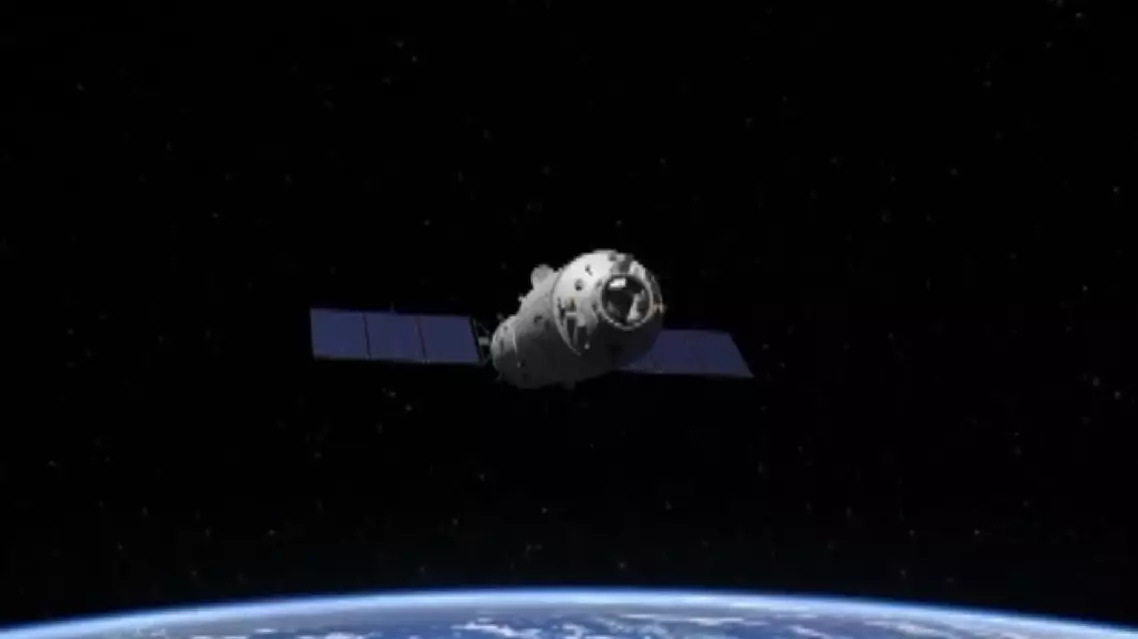
China's Tianzhou-10 cargo space craft is set to deliver over 220 items of supplies weighing nearly 6.3 tons to the space station to support the Shenzhou-23 and Shenzhou-24 astronauts' on-orbit life and work.
The cargo spacecraft is 10.6 meters long and adopts a two-module configuration, consisting of a cargo module and a propulsion module. It is specifically designed to deliver supplies to the space station, with a launch weight of approximately 14 tons, making it the most capable space cargo ship currently in service.
"Supplies include several categories. The first category consists of essential living supplies for the astronauts, such as food and water. Another category includes instruments, equipment, accessories and spare parts needed for the daily operation and maintenance of the space station. In addition, we have also replenished nearly 700 kilograms of propellants for the space station this time," said Yu Lei, chief designer of China Aerospace Science and Technology Corporation.
The cargo spacecraft is also scheduled to deliver a new set of extravehicular spacesuit. Together with the two sets previously sent up by Tianzhou-9, there are now three new extravehicular spacesuits in total in the space station, which will fully replace and upgrade the original spacesuits.
In addition, the cargo spacecraft will also carry a new space treadmill to meet the astronauts' exercise needs in orbit. "The main structure of the space treadmill and orbital replacement units (ORUs) will be launched. Based on in-orbit validation and application results, over 10 technical optimizations and improvements have been made to the space treadmill, enhancing the running experience and exercise intensity. This mission will also deliver fresh fruits and vegetables such as apples, cherry tomatoes, green grapes, and flat peaches, as well as frozen steak and frozen chicken wings, improving the diversity of the food menu and the dining experience," said Zheng Zehao, a researcher from the China Astronaut Research and Training Center.
Meanwhile, for biological samples that require low-temperature refrigerated storage, the cargo spacecraft will also carry a space freezer. Yu also said that the number of payload devices carried by Tianzhou-10 this time is also the largest since the construction of the space station began.
"Tianzhou-10 cargo spacecraft will carry a large number of payload devices this time, making it the mission with the most payload equipment since the space station construction mission began. After entering orbit, we will carry out in-orbit validation of some new technologies and new products," Yu said. In addition, Tianzhou-10 will also help the space station to carry out the orbit control and attitude adjustment during the mission.
"Since the space station's engines cannot be replaced or repaired and have limited operating life, whenever possible, the cargo spacecraft's engines are used for attitude adjustment and orbit control," said Wang Xi, an expert from China Aerospace Science and Technology Corporation.
The combination of the Tianzhou-10 cargo craft and a Long March-7 carrier rocket was vertically transferred to the launch site on Friday, according to the China Manned Space Agency (CMSA).
The cargo spacecraft will be launched at a proper time in the near future, the CMSA said.
Currently, the facilities and equipment at the Wenchang Spacecraft Launch Site in the southern island province of Hainan are in good condition, and comprehensive functionality checks and joint tests are scheduled to proceed as planned ahead of the launch, the CMSA added.
The Tianzhou-9 separated from the orbiting Tiangong space station combination on Wednesday and re-entered the atmosphere under controlled conditions on Thursday. The space station has thus cleared a docking port to make room for the Tianzhou-10, the CMSA noted.
China's Tianzhou-10 cargo spacecraft to deliver 6.3 tons of supplies to space station