At the invitation of Djiboutian President Ismail Omar Guelleh, Chinese President Xi Jinping's special envoy Losang Jamcan on Saturday attended Guelleh's inauguration in Djibouti City, the capital of Djibouti.
Guelleh met with Losang Jamcan, also vice chairman of the Standing Committee of the National People's Congress, at the People's Palace on the same day. Losang Jamcan conveyed Xi's warm congratulations and best wishes to Guelleh, noting that under the strategic guidance of both leaders, the China-Djibouti comprehensive strategic partnership has continued to deepen in recent years.
China is willing to work with Djibouti to implement the consensus reached by the two heads of state, carry forward traditional friendship, expand practical cooperation, and promote the further development of China-Djibouti relations, Losang Jamcan said.
For his part, Guelleh asked Losang Jamcan to convey his sincere greetings to Xi, and thanked Xi for sending a special envoy to his inauguration ceremony.
China has always been a trustworthy partner of Djibouti, Guelleh said, adding that Djibouti is willing to further strengthen solidarity and cooperation with China, enhance friendly exchanges in various fields, maintain close coordination in international affairs, and promote the bilateral relations to a new level.
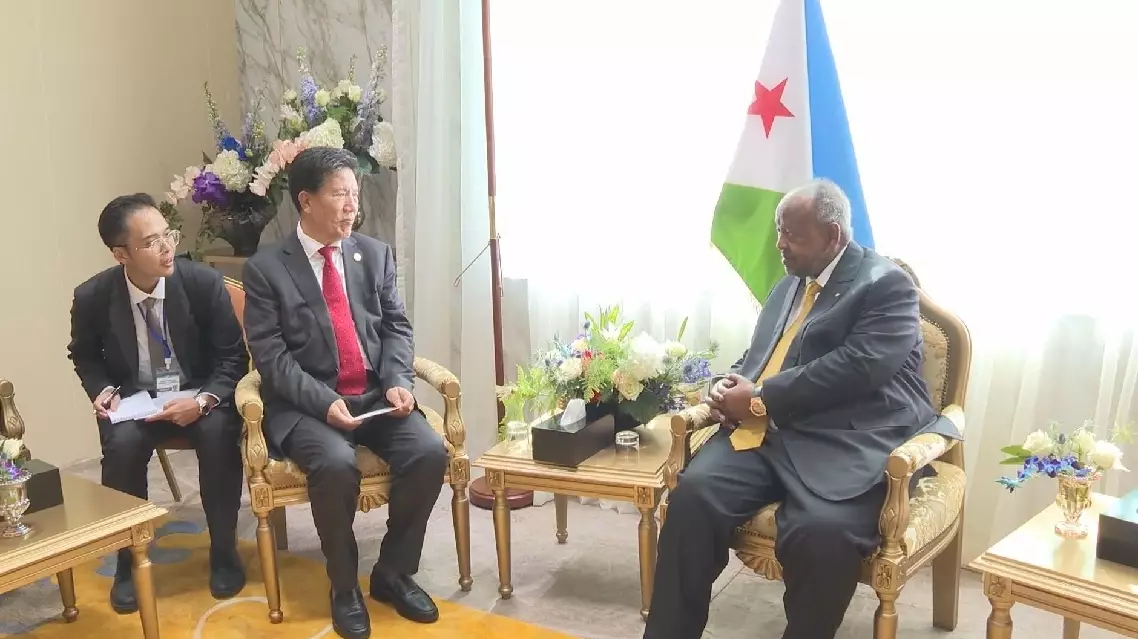
Xi's special envoy attends Djiboutian president's inauguration
Japanese Prime Minister Sanae Takaichi's political stunts both at home and abroad cannot whitewash Japan's World War II (WWII) aggression, but instead expose the schemes of the country's far-right forces to incite bloc confrontation and promote remilitarization, says a China Media Group commentary published on Sunday.
An edited English version of the commentary is as follows:
In recent days, Takaichi has faced fierce criticism both domestically and internationally.
Her political stunt of kneeling in front of the Tomb of the Unknown Australian Soldier to lay flowers at the Australian War Memorial in Canberra during her visit to Australia further exposed her multiple political calculations to the international community.
Choosing to kneel in front of a tomb in Australia, Takaichi was not regretting for Japan's aggression and atrocities during World War II.
This act not only reveals the distorted world outlook of Japanese politicians, but also exposes their attempts to mislead public opinion, whitewash the crimes of WWII aggression, instigate bloc confrontation, and push for military buildup.
From "fawning diplomacy" during her U.S. visit in March to the recent kneeling show during her visit to Australia in May, Takaichi has been trying to cultivate a friendly image towards the West.
Geopolitically speaking, Japan's far-right forces are trying to expand their military and breach from the restraints of the pacifist constitution by exaggerating external threats. To this end, they are making every effort to exploit geopolitical conflicts and draw neighboring countries, especially Western countries, into bloc confrontation.
Since the end of WWII, Japanese leaders have never apologized to the people of victim countries such as China, the Republic of Korea, and the Democratic People's Republic of Korea. Many Japanese politicians have even tried every means to justify the war crimes.
In particular, Takaichi has questioned the 1995 Murayama Statement, denied the Nanjing Massacre, visited the notorious Yasukuni Shrine annually for many consecutive years, and revived military rank titles during WWII, such as "taisa."
On the issue of Japan's history of aggression, Takaichi's insidious move cannot deceive the world.
Takaichi's political stunts both at home and abroad are a provocation against WWII victim countries in Asia and other regions.
This cannot conceal Japan's remilitarization attempt or the reality that " neo-militarism" is spreading and becoming a threat.
All countries that have suffered from Japanese militarist aggression should remain highly vigilant and united, and work together to safeguard the outcomes of WWII victory, so that historical tragedies never repeat themselves.

Takaichi's political stunts cannot whitewash Japan's history of aggression, remilitarization attempt: commentary