Northwest China's Xinjiang Uygur Autonomous Region has launched large-scale planting of arundo, a hardy perennial grass, as part of its efforts to strengthen an ecological barrier along the edge of the Taklimakan Desert and improve sandy and saline-alkali land.
Arundo is a tall perennial herb known for its strong resistance to drought, cold, poor soil and salinity, making it an ideal crop for desert and saline-alkali land restoration.
In Alar City, located on the northern rim of the Taklimakan Desert, multiple large machines operated simultaneously to transplant arundo seedlings into sandy soil.
Each machine requires only one or two workers to assist with soil covering, ensuring efficient and orderly operations. This also marks the first time mechanized arundo planting has been realized in the area.
A single transplanting machine can plant an average of about 3.33 hectares per day, transplanting around 25,000 seedlings. The efficiency is 25 to 30 times higher than manual labor, while the plant spacing error can be controlled within 5 centimeters, significantly improving planting standards and efficiency.
"We plant with a row spacing of 1.4 meters and a plant spacing of 1 meter this year. This can meet two needs. One is that arundo will tiller in the later stage, so its growing space must be guaranteed. The second is to facilitate our later mechanized operations. In the later stage, soil covering by tractor and harvesting will all be very convenient," said Yang Shangkun, head of production and operation from an ecological management company in Xinjiang.
In Tumxuk City, on the northwestern edge of the Taklimakan Desert, reclaimed treated water is being used to irrigate newly planted arundo, supported by an intelligent drip irrigation control system that precisely allocates water usage to improve efficiency.
"We all use intelligent and water-saving irrigation. For sandy land, we drip more, and for loamy soil and clayey soil areas, we drip less, to achieve proper allocation," said Ma Guoqing, head of arundo planting base in Tumxuk City.
Arundo can both be used for medicinal purposes and also serves as an industrial raw material and animal feed, offering considerable economic value.
Cities of Alar and Tumxuk successfully carried out trial planting of arundo in 2024, and have launched full-scale promotion this year.
In addition, the region plans to complete the planting of nearly 1,900 hectares of arundo and more than 12.7 million seedlings along the edge of the Taklimakan Desert by the end of May, according to local authorities.
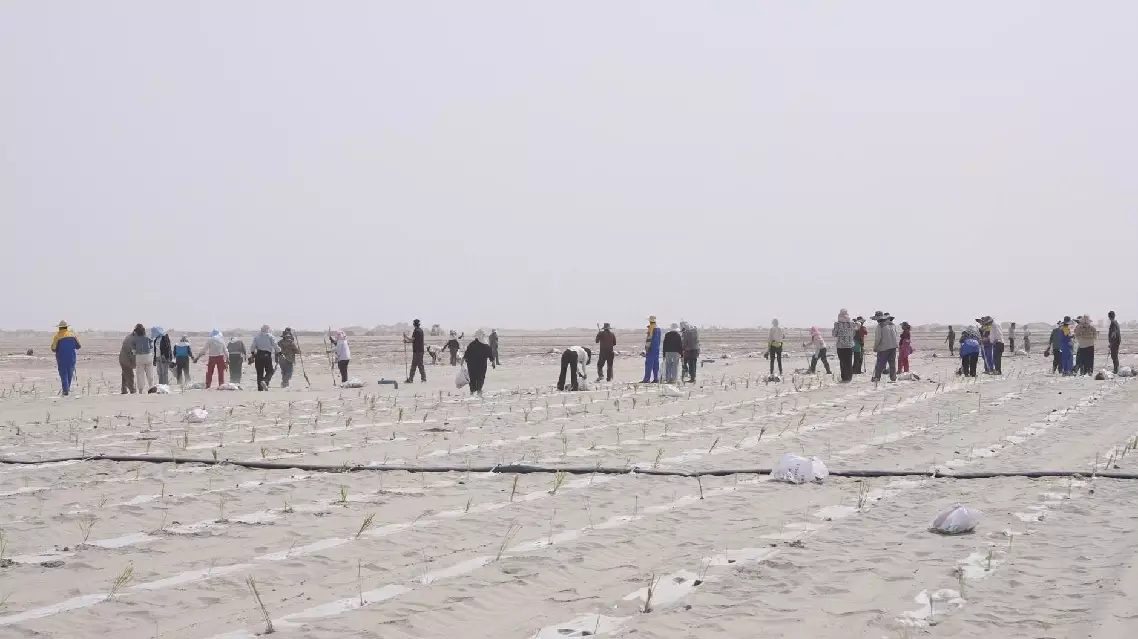
Xinjiang promotes large-scale arundo planting to curb desertification