Recess isn’t just a fun break for grade schoolers. It’s crucial to good health and good grades for kids of all ages.
That's the message from a leading pediatricians group, which just released the first new guidance in 13 years about this unstructured time at school and how it needs to be protected.
The updated policy statement by the American Academy of Pediatrics comes after years of shrinking recesses and worsening children’s health.
The group "has always supported play – free play for kids – but it’s been increasingly threatened over time,” partly by the drive for higher test scores, said Dr. Robert Murray, a lead author. “It has a very powerful benefit if it’s used to the fullest.”
The new guidance, published Monday in the journal Pediatrics, is similar to the previous policy statement but cites the latest research on why these breaks are essential for kids’ academic success and mental, physical, social and emotional growth.
For example, new evidence shows that kids need pauses between concentrated bouts of learning so the brain can hold and store the information. Researchers also say recess gives kids a chance to navigate relationships and build confidence, which is just as important for older kids as younger ones.
Murray and his colleagues also stressed the importance of physical activity in preventing obesity, a condition that now affects about 1 in 5 U.S. children and teens.
Given these benefits, they recommend that recess be protected and never withheld for academic or punitive reasons, as sometimes happens in schools.
“If the child is disruptive or rude and disrespectful, recess is one of the things that teachers use to punish kids,” Murray said, adding that students struggling with behavioral issues or grades are often the ones who need recess most.
But those students aren’t the only ones losing out. Recess has been waning for all kids. Since the mid-2000s, up to 40% of school districts nationally have reduced or eliminated recess, according to data from the group Springboard to Active Schools in collaboration with the U.S. Centers for Disease Control and Prevention.
Today, the duration of recess varies widely across U.S. schools, ranging from less than 10 minutes to more than an hour a day, the pediatrics group said. Older kids generally get less time than younger ones.
Ideally, studies show, kids should get a minimum of 20 minutes a day and multiple breaks. In other countries such as Denmark, Japan and the United Kingdom, students get breaks after every 45 minutes to 50 minutes of classroom instruction.
“They should get a long enough period of time where they can de-stress and blow off steam and prepare for the next class,” Murray said.
Dr. Lauren Fiechtner, a childhood obesity expert at Mass General Brigham for Children in Boston, said she’s glad about the updated recess recommendations. She’s seen the importance of recess as both a doctor and mother of two. She recalled how her 8-year-old son learned how to play basketball at recess and now loves the game.
Fiechtner, who wasn’t involved in creating the guidance, agrees with the recommendation that middle and high school students need recess, too.
“As kids get older, they’re more on their screens. So it’s really helpful, I think, for outdoor activity and recess to be happening,” she said. “Recess is great. We all kind of need recess.”
The Associated Press Health and Science Department receives support from the Howard Hughes Medical Institute’s Department of Science Education and the Robert Wood Johnson Foundation. The AP is solely responsible for all content.
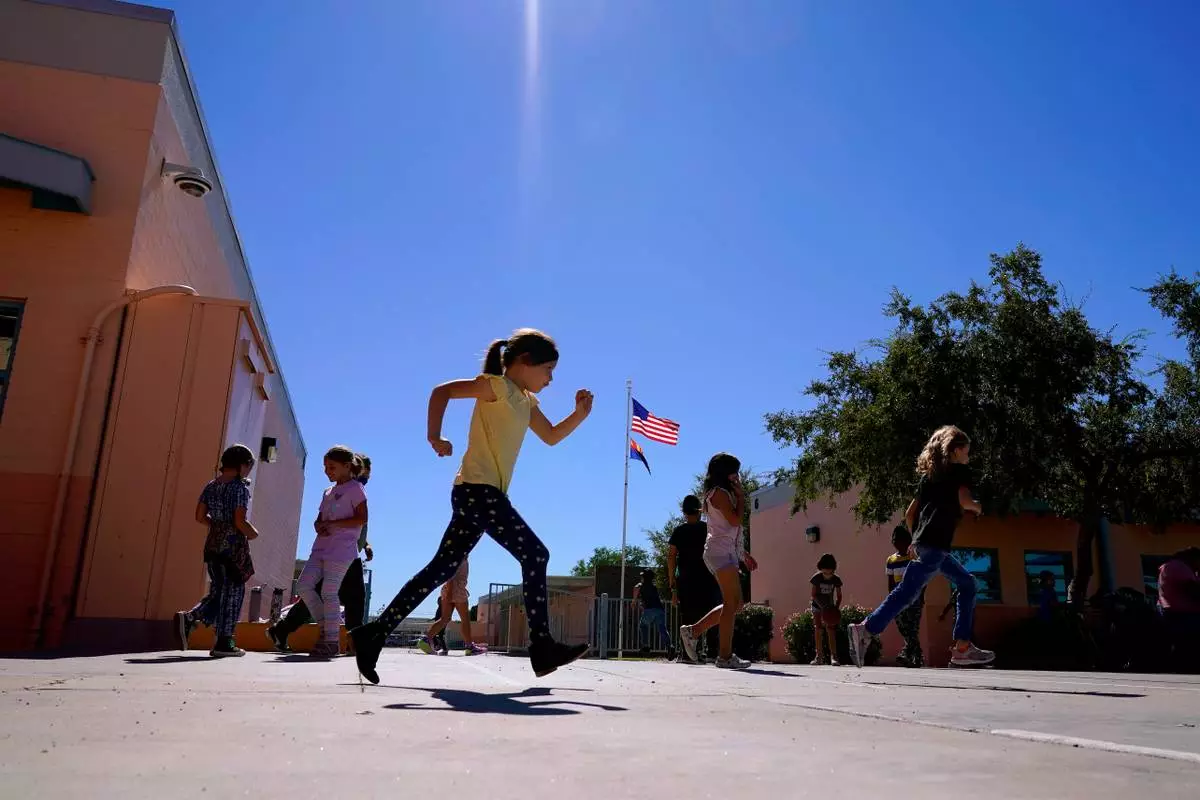
FILE - Whittier Elementary School students enjoy recess, Tuesday, Oct. 18, 2022 in Mesa, Ariz. (AP Photo/Matt York,File)

FILE- Students play ball during recess at the St. Agnes Elementary School in Phoenix, Ariz., on March 3, 2020. (AP Photo/Dario Lopez-MIlls, File)
For years, younger Americans have been more optimistic about the job market than older Americans, even through the depths of the Great Recession. But in an abrupt shift, a new poll released Monday finds young people's confidence has plummeted over the past two years — while their elders remain more upbeat.
The gap between young and older Americans' views of the job market now is greater than in any other country among the 141 surveyed, according to the Gallup World Poll. In the United States, 43% of those aged 15-34 believe it’s “a good time” to find a job in the area where they live, well below the 64% of those aged 55 and over who say the same.
Around the world, it's the opposite. Globally, the median share of younger people who say it’s “a good time” to find work in their local job market is 48%, compared with 38% among older people.
The findings reveal a generational rift in Americans' views of economic opportunity, with young people feeling increasingly downtrodden about job prospects, while older people still largely think it's a good time to find work. The schism is likely to continue fueling generational divides in politics, where younger voters have focused on economic issues such as housing costs and have registered less faith in institutions.
“It’s an incredibly new phenomenon,” Benedict Vigers of Gallup said of young Americans' pessimism. He added that last year was the first time in Gallup’s decades of polling that young Americans were more pessimistic about the job market than their peers in other developed countries. “Has this happened in most other advanced economies? The answer is a resounding no.”
Young people, with fewer physical limitations and family responsibilities — along with an ability to adapt more quickly than older counterparts — normally are more optimistic about their ability to land work.
But the new Gallup analysis finds the U.S. is one of only five countries where younger people are at least 10 points more pessimistic about the availability of work than older ones, joining China, Hong Kong, Norway, Serbia and the United Arab Emirates.
Among the 141 countries surveyed, younger Americans ranked 87th in job market expectations. Even that is striking, Vigers said, because young Americans have long stood out globally for their optimism about job opportunities. Other countries, such as New Zealand and Canada, had lower levels of optimism among the youngest group, but there was no significant generational divide.
The divergence between younger and older Americans happened suddenly. Every U.S. age group registered a drop in confidence in the job market after 2023 — following a post-COVID rebound in 2021 and 2022 — but those 34 and younger saw the largest decline in recent years. The share of younger Americans saying it was “a good time” to find a job plunged by 27 percentage points from 2023 to 2025. That's comparable to the rate of decline for young people during the 2008 global financial crisis, which also saw a drastic drop in confidence for older Americans. But that hasn't happened in the last few years. In fact, older Americans’ views have barely dropped.
Older Americans also have a sunnier view of the economic landscape more generally, according to recent AP-NORC polling. About 8 in 10 adults under 35 describe the U.S. economy as very or somewhat poor, according to an AP-NORC poll conducted in April. Only about 6 in 10 adults 55 and older say the same, although a majority still see the U.S. economy negatively.
John Della Volpe, a pollster who regularly surveys U.S. youth for the Harvard Kennedy School's Institute of Politics, said young people are frequently frustrated at how prior generations don't understand their current economic challenges.
“It's just another thing that drains their mental health — 'my parents don't understand that their pathway at this stage in life that I'm in was so much easier,'” Della Volpe said.
Younger Americans’ job market views now register close to the level they did in 2010, when the country was still deep in the Great Recession. This is not the first Gallup poll to find striking levels of pessimism among young Americans — they also register notably high levels of anxiety about pocketbook issues compared with people their age in other countries.
A separate Gallup survey on perceived U.S. job prospects found pessimism emerging at the end of 2024 and continuing into 2025. That coincides with the beginning of President Donald Trump’s second term and the rise of artificial intelligence, which many fear will transform the labor market and eliminate many entry-level jobs.
The new poll finds the most frustrated groups of young people are those who haven’t secured a first job yet, college graduates and young women. But the heightened pessimism spreads across all subgroups of younger Americans, including men and those who haven't attended college.
“Whoever they are, they are more pessimistic than they were three years ago,” Vigers said of young Americans.
The older Americans who have a less dire view of the job market are themselves more likely to be retired and not looking for work. They’re also more likely to own their own homes, a longtime building block of American prosperity that has increasingly seemed out of reach to younger people.
Day-to-day financial concerns were a key issue in the 2024 election, particularly for younger voters, and Trump improved on his previous performance among this group as he ran on a platform of economic prosperity, fighting inflation and affordability. But like other groups that were important parts of Trump's 2024 coalition, some younger Americans have soured on the president as inflation continues, recent AP-NORC polling finds.
About 8 in 10 adults under 35 disapprove of how Trump is handling the economy and the cost of living, the recent AP-NORC poll found, compared with about 6 in 10 older adults.
The Gallup World Poll results are based on telephone interviews conducted among approximately 1,000 U.S. adults from June 14 to July 16, 2025. The margin of error is ±4.4 percentage points for the U.S. sample.
Associated Press writer Linley Sanders in Washington contributed to this report.

FILE - Commuters walk through a corridor in the World Trade Center Transportation Hub in New York on June 21, 2019. (AP Photo/Mark Lennihan, File)