Economic and tech experts in Syria have stressed the importance of cooperation between China and the Untied States, saying that an improved trade relationship between the world's two largest economies is an important avenue for global development, particularly in trade, technology, and advanced industries.
Ties between the two countries are in the spotlight this week with U.S. President Donald Trump set to pay a visit to China from May 13 to 15 at the invitation of Chinese President Xi Jinping.
Underscoring the wider significance of the relationship, economic affairs expert Rania Mahjazi believes that a trade reconciliation between the two sides is crucial in boosting trade and bringing wider benefits.
"The China-U.S. trade relationship is one of the most important economic issues of the 21st century. It operates within a framework that seeks a balance between shared interests and potential threats, presenting a model that lies somewhere between conflict and competition. A trade reconciliation between China and the U.S. would lead to a reduction in tariffs that drive up prices. Lower tariffs, in turn, would bring lower prices, greater trade volumes, and a freer international trading environment. Such reconciliation directly benefits both countries by alleviating existing trade deficits, lowering tariffs, promoting China-U.S. partnerships, and increasing investment and capital flows," she said.
Maryam Fayyad, a tech expert who is also a board member of the Syrian Computer Society, pointed out that China-U.S. cooperation in fields such as artificial intelligence, the semiconductor industry, and clean energy combines the respective strengths of both sides and can serve as a key driver for solving global challenges.
"China-U.S. cooperation is not merely an option but a crucial driver of global innovation. It is well known that China has strong manufacturing capabilities and advanced digital infrastructure, while the U.S. has a long history of scientific research and fundamental innovation. When these strengths are combined, they can provide solutions to major global challenges, such as those in artificial intelligence, semiconductors, clean energy, and biotechnology. Such partnerships help enhance health security, address climate change, and improve production efficiency. The deeper the cooperation between China and the U.S., the greater the prosperity it will bring to the entire world," she said.

China, US should combine strengths to deliver solutions for global development: Syrian experts
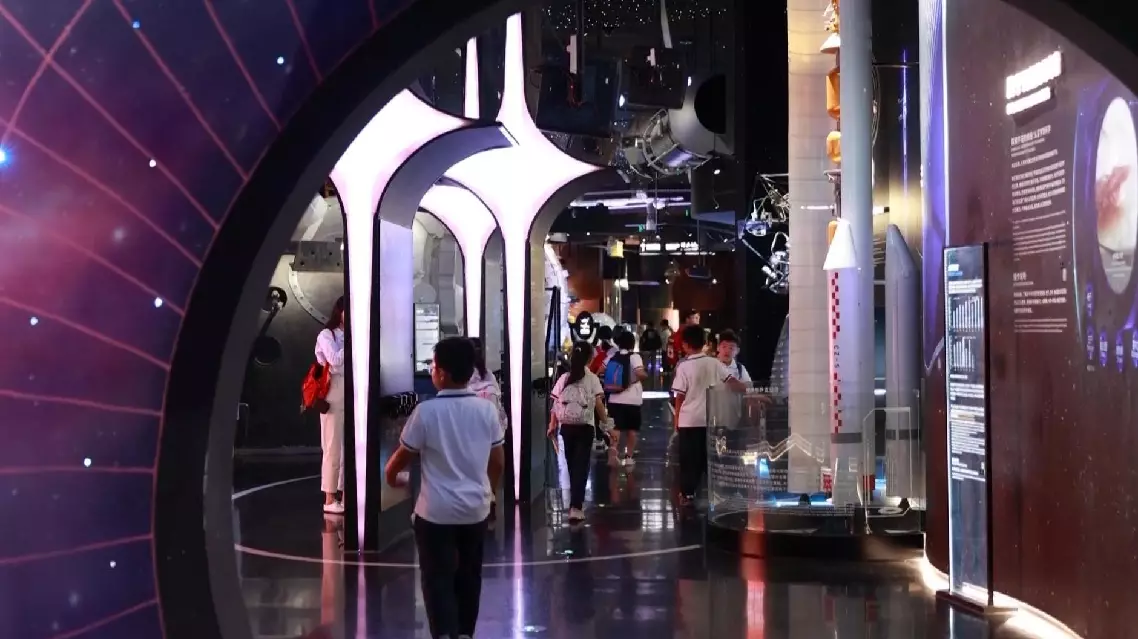
The Shenzhen Science and Technology Museum in south China's Guangdong Province has received over four million visitors since opening on May 1 last year.
In addition to gaining astounding popularity, the museum has been selected as one of the "World's Most Beautiful Museums" by UNESCO.
One morning during the first anniversary period of its opening, the museum was already packed with student groups and family visitors as early as 10:00.
To the delight of the hundreds of children attending on that day, the museum is filled with highly interactive exhibits that are as fun as they are educational. In the AI ping-pong robot zone, visitors play matches against a robot, which adjusts its difficulty level in real time according to human opponent's skill, precisely matching ball speed and strength.
"I tried seven or eight exhibits. My favorite is the ping-pong. The experience showed me how powerful science can be, and the ping-pong robot made me realize that machines can be so amazing," said Mo Jiquan, a young student from Guangdong's Zhongshan City.
In the "Smart Industry" hall, a group of students from Singapore learned to race model cars controlled by brainwaves.
By pressing foreheads against an electroencephalogram (EEG) signal collection device and concentrating, the students used the power of their minds to propel the cars forward.
"Science fiction has become reality. These things are different from what we learn at school. For example, these brainwave-control devices, we have never seen anything like them. So I think it's a new and very meaningful experience," said Chen Mengfanglin, a student from Singapore.
Among the museum's 950 innovative exhibits, such as brain-computer interfaces, simulated space capsules, dexterous hands, 80 percent offer deep interactive experiences.
More importantly, these exhibits are dynamically updated as industrial technologies evolve.
"I think this place is very futuristic and fun. This is my second time here. I feel that there are more exhibits, and the technology has advanced," said Wu Zining, a Shenzhen student.
According to the museum, visitor numbers remain steady on weekdays, surge significantly during holidays, and overseas visitors have seen a notable increase since the beginning of this year.
"Our museum receives between 2,000 and 5,000 visitors on weekdays. On holidays, we get around 30,000 visitors per day. Since the beginning of this year, the number of overseas visitors has also risen significantly," Zhang Haitian, director of the Exchange and Cooperation Center of the museum.
Unlike traditional science museums that simply display items alongside written explanations, the Shenzhen Science and Technology Museum has pioneered an approach that combines innovation, public outreach, and education into one seamless experience.
Over the past year, it has collected 39 technology transfer projects, held 10 "deep science and technology" project matchmaking events, and brought research institutes, leading enterprises, investors, and the public together, creating a new ecosystem linking government, enterprises, research institutes, and the museum.
"On the basis of the original basic functions of a science and technology museum, we have taken a bolder step forward. We have extensive links with sci-tech innovation companies, so a steady stream of new technologies, achievements, products and ideas flow into the museum. We also have close interactions with science fiction and cultural heritage sectors, integrating science and technology with culture and art. Through flexible cooperation with various industries, this approach has opened up unlimited possibilities for the entire science and technology museum," said Zheng Yongchun, head of the museum.
Interactive sci-tech museum in south China hosts 4 million visitors in first year