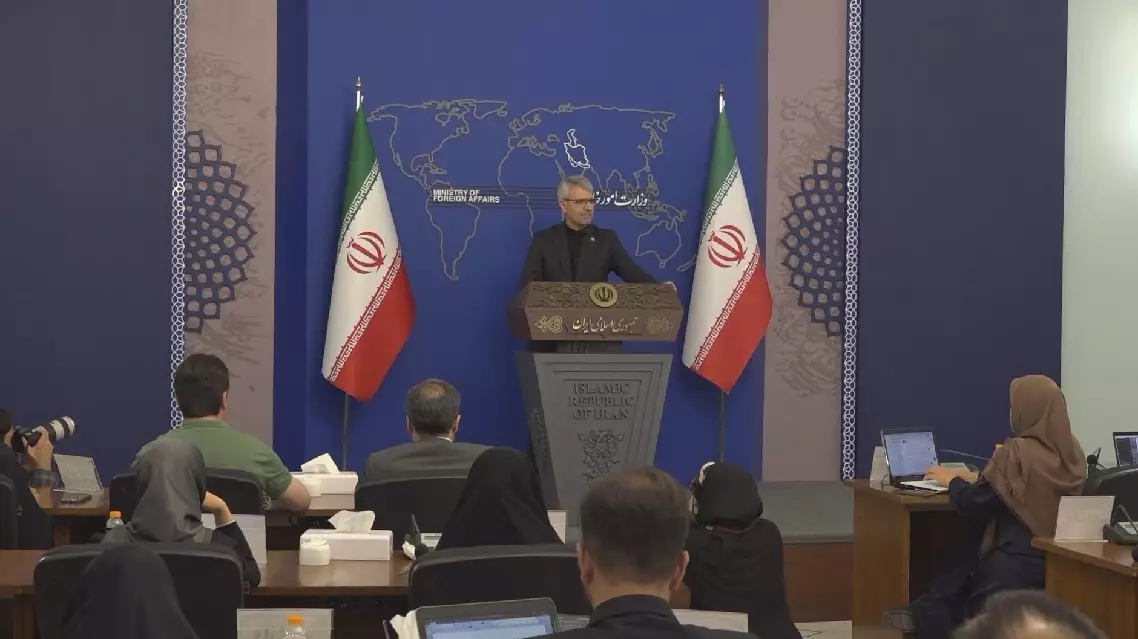
Iranian Foreign Ministry spokesman Esmaeil Baghaei said Monday that Tehran had sought only its "legitimate rights" in a new peace proposal delivered to the United States through Pakistan, which has been mediating between the two sides.
Speaking at a weekly news conference in Tehran, Baghaei said Iran's demands included ending the war in West Asia, lifting the U.S. naval blockade on Iranian shipping, releasing Iranian assets frozen abroad, ensuring safe passage through the Strait of Hormuz and restoring regional stability.
Iran has not demanded any concession, he said, adding that the only things it demanded are the Iranian nation's legitimate rights.
Baghaei described Tehran's proposal as "reasonable and responsible," saying it was aimed at protecting Iran's interests as well as regional and global security.
He also noted that nuclear issues would be discussed later as Tehran was currently focused on ending the conflict.
U.S. President Donald Trump branded Iran's terms for ending the war "totally unacceptable." Baghaei accused Washington of pursuing "unreasonable demands" influenced by Israel.
Commenting on reports that European countries, including France and Britain, had deployed warships to safeguard shipping in the Strait of Hormuz, Baghaei warned against outside involvement in the region.
Any interference in issues on the Strait of Hormuz and West Asia will only further complicate the situation, he said.
Iran, the United States, and Israel agreed to a ceasefire on April 8 after 40 days of fighting triggered by U.S. and Israeli strikes on Iran on Feb 28.
Iranian and U.S. delegations later held talks in Islamabad on April 11-12 but failed to reach an agreement. Since then, the two sides have exchanged several proposals through Pakistan, while sporadic clashes have continued in and around the Strait of Hormuz.
Separately, Baghaei denied Western media reports that Iran had been dumping oil into the sea because its storage facilities were full.
He called the claims "complete lies" and dismissed reports of an oil slick near Iran's Kharg Island as "fabricated."
London-based maritime risk intelligence firm Windward said Friday that satellite imagery had detected an oil spill near Kharg Island, Iran's main oil export terminal. The company said the spill was first identified on May 5 and later confirmed through three satellite observations over 20 hours.
After post-ceasefire talks collapsed, the United States imposed a naval blockade in the Strait of Hormuz aimed at restricting vessels traveling to and from Iranian ports, which Tehran says is intended to curb its oil exports.
Iran says proposal to US seeks only "legitimate rights"

Major breakthroughs by Chinese scientists have laid the foundation for a future where space-based solar power stations are capable of wirelessly transmitting energy to Earth and spacecraft, though significant engineering problems remain.
A research team from Xidian University in northwest China's Shaanxi Province has made significant progress on the Sun Chasing project, or "Zhuri" in Chinese. The team has developed a ground-based test system for wireless power transmission that can charge multiple moving targets at the same time.
In recent tests, the system achieved a wireless power transmission efficiency of 20.8 percent from direct current to direct current over a distance of 100 meters. It delivered 1,180 watts of power. The team has also built a wireless charging system for drones. In a test, a drone flying at 30 kilometers per hour was able to receive 143 watts of stable power from 30 meters away.
A space solar power station works exactly as its name suggests: a huge array of solar panels placed in orbit. It would collect sunlight in space, where the sun always shines, and then convert that energy into microwaves or lasers to beam down to Earth or directly to satellites and spacecraft. This could address two significant issues: supplying uninterrupted power for space missions and alleviating energy shortages on the ground.
"The construction of space solar power stations could become a major undertaking in the future. One potential benefit is access to a virtually unlimited power supply. Because energy can be collected continuously in space 24 hours a day, electricity could be supplied on an uninterrupted basis," said Fan Guanheng, an associate professor at the School of Mechano-Electronic Engineering at Xidian University.
"Secondly, it could reduce our dependence on fossil fuels, thereby lowering carbon emissions and helping protect the environment. Thirdly, it could support the development of charging infrastructure in space and enable wireless microwave charging for spacecraft, changing the way power is supplied to space vehicles," the professor added.
In 2018, the research team launched the first phase of the Sun Chasing project to build a ground test system. By June 2022, they had completed the world's first full-link, full-system ground validation system for a space solar power station. Now, the team has moved to phase two. The goal now is to solve the challenges of generating high power in space and transmitting it efficiently over long distances.
According to Duan Baoyan, an expert at Xidian University and an academician of the Chinese Academy of Engineering, recent breakthroughs include improving the efficiency of solar energy collection and conversion, increasing the precision of microwave beam control to reduce energy loss, and making the transmitting and receiving antennas smaller and lighter, which is critical for space application.
The team has also solved the problem of how to power multiple moving targets at once using a single transmitter. This means that in the future, one space power station could potentially supply electricity to several satellites or ground vehicles at the same time, Duan said.
Despite the advances in ground-based validation, a series of technical challenges must still be overcome before the technology can be deployed in space.
"The first issue that needs to be addressed is the adaptability of components to the space environment, as conditions in space are completely different from those on Earth, including radiation exposure and extreme temperatures. Another challenge involves the deployment and retraction design of transmitting and receiving antennas. We also need to develop thermal management systems to cope with extreme temperatures and temperature fluctuations in space. These are all areas where further breakthroughs are needed," said Qian Sihao, an associate professor at the School of Mechano-Electronic Engineering at Xidian University.
"We have now completed the development and validation of a ground-based test system, and our next step is to carry out in-orbit wireless microwave power transmission," Fan said.
With ground validation complete, the team now turns its attention to overcoming the harsh realities of space, aiming to demonstrate in-orbit wireless power transmission and bring the vision of orbital solar energy closer to reality.
Space-to-earth solar power moves closer to reality although hurdles remain: scientists