The 2026 World Digital Education Conference opened in Hangzhou City, east China's Zhejiang Province on Monday.
Themed "AI+ Education: Transformation, Development and Governance," the three-day conference aims to build an open and inclusive global dialog platform and promote consensus and norms on artificial intelligence (AI) governance in education.
The event features four segments: an opening ceremony, plenary sessions, parallel sessions and a closing ceremony. Addressing the opening ceremony on Monday, Chinese Vice President Han Zheng said that President Xi Jinping attaches great importance to the profound impact of AI on education, and emphasizes the need to promote AI education at all educational levels and throughout the whole society to continuously cultivate high-caliber talent.
China is vigorously carrying out its strategy for education digital transformation at the national level, accelerating the use of digital technology to drive educational reform, and working with all stakeholders to build a more equitable, inclusive, and sustainable global digital education ecosystem, Han said.
Pointing out that the integrated development of digital technologies such as AI and education represents not only a significant opportunity for global educational development but also a common challenge facing all nations, Han said China is willing to work with all parties to explore the vision for digital education development and governance approaches, improve the system of rules and standards, and promote digital education transformation and innovation.
He then made a four-point proposal in this regard:
First, all parties should adhere to a people-centered approach, stay true to the original mission of nurturing talents, and cultivate young people who are skilled at solving problems, possess the ability to engage in lifelong learning, can master artificial intelligence, and are capable of leading future development.
Second, efforts should be made to uphold the principles of inclusiveness and fairness, ensure equal access, and make sure that the benefits of the integrated development of digital technology and education reach more people.
Third, it's necessary to adhere to the principle of developing AI for good in a safe and orderly manner, so as to ensure that AI technologies can truly serve the all-around development of learners.
Fourth, measures should be taken to uphold openness and collaborative innovation, promote mutual learning among civilizations, deepen international exchange and cooperation, and jointly advance the healthy development of digital education. President of the Swiss Confederation Guy Parmelin, also head of the Federal Department of Economic Affairs, Education and Research, delivered a video speech at the ceremony.
UNESCO Director-General Khaled El-Enany attended the ceremony and delivered a speech.
The opening ceremony was attended by more than 850 people, including representatives from Chinese and foreign government agencies, international organizations, educational institutions, businesses, and experts and scholars.
Before the opening ceremony, Han toured an exhibition on achievements in educational digitization.
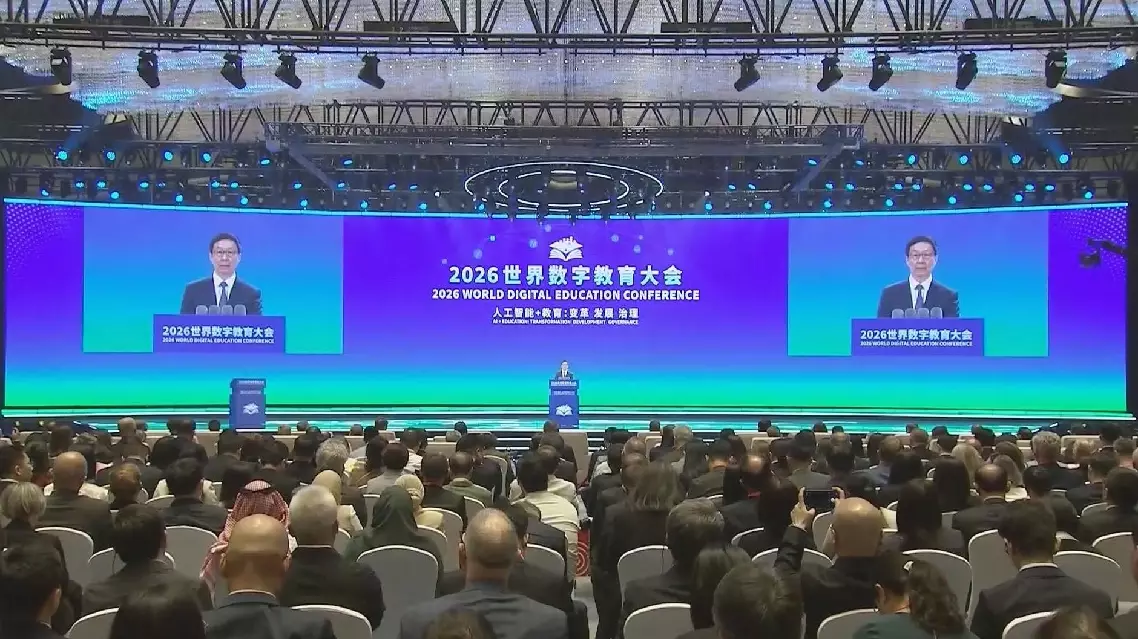
2026 World Digital Education Conference opens in Hangzhou