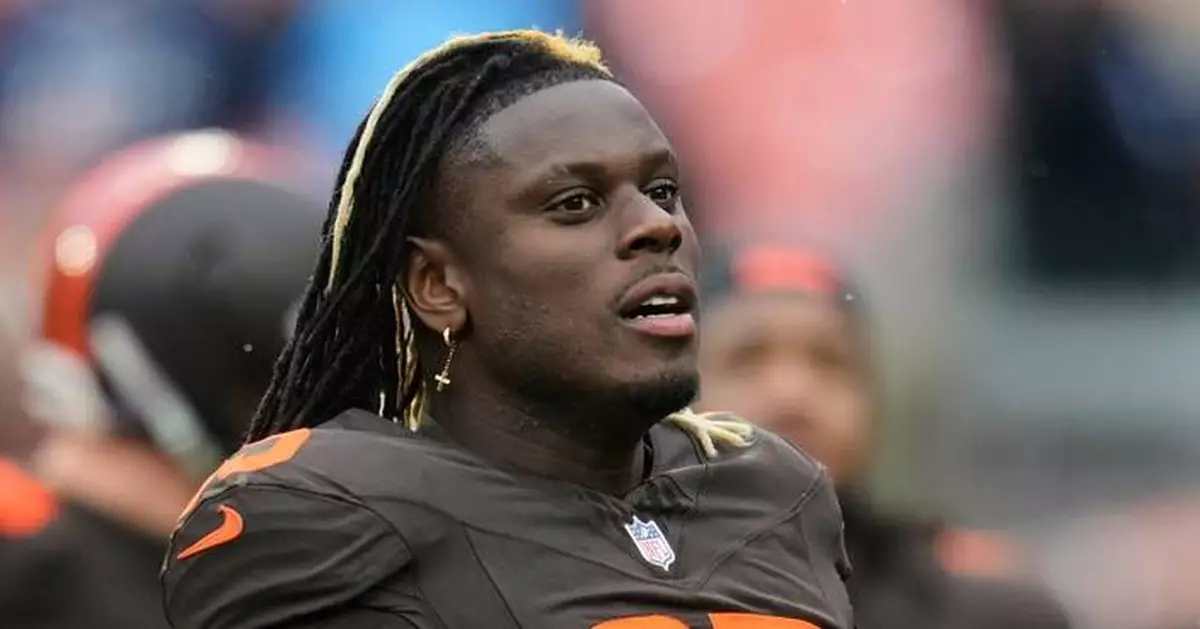
EL SEGUNDO, Calif. (AP) — Veteran tight end David Njoku agreed to a one-year deal with the Los Angeles Chargers on Monday.
Njoku spent the first nine seasons of his NFL career with the Cleveland Browns, earning one Pro Bowl selection while catching 384 passes for 4,062 yards and 34 touchdowns. He is second in Browns franchise history to Ozzie Newsome for catches and TDs among tight ends, but he became a free agent in February.
Njoku missed significant parts of the past two seasons with injuries. He had 33 receptions for 293 yards and four touchdowns while appearing in 12 games last season.
Njoku could be a major contributor for the Chargers, who are rebooting Justin Herbert's offense under new offensive coordinator Mike McDaniel.
Three tight ends caught at least 15 passes in McDaniel’s offense with the Miami Dolphins last season. The Bolts' only major contributor to the passing game as a tight end last season was rookie Oronde Gadsden, the fifth-round pick who had 49 catches for 664 yards and three TDs.
Veteran receiver Keenan Allen is still on the free-agent market, but starting receivers Ladd McConkey and Quentin Johnston are returning to a Los Angeles passing offense that ranked 18th in the NFL last season despite another strong effort from Herbert, who earned his second Pro Bowl selection.
Los Angeles went 11-6 for the second straight season under head coach Jim Harbaugh but also lost in the first round of the playoffs for the second straight year.
AP NFL: https://apnews.com/NFL
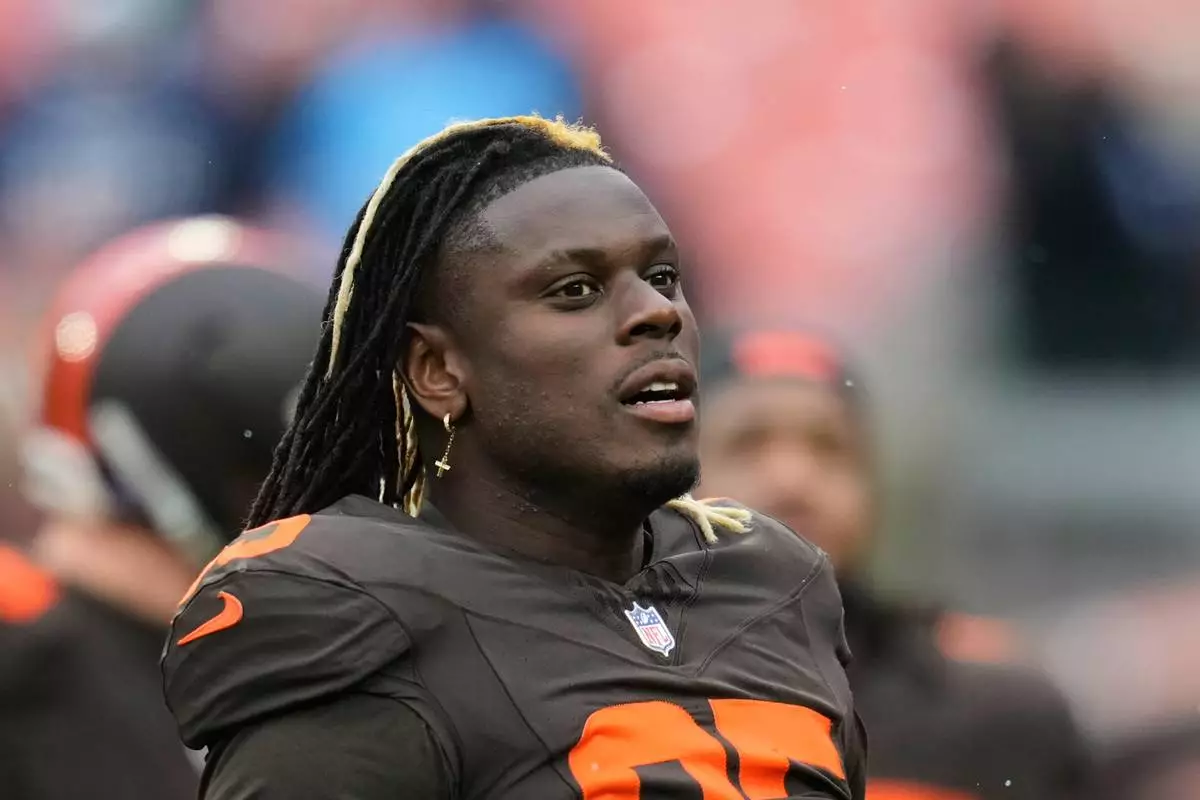
FILE - Cleveland Browns tight end David Njoku warms up before an NFL football game against the Tennessee Titans in Cleveland, Dec. 7, 2025. (AP Photo/Sue Ogrocki, File)
THE HAGUE, Netherlands (AP) — Venezuela ’s acting President Delcy Rodríguez told journalists Monday that her country had no plans to become the 51st U.S. state after President Donald Trump said he was “seriously considering” the move.
Rodríguez was speaking at the International Court of Justice in The Hague on the final day of hearings in a dispute between her country and neighboring Guyana over the massive mineral- and oil-rich Essequibo region.
“We will continue to defend our integrity, our sovereignty, our independence, our history,” said Rodríguez, who assumed power in January following a U.S. military operation that ousted then-President Nicolás Maduro. Venezuela is “not a colony, but a free country,” she added.
Speaking to Fox News earlier on Monday, Trump said he was “seriously considering making Venezuela the 51st US state,” according to a post by Fox News' co-anchor John Roberts on social media. The White House did not immediately respond to a request for comment on the matter.
Trump has made similar comments about Canada.
White House spokesperson Anna Kelly later declined to comment on Trump’s plans in an interview of her own with Roberts on Fox News. Kelly said the president is “famous for never accepting the status quo,” and praised Rodríguez for “working incredibly cooperatively” with the U.S.
Rodríguez went on to say that Venezuelan and U.S. officials have been in touch and are working on “cooperation and understanding.”
Before addressing Trump's comments, Rodríguez defended her country’s claim to Essequibo at the United Nations' highest court, telling judges that political negotiations — not a judicial ruling — will resolve the century-old territorial dispute.
The 62,000-square-mile territory, which makes up two-thirds of Guyana, is rich in gold, diamonds, timber and other natural resources. It also sits near massive offshore oil deposits currently producing an average 900,000 barrels a day.
That output is close to Venezuela’s daily production of about 1 million barrels a day and has transformed one of the smallest countries in South America into a significant energy producer.
Venezuela has considered Essequibo its own since the Spanish colonial period, when the jungle region fell within its boundaries. But an 1899 decision by arbitrators from Britain, Russia and the United States drew the border along the Essequibo River largely in favor of Guyana.
Venezuela has argued that a 1966 agreement sealed in Geneva to resolve the dispute effectively nullified the 19th-century arbitration. In 2018, however, three years after ExxonMobil announced a significant oil discovery off the Essequibo coast, Guyana’s government went to the International Court of Justice and asked judges to uphold the 1899 ruling.
Tensions between the countries further flared in 2023, when Rodríguez’s predecessor, Maduro, threatened to annex the region by force after holding a referendum asking voters if Essequibo should be turned into a Venezuelan state. Maduro was captured Jan. 3 during a U.S. military operation in Venezuela’s capital, Caracas, and taken to New York to face drug trafficking charges. He has pleaded not guilty.
Rodríguez did not address the referendum in her remarks, but she told the court that the 1966 agreement is designed to allow negotiations between Venezuela and Guyana to resolve the territorial dispute. And she accused Guyana’s government of undermining the agreement with the “opportunistic” decision to ask the court to address the dispute.
“At a time when the mechanisms established in the Geneva agreement were still fully in force, Guyana unilaterally chose to shift the dispute from the negotiating arena to a judicial resolution,” she said. “This change was not accidental; it coincided with the discovery in 2015 of the oil field that would become world-renowned.”
When hearings opened last week, Guyana’s foreign minister, Hugh Hilton Todd, told the panel of international judges that the dispute “has been a blight on our existence as a sovereign state from the very beginning.” He said that 70% of Guyana’s territory is at stake.
The court is likely to take months to issue a final and legally binding ruling in the case.
Venezuela has warned that its participation in the hearings does not mean either consent to, or recognition of, the court’s jurisdiction.
Garcia Cano reported from Mexico City.
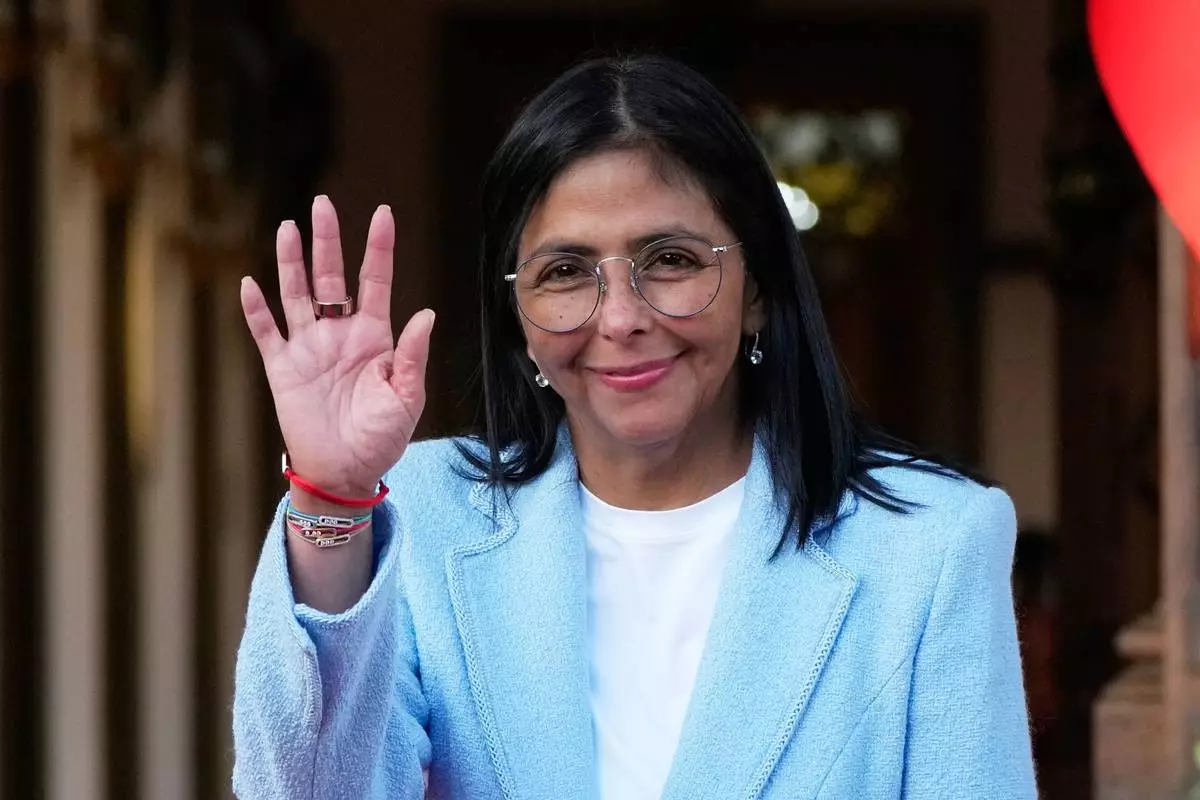
FILE - Venezuela's acting President Delcy Rodriguez waves after bidding farewell to U.S. Energy Secretary Chris Wright following their meeting at Miraflores Palace in Caracas, Venezuela, Feb. 11, 2026. (AP Photo/Ariana Cubillos, File)