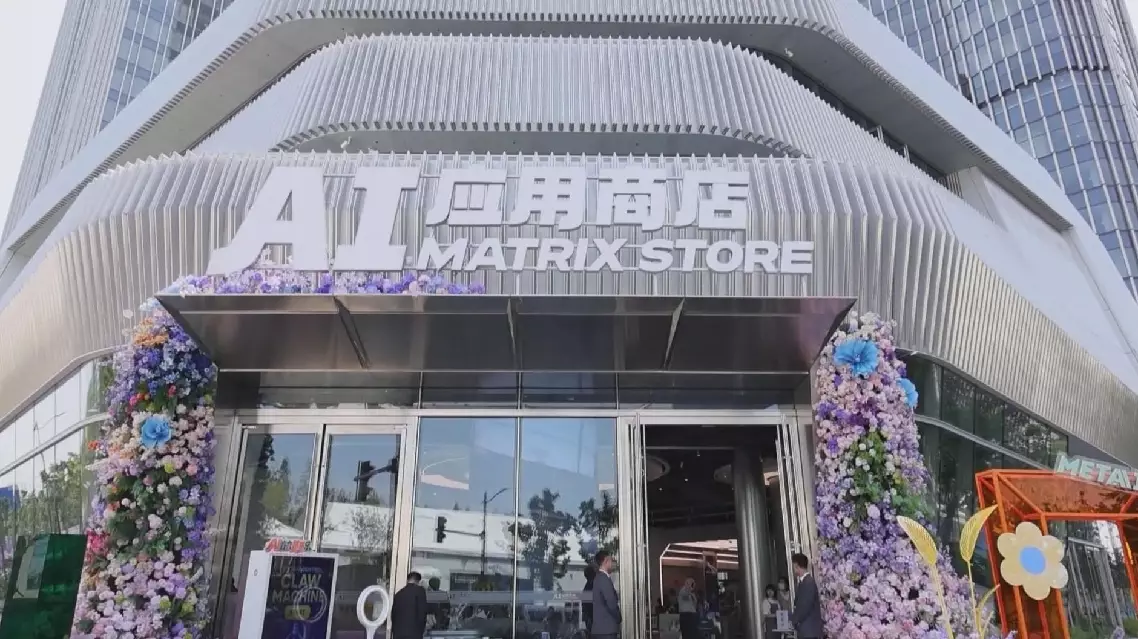
A store selling more than 500 cutting-edge AI products from around the world officially opened for operation on Monday in Shanghai.
Featuring the latest in technology, the store displays a wide range of AI-powered products, including educational robots, smart health assistants, intelligent office equipment, and AI companions for pets.
Covering an area of over 2,000 square meters, the store, known as the MetAI Hub, offers consumers an immersive experience and a chance to try out frontier smart technologies. Visitors can watch robots dance, interact with AI in real time, and experience the convenience of smart home devices.
"I am here to take a look together with my child. There are a lot of AI learning products here which I think will be very helpful for his schoolwork."
At the same time, a special "creative space" has also been set up for science and technology innovators.
According to the store's management, this is where many startups and entrepreneurs hope to produce samples and test consumer demand when they come up with new ideas, which are often expensive to develop.
The store can provide low-cost production resources on the one hand, and serve as a platform for closer interaction between products, consumers and creators on the other, shortening product development cycles.
"Because I am a science and technology innovator, I think what the store offers is very advanced. For example, here I found the latest desktop five-axis CNC machine, and also this UV printer. Actually, I only saw these released on their official website recently, but here I can already try them. It cost me less than 200 yuan today, " said an entrepreneur named Lan Chaoxiang.
Zhao Tongyang, an executive at the store, said they have conducted experiments on how the store can help promote the commercialization of AI products.
"We have tested it, and found that some products, which would normally take around six months before being launched to the market, can hit the shelves in only two to three months with our store. Because we are a first-release platform for real-world application scenarios, a debut stage for new products, and also a connector for the whole ecosystem. We hope to bring AI products from distant line of code directly to the hands of consumers, " said Zhao.
Store selling AI-powered products opens in Shanghai
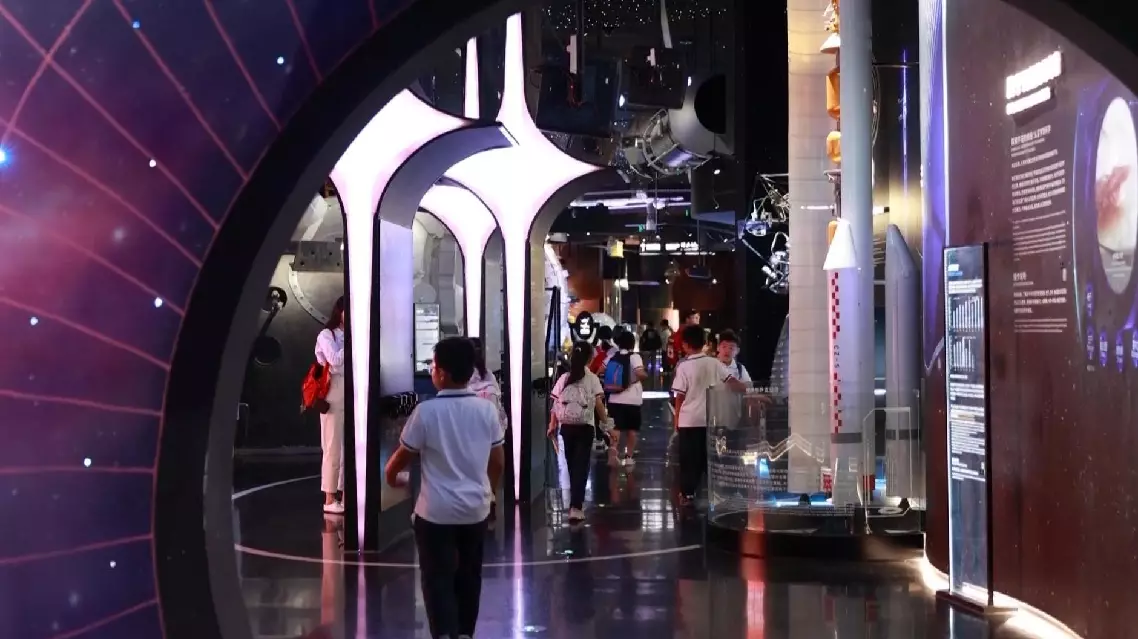
The Shenzhen Science and Technology Museum in south China's Guangdong Province has received over four million visitors since opening on May 1 last year.
In addition to gaining astounding popularity, the museum has been selected as one of the "World's Most Beautiful Museums" by UNESCO.
One morning during the first anniversary period of its opening, the museum was already packed with student groups and family visitors as early as 10:00.
To the delight of the hundreds of children attending on that day, the museum is filled with highly interactive exhibits that are as fun as they are educational. In the AI ping-pong robot zone, visitors play matches against a robot, which adjusts its difficulty level in real time according to human opponent's skill, precisely matching ball speed and strength.
"I tried seven or eight exhibits. My favorite is the ping-pong. The experience showed me how powerful science can be, and the ping-pong robot made me realize that machines can be so amazing," said Mo Jiquan, a young student from Guangdong's Zhongshan City.
In the "Smart Industry" hall, a group of students from Singapore learned to race model cars controlled by brainwaves.
By pressing foreheads against an electroencephalogram (EEG) signal collection device and concentrating, the students used the power of their minds to propel the cars forward.
"Science fiction has become reality. These things are different from what we learn at school. For example, these brainwave-control devices, we have never seen anything like them. So I think it's a new and very meaningful experience," said Chen Mengfanglin, a student from Singapore.
Among the museum's 950 innovative exhibits, such as brain-computer interfaces, simulated space capsules, dexterous hands, 80 percent offer deep interactive experiences.
More importantly, these exhibits are dynamically updated as industrial technologies evolve.
"I think this place is very futuristic and fun. This is my second time here. I feel that there are more exhibits, and the technology has advanced," said Wu Zining, a Shenzhen student.
According to the museum, visitor numbers remain steady on weekdays, surge significantly during holidays, and overseas visitors have seen a notable increase since the beginning of this year.
"Our museum receives between 2,000 and 5,000 visitors on weekdays. On holidays, we get around 30,000 visitors per day. Since the beginning of this year, the number of overseas visitors has also risen significantly," Zhang Haitian, director of the Exchange and Cooperation Center of the museum.
Unlike traditional science museums that simply display items alongside written explanations, the Shenzhen Science and Technology Museum has pioneered an approach that combines innovation, public outreach, and education into one seamless experience.
Over the past year, it has collected 39 technology transfer projects, held 10 "deep science and technology" project matchmaking events, and brought research institutes, leading enterprises, investors, and the public together, creating a new ecosystem linking government, enterprises, research institutes, and the museum.
"On the basis of the original basic functions of a science and technology museum, we have taken a bolder step forward. We have extensive links with sci-tech innovation companies, so a steady stream of new technologies, achievements, products and ideas flow into the museum. We also have close interactions with science fiction and cultural heritage sectors, integrating science and technology with culture and art. Through flexible cooperation with various industries, this approach has opened up unlimited possibilities for the entire science and technology museum," said Zheng Yongchun, head of the museum.
Interactive sci-tech museum in south China hosts 4 million visitors in first year