INDIANAPOLIS (AP) — The Division I men's soccer season will be split between the fall and spring with the national tournament moving to the spring starting in 2027-28, the NCAA announced Wednesday.
The sport's oversight committee adopted the legislation, which is subject to review by the Division I Cabinet in June.
Teams will be allowed to play 18 matches from late August until the Saturday before Thanksgiving and up to 10 matches from mid-February until the start of the NCAA Tournament. Specific dates for the postseason will be determined later.
There is no movement afoot to restructure the women’s season.
The men's oversight committee introduced its new model in January with the rationale focusing on student-athlete welfare.
The committee said the fall-spring schedule would, among other things, reduce time demands and give athletes a more balanced academic and athletic experience; the potential for fewer midweek games would result in less missed class time; and more recovery time between matches would be provided.
Currently, the Division I men’s soccer season is played in a 10- to 13-week fall window with the College Cup taking place in December.
“This is a new era for college soccer," coach Jamie Clark of 2025 national champion Washington said in a statement to The Associated Press. "Hopefully, through the new calendar we can build some positive momentum and create more excitement for our sport. We have done a great job under the present model of creating an exciting product and preparing players to be professionals in life an on the field. Now, we will be challenged with making the most of this new model.”
The committee also adjusted the sport's transfer window to one 15-consecutive day period in the spring, after the College Cup. Currently, there are two transfer windows totaling 45 days.
AP college sports: https://apnews.com/hub/college-sports

FILE - Washington's Christian Soto (14), Charlie Ostrem (20), Nick Scardina (11), and Kalani Kossa-Rienzi (6) celebrate the team's win over Georgetown in an NCAA men's soccer tournament semifinal game in Cary, N.C., Friday, Dec. 10, 2021. (AP Photo/Ben McKeown, File)
MEXICO CITY (AP) — Mexican President Claudia Sheinbaum on Wednesday denied a CNN report that the CIA was carrying out deadly operations in Mexican territory, accusing the U.S.-based news organization of attempting to “hurt the government and the people of Mexico.”
CNN reported Tuesday that the CIA facilitated a targeted assassination of a member of the Sinaloa cartel on a highway outside Mexico City, fueling a firestorm in Mexico. The New York Times later reported that Mexican forces carried out the attack and the CIA provided planning and support.
Sheinbaum called the CNN report a “lie.” Asked about the New York Times report during her morning press briefing, she called it “a fiction the size of the universe.”
Liz Lyons, a spokesperson for the CIA, also lambasted the CNN report, posting on X that “this is false and salacious reporting that serves as nothing more than a PR campaign for the cartels and puts American lives at risk.”
A CNN spokesperson said the CIA had been presented with details of the report prior to publication and had declined to comment. While the network did not directly address Sheinbaum's statements, it said it stands by its reporting.
“After publication, CIA spokesperson Liz Lyons released a statement to CNN saying, ‘This is false and salacious reporting that serves as nothing more than a PR campaign for the cartels and puts American lives at risk,’ without specifying what aspect of the reporting is false,” the CNN spokesperson said.
The New York Times also stood by its reporting, with Charlie Stadtlander, executive director of media relations and communications, saying in an emailed statement that the publication "remains confident in the accuracy of what we reported.”
While Sheinbaum's mentor and predecessor, Andrés Manuel López Obrador, regularly attacked journalists in his morning news briefings, going as far as to dox critical reporters, Sheinbaum has taken a more measured tone in the face of criticism.
But the president has been plagued by scandals involving the United States in recent weeks as she comes under pressure to maintain a strong relationship with Washington in the face of renegotiating a free-trade agreement and threats by U.S. President Donald Trump to take action on cartels.
Sheinbaum has underscored Mexico's sovereignty, a narrative that increasingly has been questioned.
Last month, two CIA agents were killed in a car crash along with local Mexican investigators on their return from an anti-narcotics operation in the northern state of Chihuahua. Sheinbaum said she had no knowledge of the operation, and Mexican and U.S. authorities contradicted themselves for days.
A week later, a New York court charged Sinaloa's governor — a high-ranking member of Sheinbaum's party and ally of López Obrador — with drug trafficking and weapons offenses, accused of aiding in the massive importation of illicit narcotics into the U.S.
Follow AP’s coverage of Latin America and the Caribbean at https://apnews.com/hub/latin-america
——
Jocelyn Noveck contributed to this report from New York.
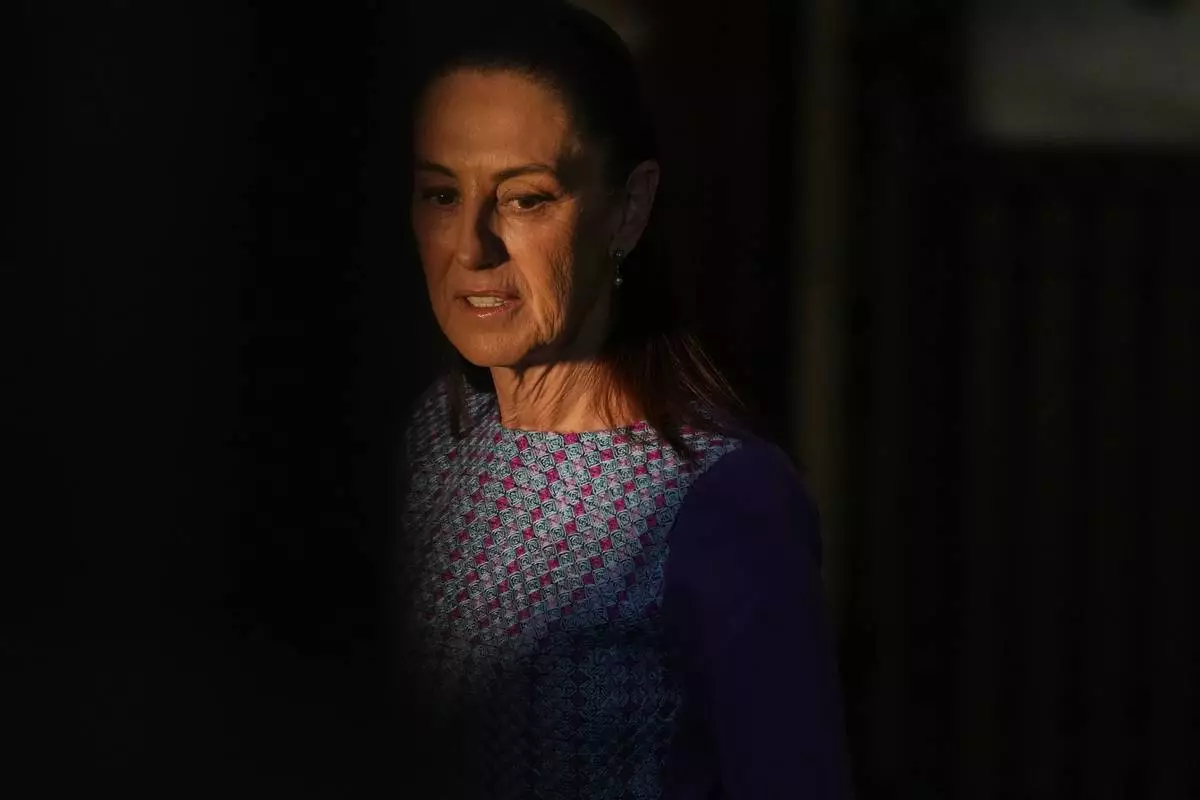
Mexican President Claudia Sheinbaum arrives at the National Palace to give her daily morning press conference in Mexico City, Thursday, April 30, 2026. (AP Photo/Fernando Llano)