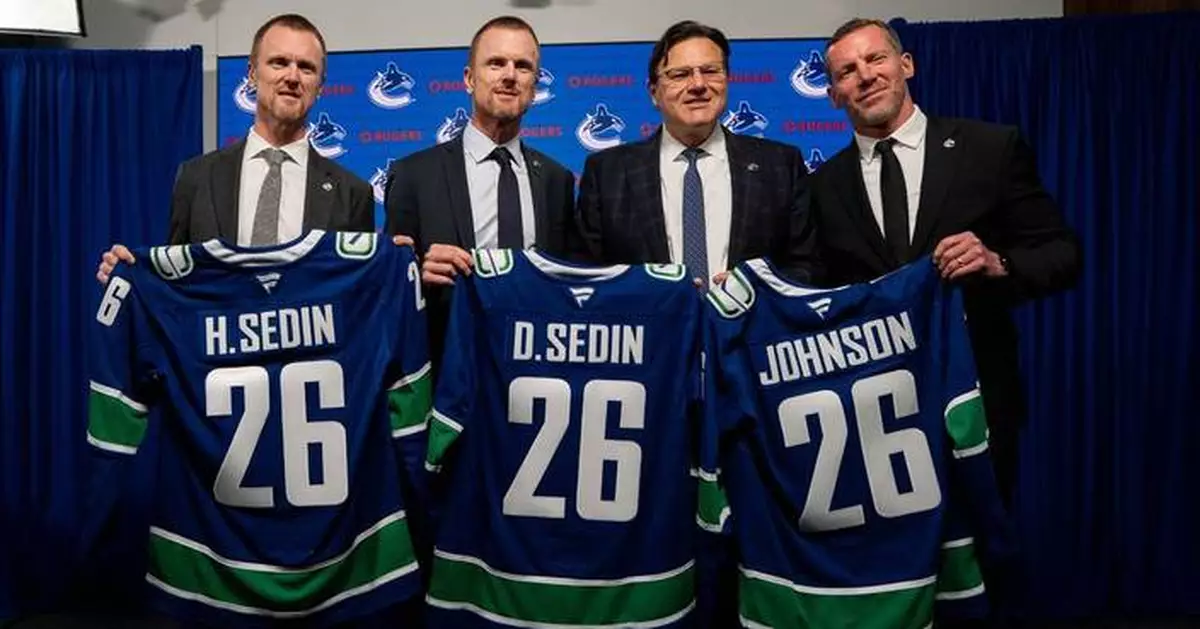
VANCOUVER, British Columbia (AP) — The Vancouver Canucks promoted Ryan Johnson to general manager on Thursday and said Daniel and Henrik Sedin will share the role of president of hockey operations.
The Canucks fired Patrik Allvin as general manager on April 17 following a last-place finish and a 25-49-8 record. Jim Rutherford then announced on May 6 that he will step down as president of hockey operations following next month’s draft and become an adviser.
Rutherford said the search for general manager involved more than 15 candidates. The list reportedly included former Ottawa Senators GM Pierre Dorion, Boston Bruins assistant general manager Evan Gold and former Maple Leafs special adviser Shane Doan.
Johnson, a 49-year-old former NHL center from Thunder Bay, Ontario, first joined the Canucks’ front office in 2013 and was named assistant general manager in 2024. He played 13 seasons in the NHL, splitting his time with the Canucks, Florida Panthers, Tampa Bay Lightning, St. Louis Blues and Chicago Blackhawks.
He will be joined in the front office by the Sedins, the Swedish twins who Johnson played with in Vancouver before later working alongside them in developing the franchise’s young talent.
The Sedins played 17 seasons together for the Canucks, including the team’s run to the 2011 Stanley Cup final, where Vancouver lost to the Boston Bruins in seven games.
Henrik Sedin served as Vancouver’s captain from 2010-18 and still leads the franchise in games played (1,330), assists (830) and points (1,070). He won the Hart Trophy as NHL MVP in 2010.
Daniel Sedin is the franchise-leader in goals (393), power-play goals (138) and game-winning goals (86).
The Hall of Fame forwards retired in 2018, then rejoined the Canucks as special advisers to the general manager in June 2021. They moved into player development roles the following spring.
AP NHL: https://apnews.com/hub/nhl
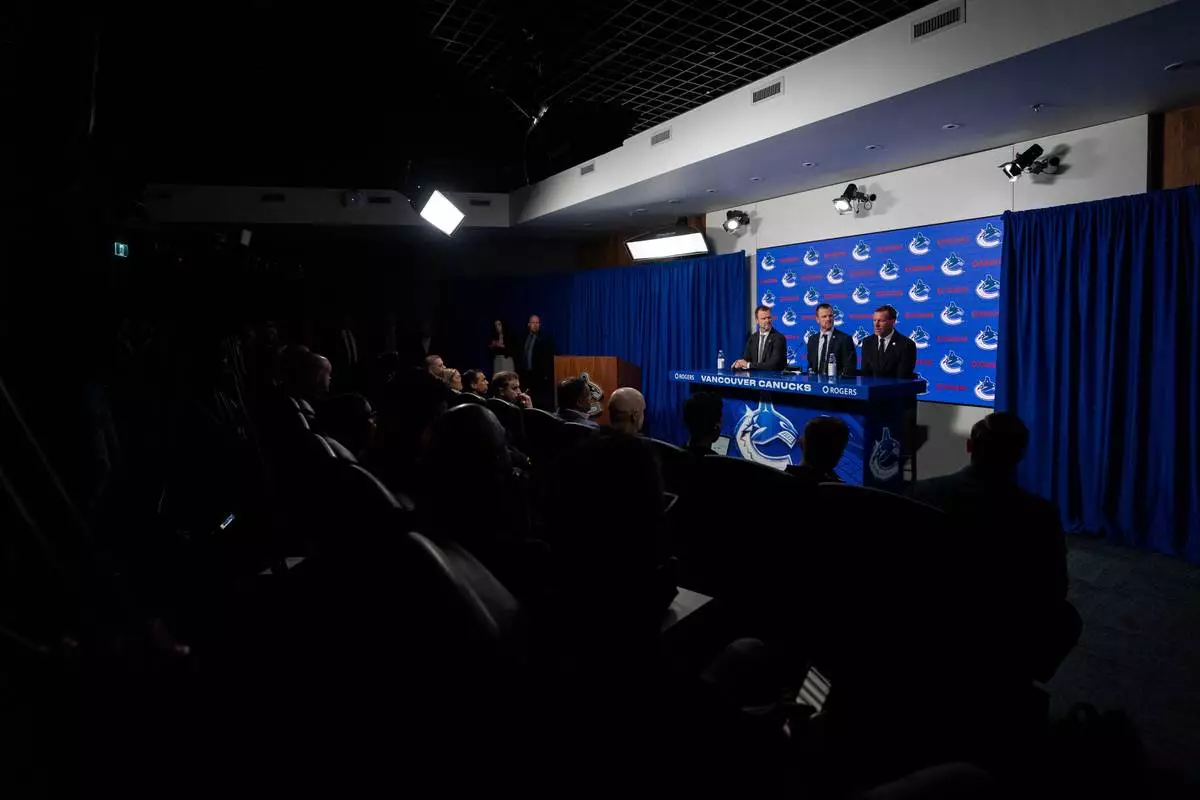
Vancouver Canucks co-president Henrik Sedin, from left to right, co-president Daniel Sedin, and general manager Ryan Johnson speak with media during an announcement for management change in Vancouver, British Columbia, Thursday, May 14, 2026. (Ethan Cairns/The Canadian Press via AP)
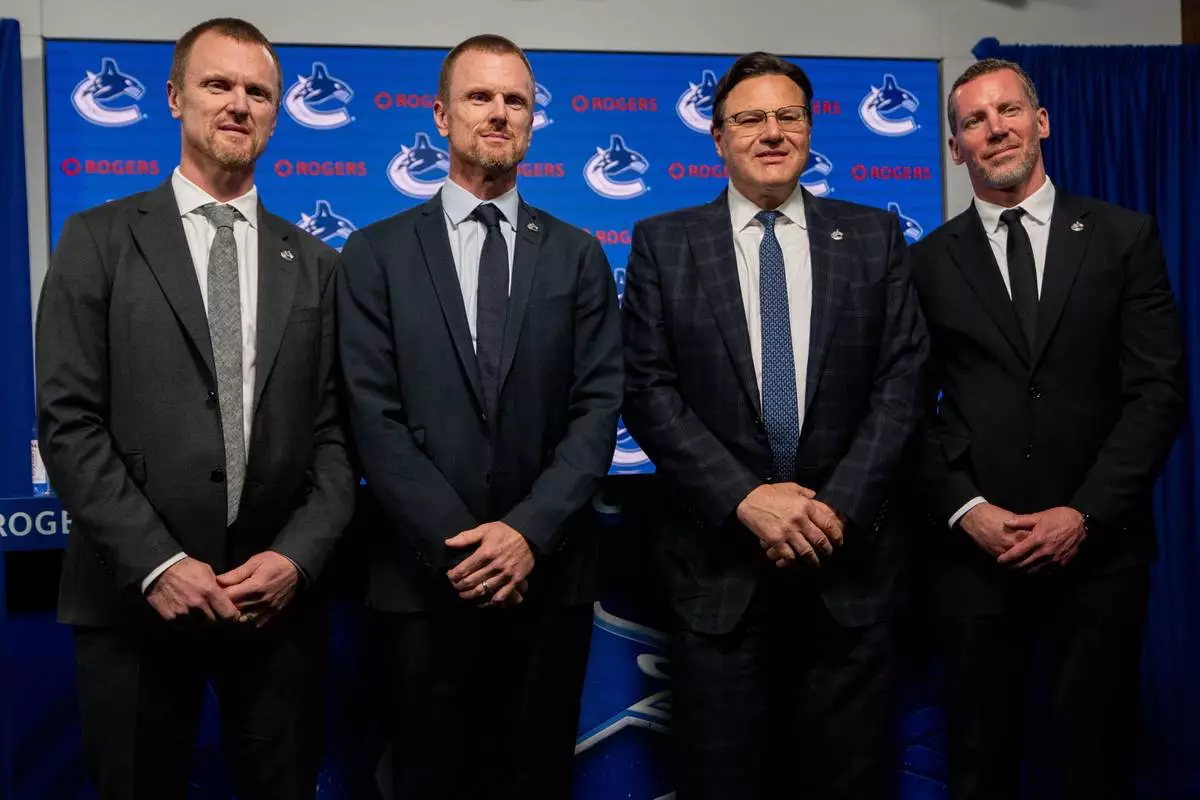
Vancouver Canucks co-president Henrik Sedin, from left to right, co-president Daniel Sedin, chairman and owner Francesco Aquilini and general manager Ryan Johnson pose during an announcement for management change in Vancouver, British Columbia, Thursday, May 14, 2026. (Ethan Cairns/The Canadian Press via AP)
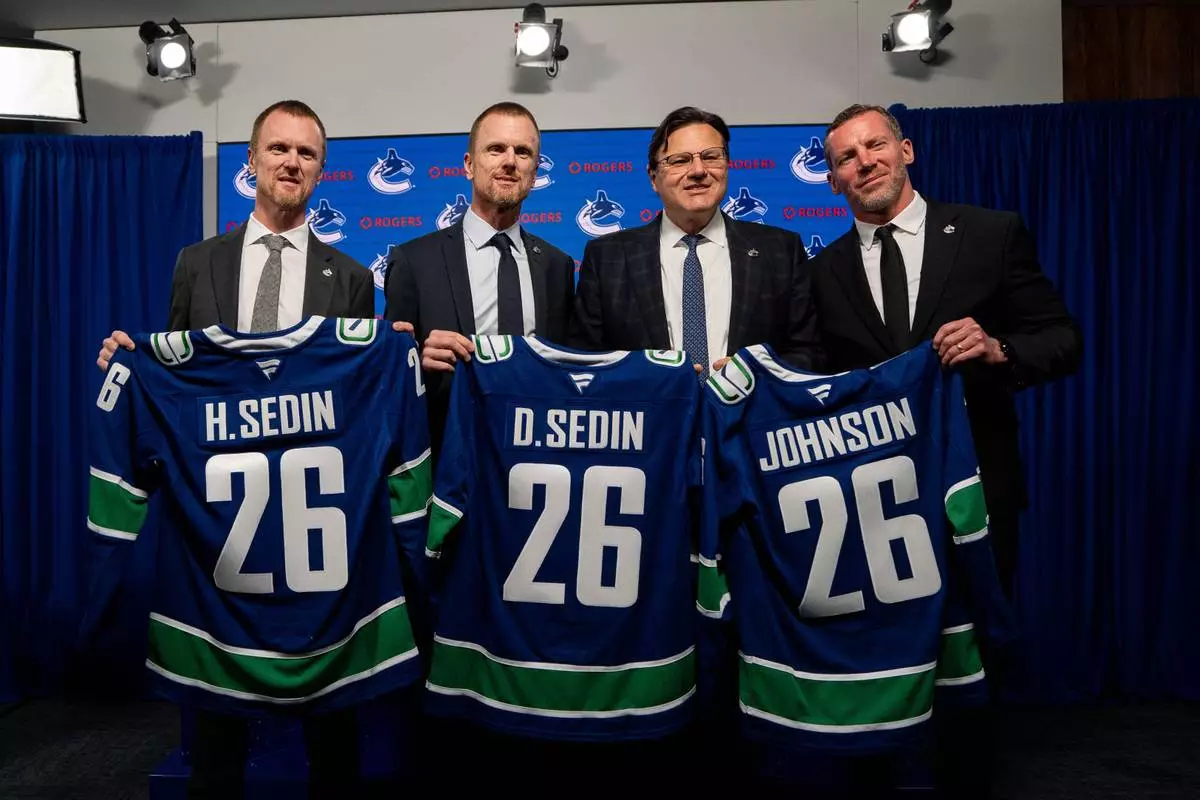
Vancouver Canucks co-president Henrik Sedin, from left to right, co-president Daniel Sedin, chairman and owner Francesco Aquilini and general manager Ryan Johnson pose during an announcement for management change in Vancouver, British Columbia, Thursday, May 14, 2026. (Ethan Cairns/The Canadian Press via AP)
DES MOINES, Iowa (AP) — Two Democrats vying to be Iowa's next U.S. senator opened their final debate Thursday with a pitch to voters on how they would flip the Republican-held seat in a contest that has seen heavy outside spending and high-profile endorsements.
State lawmakers Zach Wahls and Josh Turek are competing in a June 2 primary. It is one of the few remaining competitive Democratic Senate primaries this year, as the party seeks the best approach to reclaim the U.S. Senate this fall.
Iowa’s Republican Sen. Joni Ernst opted out of a reelection bid, leaving the seat open for the first time since she replaced retiring Democratic Sen. Tom Harkin in 2014. Republican Senate leaders have backed Ashley Hinson, a congresswoman representing northeast Iowa, and the campaign arm has committed $29 million to help her keep their thin majority.
Democrats see an opportunity to flip seats in the once-competitive state, despite President Donald Trump’s double-digit win in the last presidential election and an all-Republican federal delegation. The political committee aligned with Senate Democrats said Thursday they were investing $13 million in the state. But Iowa Democrats first need to settle on which federal candidate will be at the top of the ticket. Early voting began on Wednesday.
While Wahls and Turek have raised and spent similar amounts, a Democratic political organization, VoteVets, has spent about $7 million to support Turek in the final stretch of the campaign. That's more than the two candidates have spent combined.
Turek, who is not a veteran, was born with spina bifida after his father’s exposure to chemicals while serving in the Vietnam War. The group has said Turek is uniquely positioned to advocate for veterans’ services, especially health care and military families.
Wahls has criticized the influx of cash as insiders in Washington trying to exert outsized influence, and it's likely to come up again Thursday, as it did at an Iowa Press debate last week.
Another group purchased more than $40,000 in airtime to support Wahls this week, according to filings. Iowa Action was funded by a lawyer with a California address who has also donated directly to Wahls' campaign.
Wahls has been vocal about who should — or should not — lead Senate Democrats, saying he would not vote for Sen. Chuck Schumer of New York to be the caucus leader.
“The leadership of Chuck Schumer has failed the Democratic Party, it has failed the state and it has failed this country,” Wahls said during last week's debate. “Dark money has an agenda, and that agenda is to protect the broken status quo and the failed leadership of Sen. Schumer.”
Schumer has tried to keep the focus on Republicans.
Turek responded to Wahls' criticism, saying he's not a “D.C. insider.”
“I don't know these folks,” he said. Turek explained his criteria for leader candidates, but stopped short of saying he wouldn’t support Schumer.
“I will go up and ask whoever is deciding to run for leadership ... ‘What are you going to do for Iowa? What are you going to do for Iowans? What are you going to do for the middle class?’” Turek said.
The two have also drawn distinct endorsements from well-known Democrats.
In the last week, Turek unveiled a rare endorsement from Harkin, who represented Iowa in the Senate for three decades, as well as former Transportation Secretary Pete Buttigieg. Turek also has collected endorsements from sitting U.S. senators, including Illinois' Tammy Duckworth, New Hampshire's Maggie Hassan and Nevada's Catherine Cortez Masto.
Wahls is endorsed by U.S. Sen. Elizabeth Warren of Massachusetts, who joined him in Iowa for campaign events over the weekend. The progressive senator told voters the Senate needs Democrats who are willing to “get in there and stand up and fight.”
In the first debate last week, Turek and Wahls were aligned on many issues. Both said that they would not support the Republican president’s tariffs or the war in Iran and that they do support raising the minimum wage and restoring health care access with a public insurance option. They criticized corruption in Washington and proposed higher taxes on corporations and wealthy Americans.
But they also started to draw some contrasts. More of that is likely Thursday in the debate hosted by local broadcast stations in Des Moines, Cedar Rapids, Sioux City and the Quad Cities.
Wahls referenced a law Turek supported in the Iowa legislature that makes it a state crime to be in the U.S. illegally. Turek defended his vote, saying it was Biden-era legislation, and stressed the importance of a secure U.S.-Mexico border. Turek said he also supports an easier path to citizenship and reforms to immigration enforcement under the Trump administration.
Turek highlighted his working-class background and contrasted his work for a nonprofit with Wahls’ work for a political organization focused on electing young Democrats.
Follow the AP’s coverage of the 2026 election at https://apnews.com/projects/elections-2026/.
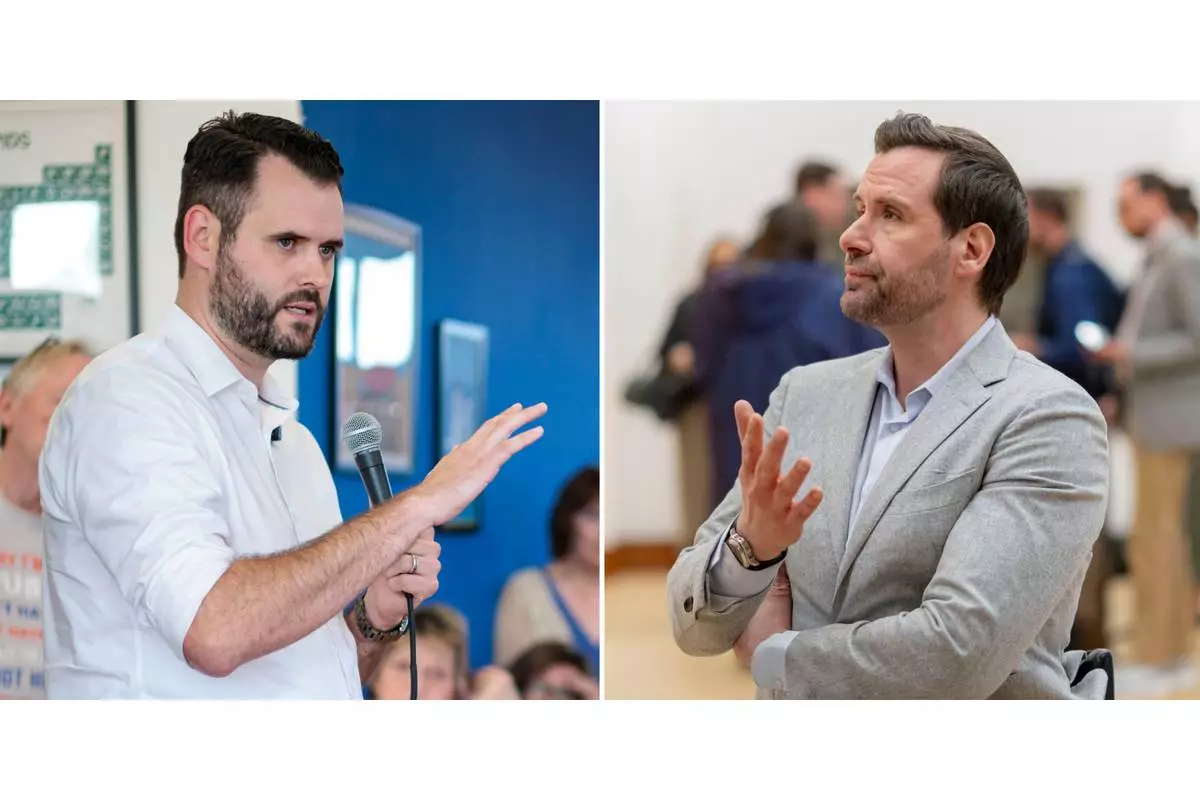
This combination of file photos shows Iowa State Sen. and candidate for the Democratic nomination for U.S. Senate Zach Wahls speaking in Cedar Rapids, Iowa, Sept, 11, 2025, left, and Iowa state Rep. Josh Turek speaking in Des Moines, Iowa, April 8, 2026, right. (Nick Rohlman/The Gazette via AP, File)