The full 2026 NFL schedule will be released Thursday night, completing the list of 272 games over 18 weeks.
The season kicks off on Sept. 9 when the Seattle Seahawks raise their Super Bowl banner. It’ll be the second time the NFL season opens on a Wednesday — the Giants hosted the Cowboys on Sept. 5, 2012.
Several games already were announced, including a record nine international games across four continents. The San Francisco 49ers face the Los Angeles Rams in Melbourne on Sept. 10 in the first international game of the season.
The Pittsburgh Steelers play the New Orleans Saints on Oct. 25 in Paris in the NFL’s first regular-season matchup in France.
Sixteen of the league’s 32 teams will play at least one of their 17 regular-season games outside the United States. The 49ers and Jacksonville Jaguars each have two international games. San Francisco also faces Minnesota in Mexico City in Week 11. The Jaguars have consecutive games in London in Weeks 5 and 6 against the Eagles and Texans. The Colts-Commanders also face off in London in Week 4.
The Dallas Cowboys and Baltimore Ravens go head-to-head in Rio de Janeiro in Week 3. The Bengals-Falcons are in Madrid in Week 8 and the Patriots-Lions play in Munich in Week 9.
Other highlights already announced include the Cowboys-Giants in the first Sunday night game and the Broncos-Chiefs in the first Monday night game.
The Packers-Rams are playing on Thanksgiving Eve and it’ll be the Lions-Bears and Eagles-Cowboys in two of the Thanksgiving Day games.
AP NFL: https://apnews.com/hub/NFL

FILE - A general view during the second rugby union test between Australia and the British & Irish Lions at the Melbourne Cricket Ground in Melbourne, Australia, Saturday, July 26, 2025. (AP Photo/Asanka Brendon Ratnayake, file)

FILE - Fireworks go off at the halftime during the international friendly soccer match between Mexico and Portugal at the Estadio Barnorte in Mexico City, Saturday, March 28, 2026. (AP Photo/Eduardo Verdugo, file)
Small cities in big Texas metro areas were the fastest growing municipalities in the United States last year, as smaller communities in the South outpaced the rest of the nation, which has experienced a population slowdown since the start of the immigration crackdown last year, according to figures released Thursday.
Celina, Princeton, Melissa and Anna — all part of the Dallas-Fort Worth metroplex — were the Nos. 1, 3, 4 and 5 fastest-growing U.S. cities with populations of 20,000 residents or more from mid-2024 to mid-2025, according to population estimates released by the U.S. Census Bureau.
Fulshear, in metro Houston, was the second-fastest growing U.S. city. The five Texas cities' year-over-year growth rates ranged from almost 15% to almost 25%.
In pure numbers, Celina, with only 64,000 people, grew by more residents — 12,700 — than Seattle and Houston, cities that are 12 times and 37 times larger respectively.
Small- to medium-sized cities hit a sweet spot between the largest U.S. cities, which were most impacted by the loss of immigrants from the crackdown started last year during the second Trump administration, and anemic growth in small towns, according to Matt Erickson, a Census Bureau statistician.
Nine out of 10 of the largest population gainers in pure numbers were cities in the South because of a healthy job market and its comparative affordability. The biggest numeric gainers were Charlotte, North Carolina; Fort Worth, Texas; San Antonio, Texas; and Celina.
Fort Worth leaped over Jacksonville last year as the 10th most populous U.S. city, putting four Texas cities in the nation's top 10 most populous, with the other cities being Houston, Dallas and San Antonio.
Austin skipped over San Jose for the 12th most populous spot, as Texas’ capital city surpassed 1 million residents for the first time. It is now one of a dozen U.S. cities with 1 million residents or more.
Seattle was the only non-Southern city to crack the top 10 in numeric population gains last year, at the No. 5 spot.
Like many large cities, particularly on the coasts, Seattle lost population during the height of the pandemic a half-decade ago. But recent construction of new housing has helped ease the city's affordability, making it more attractive for residents to stay in the core city rather than move to farther out suburbs in the metro area, according to the Washington State Office of Financial Management.
The growth was driven by immigrants, particularly from China and India. International migration accounted for almost three-quarters of the area's population gains, according to county-level population estimates released in March.
The two cities with the greatest rates of population loss last year — Twentynine Palms, California, by Joshua Tree National Park and Key West at the southern tip of Florida — were in places with tight housing markets. Their losses ranged from -2.4% to -2.9%.
In Twentynine Palms, a large chunk of the housing stock has been converted into short-term rentals for tourists heading to the national park. Just under 40% of its housing is occupied by its owners, compared with the national average of 65%, according to Census Bureau figures.
Hemmed in on all sides by water, the limited housing stock in Key West, as well as some of the highest home insurance rates in the U.S., have driven up housing costs for the Conch Republic. The median price for a home in Key West was $1.3 million at the start of this year, according to the Federal Reserve Bank of St. Louis.
Other cities that had some of the biggest rates of population loss last year were hit by natural disasters.
Hurricanes Helene and Milton struck Florida’s Gulf Coast within weeks of each other in late 2024. Remnants of Helene blew through western North Carolina, leaving behind damaging tornadoes and flooding. Among the cities with the greatest rates of loss were Asheville, North Carolina, and several cities on Florida’s Gulf Coast, including Pinellas Park, Dunedin, Largo and Clearwater.
Follow Mike Schneider on the social platform Bluesky: @mikeysid.bsky.social.
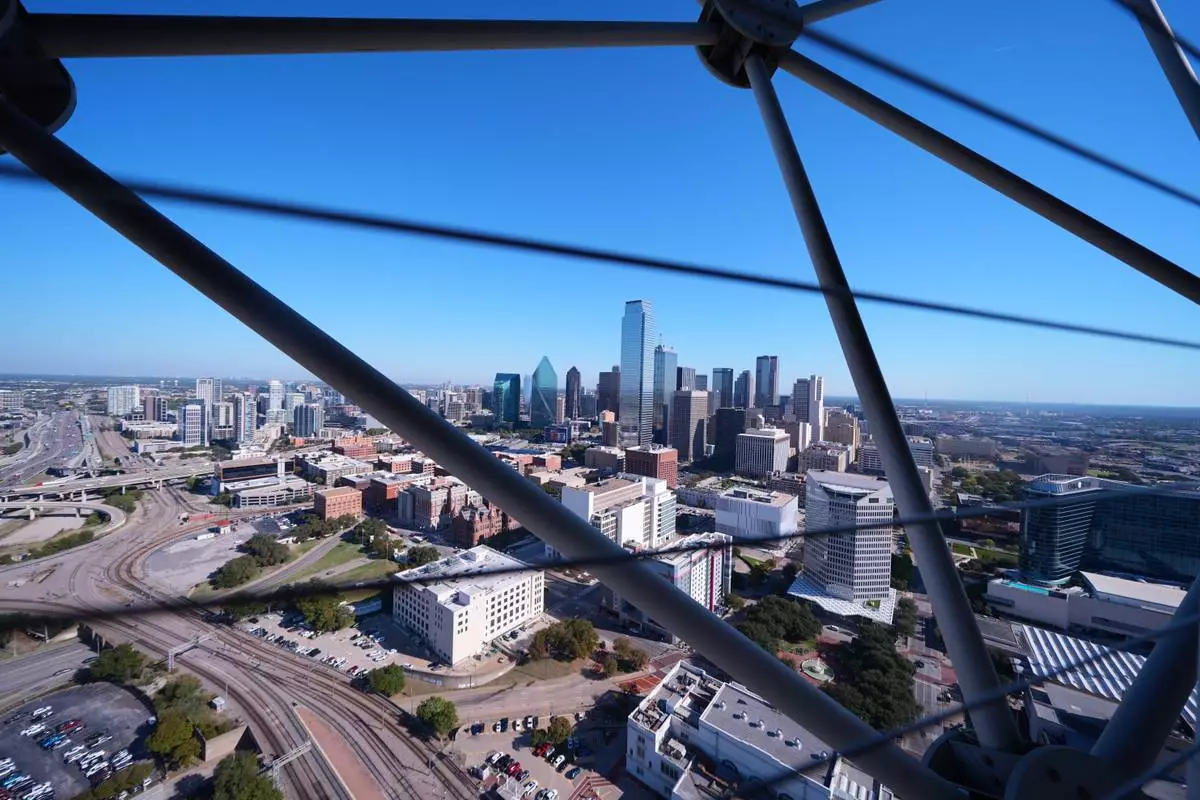
FILE - The Dallas skyline is visible through the framing of Reunion Tower, Nov. 6, 2025, in Dallas. (AP Photo/Julio Cortez, File)