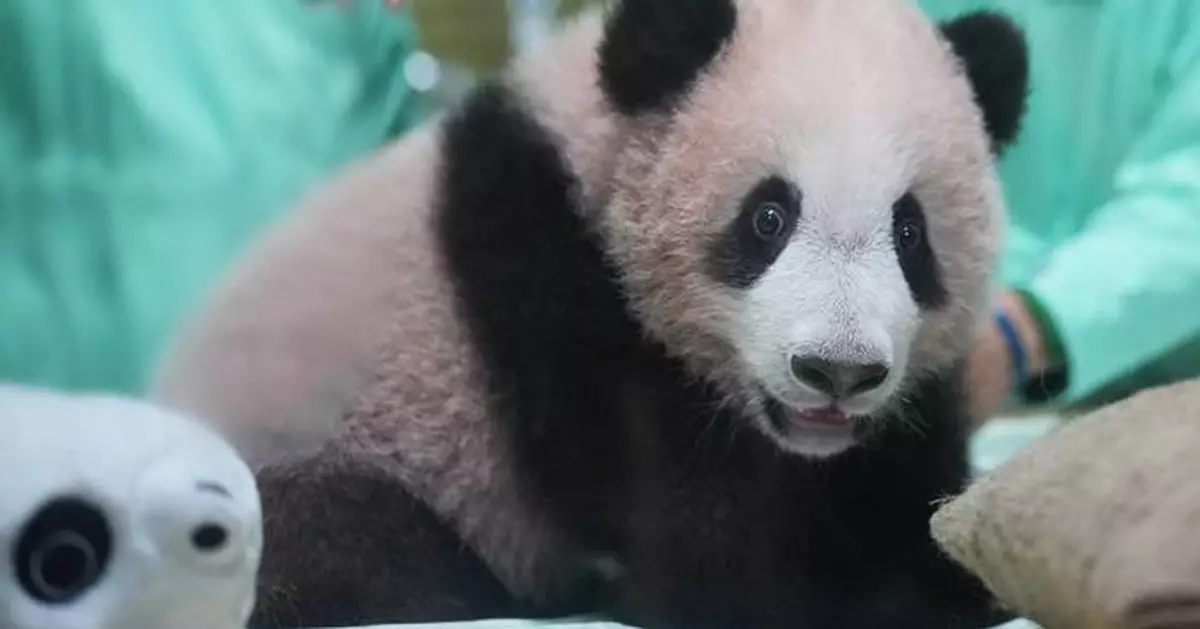
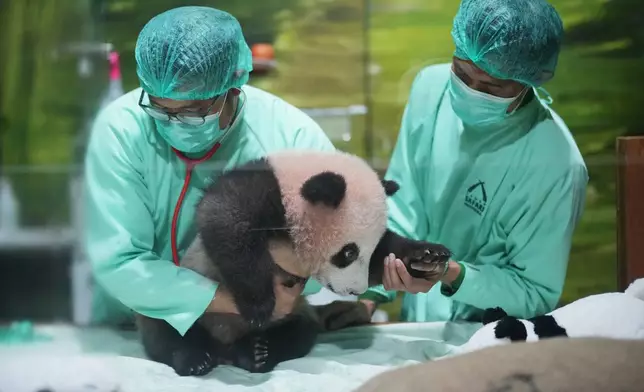
CISARUA, Indonesia (AP) — The first giant panda born in Indonesia squirmed as veterinarians checked his hearing and eyesight and confirmed the furry cub was growing and healthy Friday before his public debut later this month.
Satrio Wiratama, nicknamed “Rio,” can walk on his own, climbs on his mother and has started eating bamboo shoots. He has grown to 10 kilograms (22 pounds) at 169 days old.
Click to Gallery
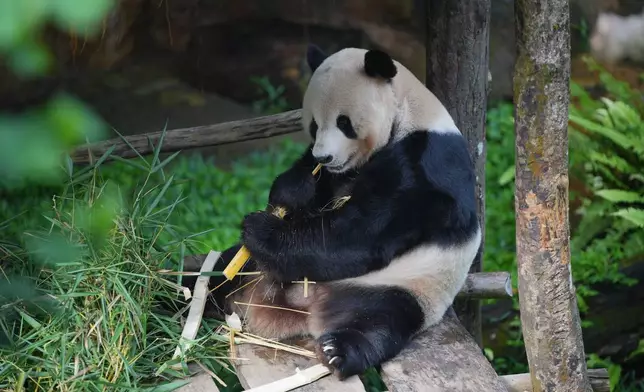
Cai Tao, a 15-year-old giant panda, the father of Satrio Wiratama, the first panda cub born in Indonesia, sits in his enclosure at Indonesia Safari Park in Bogor, West Java, Indonesia, Friday, May 15, 2026. (AP Photo/Achmad Ibrahim)
Satrio Wiratama, nicknamed "Rio," the first giant panda cub born in Indonesia, bites a bamboo stick during a media preview at Indonesia Safari Park in Bogor, West Java, Indonesia, Friday, May 15, 2026. (AP Photo/Achmad Ibrahim)
Veterinarians treat Satrio Wiratama, nicknamed "Rio," the first giant panda cub born in Indonesia, during a media preview at Indonesia Safari Park in Bogor, West Java, Indonesia, Friday, May 15, 2026. (AP Photo/Achmad Ibrahim)
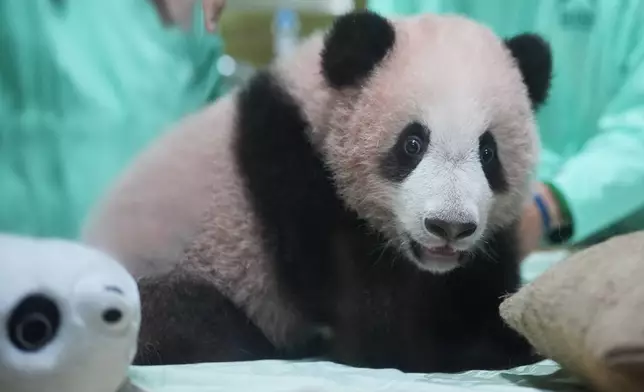
Satrio Wiratama, nicknamed "Rio," the first giant panda cub born in Indonesia, is shown during a media preview at Indonesia Safari Park in Bogor, West Java, Indonesia, Friday, May 15, 2026. (AP Photo/Achmad Ibrahim)
Veterinarians are monitoring his development to determine how well he might adapt to the crowds when he debuts at Indonesian Safari Park outside the capital, Jakarta.
“What’s important to note is that all of Rio’s senses are active; he has the ability to understand the environment, assess the situation, adapt to more people, and hear sounds, even in certain levels of noise. We will train him gradually,” said Bongot Huaso Mulia, a veterinarian who monitors Rio’s progress.
His growth in some ways is faster than average, especially his teeth, according to Mulia.
Rio was born Nov. 27 to his mother, Hu Chun, and a male panda, Cai Tao, who are both 15 years old. The pair arrived in Indonesia in 2017 on a 10-year conservation partnership with China. They live in an enclosure built for them at the park about 70 kilometers (43 miles) from the capital in Cisarua, West Java province.
The two adult pandas have a large fan base in Indonesia. Rio’s birth has drawn many panda enthusiasts, and his public debut has been eagerly anticipated, with numerous requests on social media to see him soon.
The three of them are living in a three-tier temple known as the Panda Palace on a hill surrounded by about 5,000 square meters of land (1.2 acres) and equipped with an elevator, sleeping area, medical facilities and indoor and outdoor play areas.
Rio's name symbolizes the hope, resilience, and shared commitment of Indonesia and China in protecting endangered species.
Pandas are China’s unofficial mascot and Beijing's loans of the animals to overseas zoos have long been seen as soft-power “panda diplomacy.”
Giant pandas have difficulty breeding and births are particularly welcomed. There are less than 1,900 giant pandas in their only wild habitats in the Chinese provinces of Sichuan, Shaanxi and Gansu.
Rio was born through artificial insemination. Besides having a new individual, Rio also provides new genetic data on giant pandas, which can help research in Indonesia and in China, said Aswin Sumampau, president director of the park.
“This is the moment we’ve all been waiting for, a small victory for us, as we’ve managed to breed a species that is extremely difficult to breed. Just imagine, for the past two years, no pandas were born at any ex-situ conservation facility worldwide. Taman Safari has managed to do that,” Sumampau said.
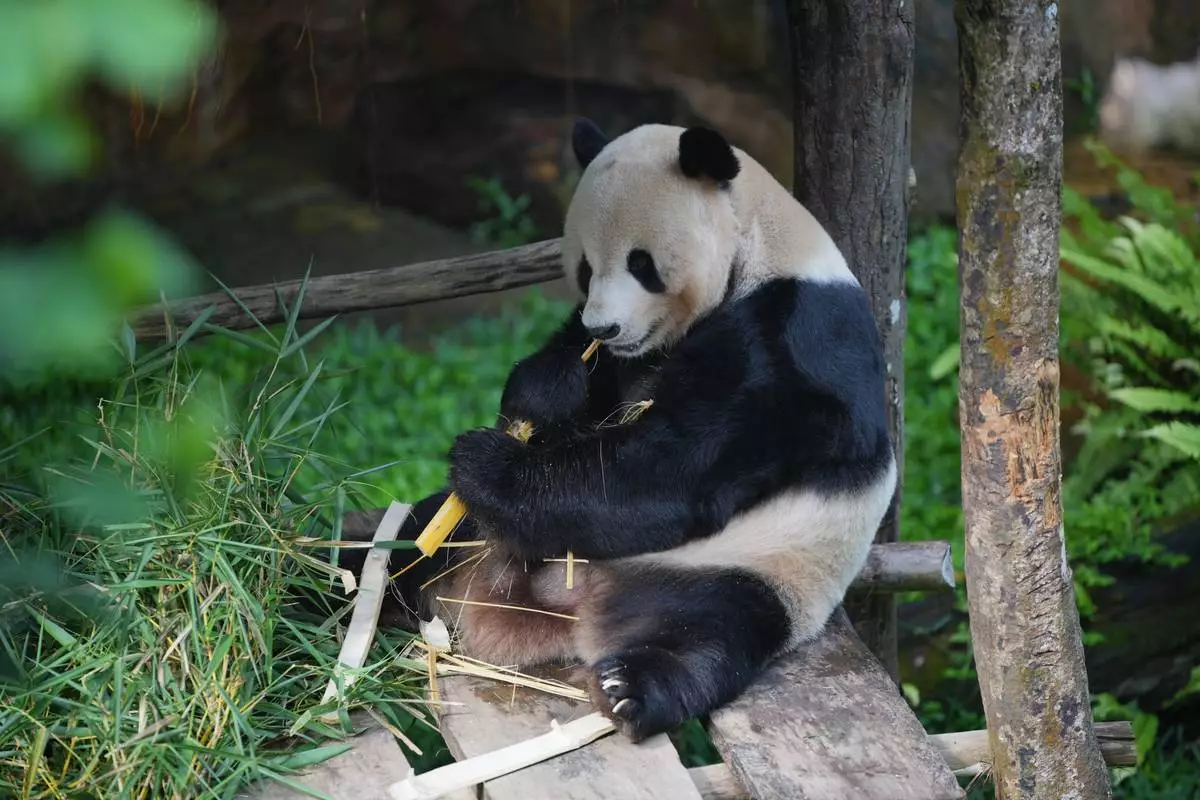
Cai Tao, a 15-year-old giant panda, the father of Satrio Wiratama, the first panda cub born in Indonesia, sits in his enclosure at Indonesia Safari Park in Bogor, West Java, Indonesia, Friday, May 15, 2026. (AP Photo/Achmad Ibrahim)

Satrio Wiratama, nicknamed "Rio," the first giant panda cub born in Indonesia, bites a bamboo stick during a media preview at Indonesia Safari Park in Bogor, West Java, Indonesia, Friday, May 15, 2026. (AP Photo/Achmad Ibrahim)
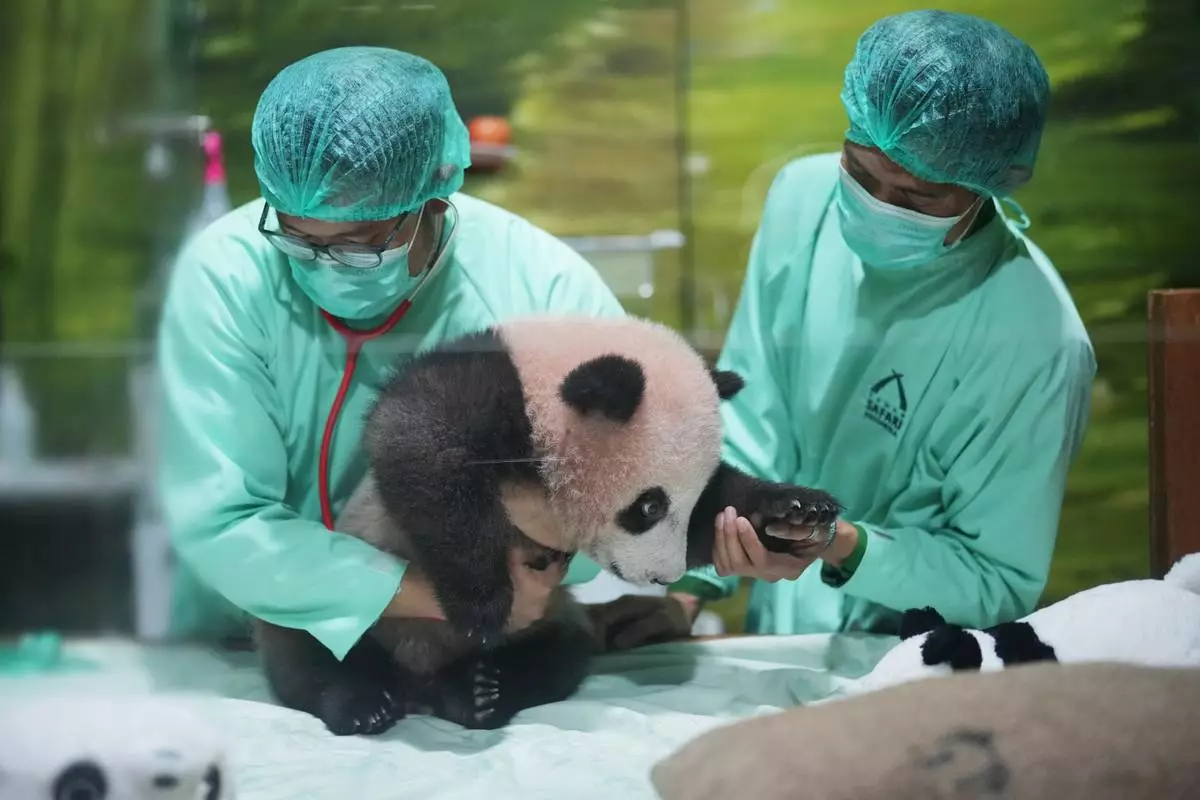
Veterinarians treat Satrio Wiratama, nicknamed "Rio," the first giant panda cub born in Indonesia, during a media preview at Indonesia Safari Park in Bogor, West Java, Indonesia, Friday, May 15, 2026. (AP Photo/Achmad Ibrahim)
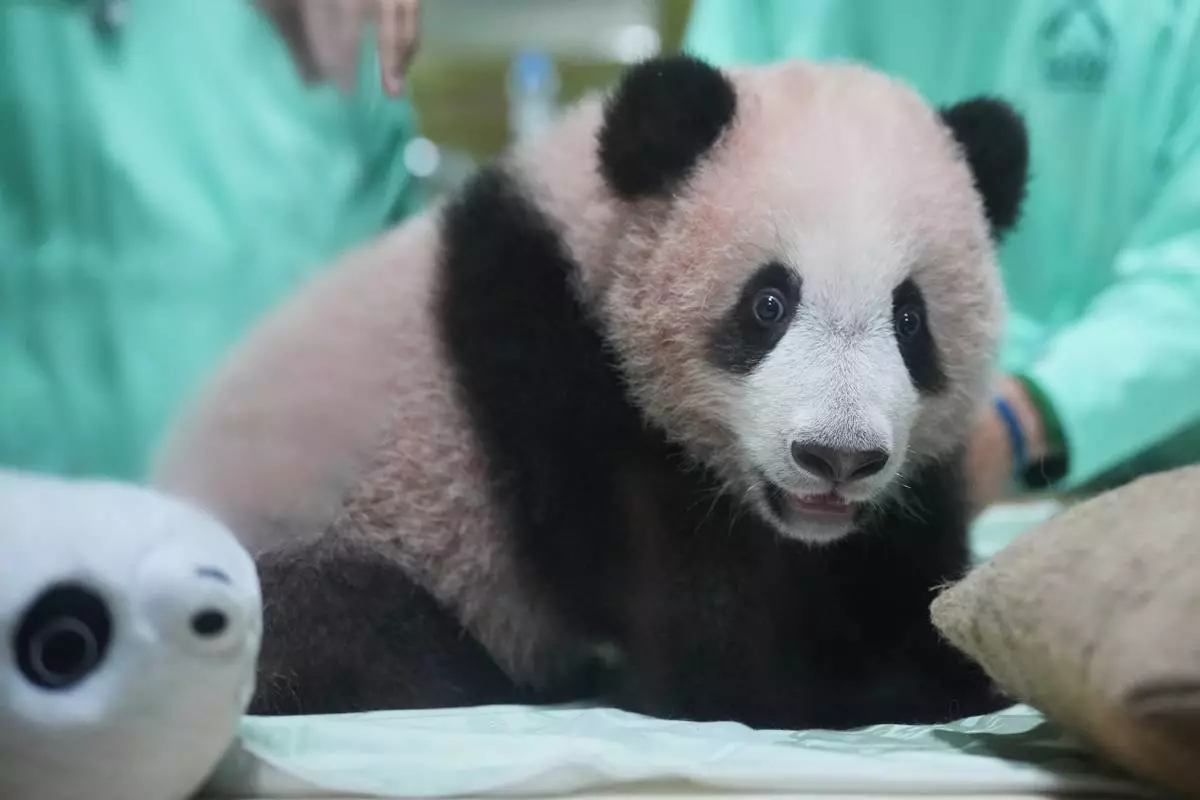
Satrio Wiratama, nicknamed "Rio," the first giant panda cub born in Indonesia, is shown during a media preview at Indonesia Safari Park in Bogor, West Java, Indonesia, Friday, May 15, 2026. (AP Photo/Achmad Ibrahim)
WASHINGTON (AP) — President Donald Trump is attending the dignified transfer Wednesday of four U.S. service members killed in the Middle East.
Trump will be at Dover Air Force Base in Delaware when the remains of the troops killed in action are returned to their families, the White House said. The ritual is one of the most somber duties of a commander-in-chief. It will be the third that Trump has attended since he launched the war in Iran in February.
Speaking to reporters on his way to Dover, Trump called it “one of the hardest things to do as a president.” His message to grieving families, he said, will simply be “we love you, we love your child.”
“There’s no games, there’s no nothing — that’s their child,” Trump said. “And all you can do is throw out your heart.”
Two U.S. Army soldiers killed in Iranian missile and drone attacks in Jordan will be returned during the dignified transfer, according to an administration official who was not authorized to discuss it publicly and spoke on condition of anonymity.
The remains of a third service member who is believed to be the soldier missing after the Jordan attacks will also be returned, the official said, as well as the remains of a soldier killed in Iraq during a detonation of an Iranian drone.
The soldiers killed in Jordan were identified by the Defense Department as Tyler James Feehan, 25, of Ewa Beach, Hawaii, and Isabella Gonzales, 19, of Carrollton, Texas. The soldier who disappeared after the Jordan attacks and is now believed to be deceased is Angel S. Rampersad, 28, of Ozone Park, New York, the Defense Department said.
The soldier killed in Iraq was identified as Michael Emmanuel Swinton, 30, who lived in Spring Lake, North Carolina.
“We feel very badly, but you know, those great people, those great patriots were out there fighting so that Iran cannot have a nuclear weapon,” Trump told reporters on Sunday. He added that the U.S. was striking Iran “in honor” of the fallen troops.
The U.S. has launched multiple retaliatory strikes against Iran as an interim agreement to end the war falls apart. Trump on Monday said that every time Iran kills an American soldier, “they will pay for that killing many times over!”
Since the war began on Feb. 28, 18 U.S. service members have been killed.
Trump on Tuesday said that while almost all the incoming fire in Jordan was stopped, some made it through.
“They did slip something through in Jordan,” he said. “If we had other operators, you know, it would have not happened, unfortunately.”
He went on: “We’ve stopped almost everything, but when you let other people do your job with the United States — we let other people do the job — and sometimes it doesn’t work out so well.”
Trump did not elaborate on his comments, and it was not immediately clear who he was saying was responsible for protecting U.S. forces in Jordan.
Trump attended two previous dignified transfers since the outset of the war, most recently in March.
During the ritual, transfer cases draped with the American flag and holding the remains of the fallen soldiers are carried from the military aircraft that transported them to an awaiting vehicle to take them to the mortuary facility at the base. There, the service members are prepared for their final resting place.
Feehan, a first lieutenant who was killed Saturday, will be posthumously promoted to the rank of captain and awarded the Bronze Star, Purple Heart and Combat Action Badge. He was assigned out of Fort Bragg, North Carolina, to the 32nd Army Air and Missile Defense Command.
Gonzales, who was killed Friday, was a private with the 10th Army Air and Missile Defense Command in Ansbach, Germany. She graduated last year from Hebron High School in Carrollton, near Dallas, school officials said.
Rampersad, a sergeant who was believed to have been killed in Friday's attacks, was assigned to the 57th Air Defense Artillery Regiment, 52nd Air Defense Artillery Brigade, 10th Army Air and Missile Defense Command in Ansbach, Germany.
Swinton, a sergeant who was killed Sunday, will receive a Bronze Star, Purple Heart and Combat Action Badge, and will be promoted to staff sergeant. He enlisted in the Army in 2017 and was assigned to the 55th Air Defense Artillery Regiment, 108th Air Defense Artillery Brigade, out of Fort Bragg, North Carolina.
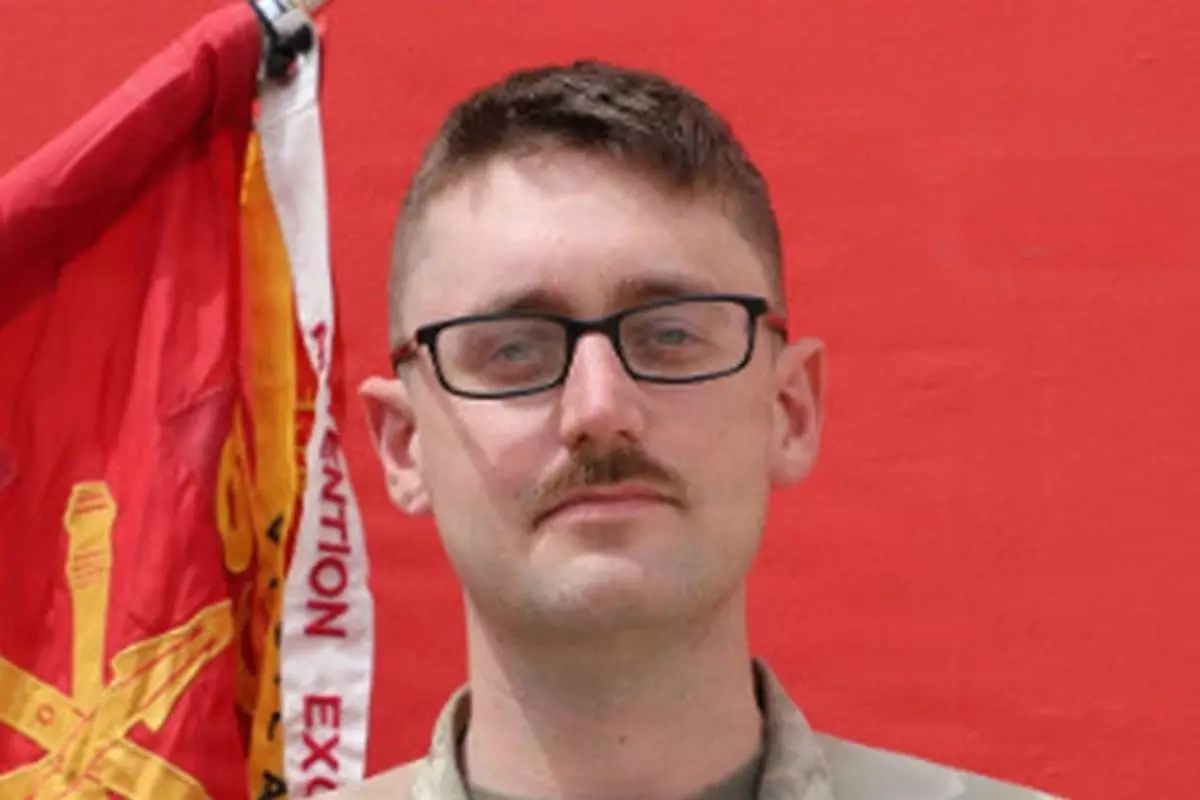
This undated photo provided by the U.S. Army Space and Missile Defense Command shows 1st Lt. Tyler James Feehan. (U.S. Army Space and Missile Defense Command via AP)
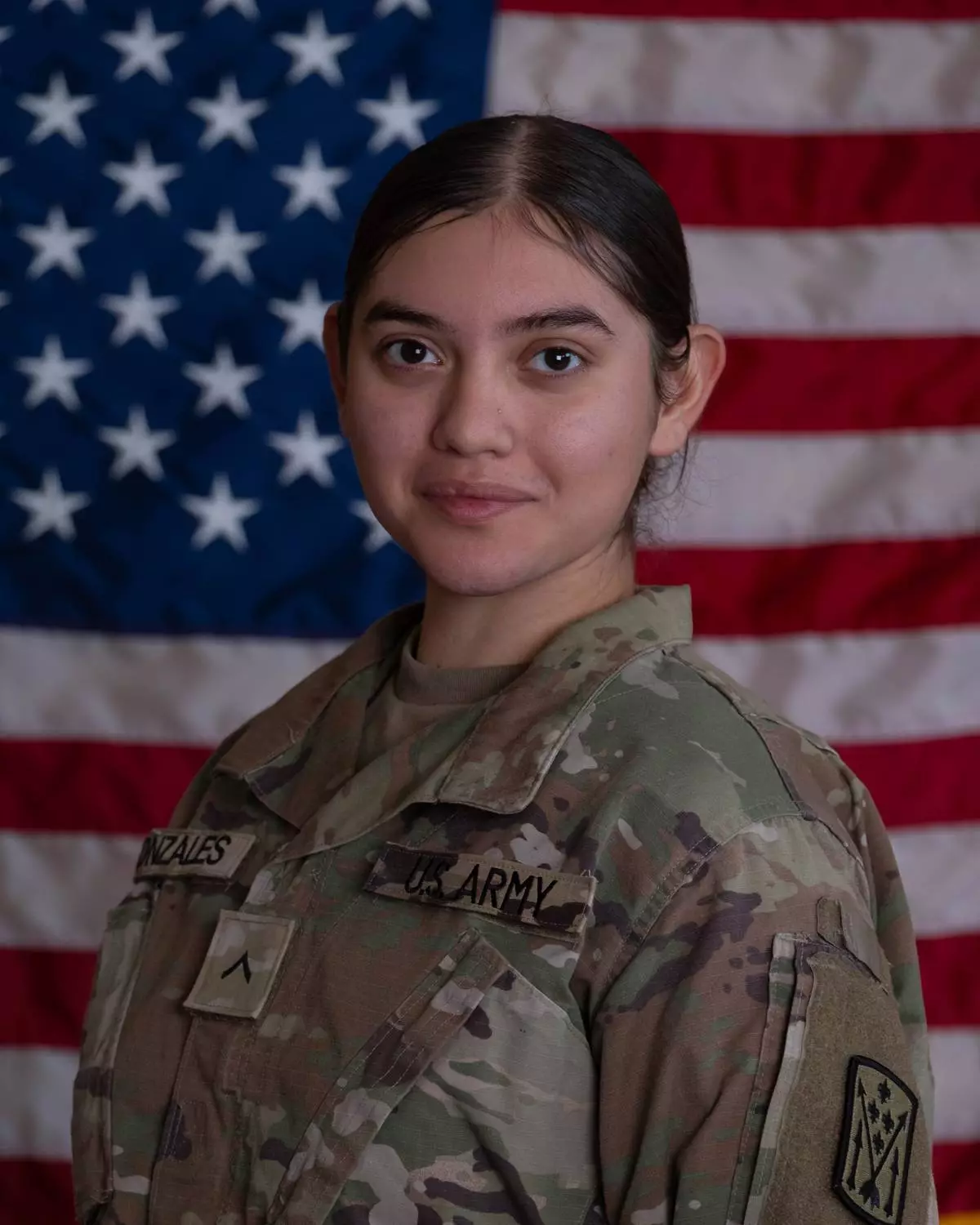
This undated image provided by the U.S. Army shows Pvt. Isabella Gonzales, 19, of Carrollton, Texas. (U.S. Army via AP)
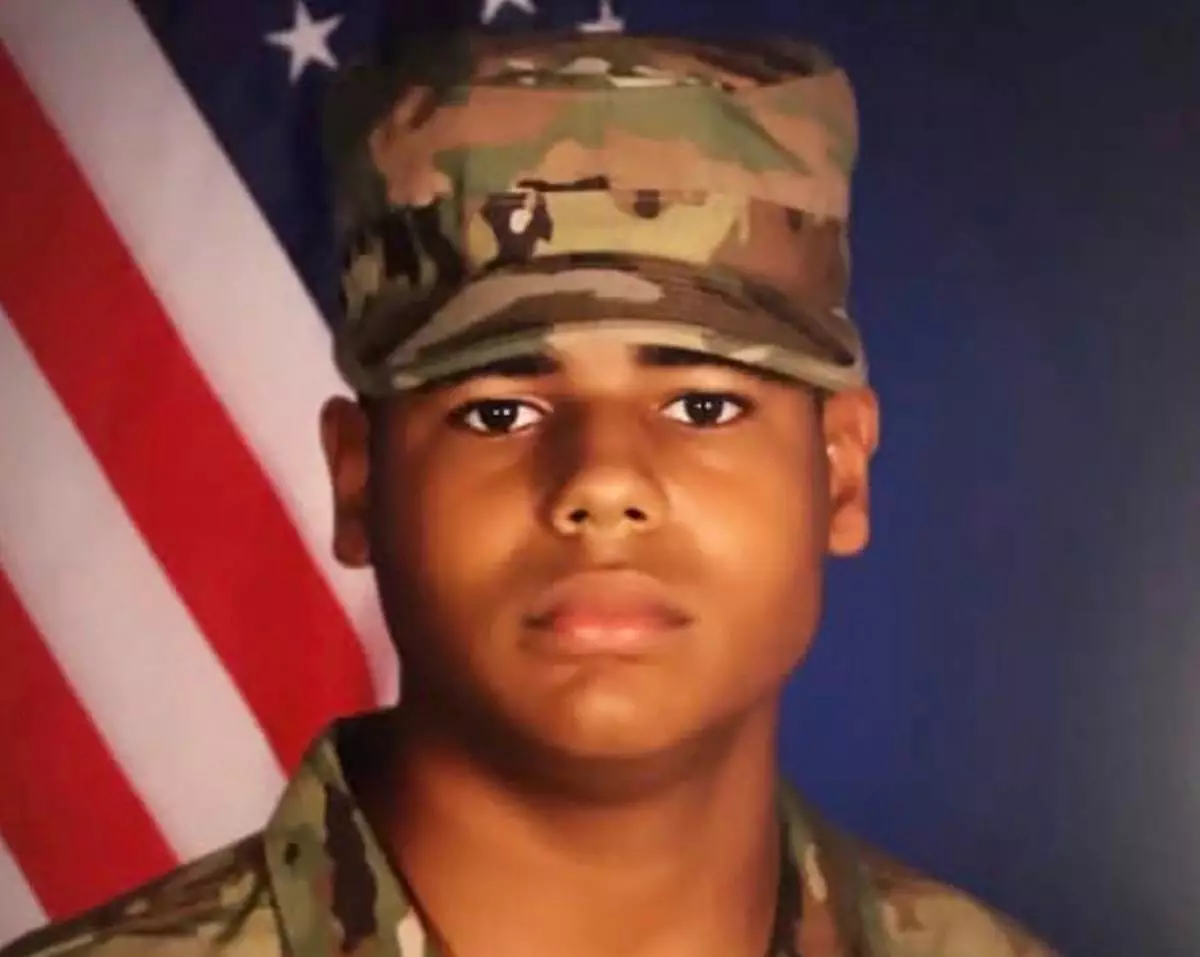
This undated photo provided by the U.S. Army Space and Missile Defense Command on Tuesday, July 21, 2026, shows Army Sgt. Michael Emmanuel Swinton. (U.S. Army Space and Missile Defense Command via AP)
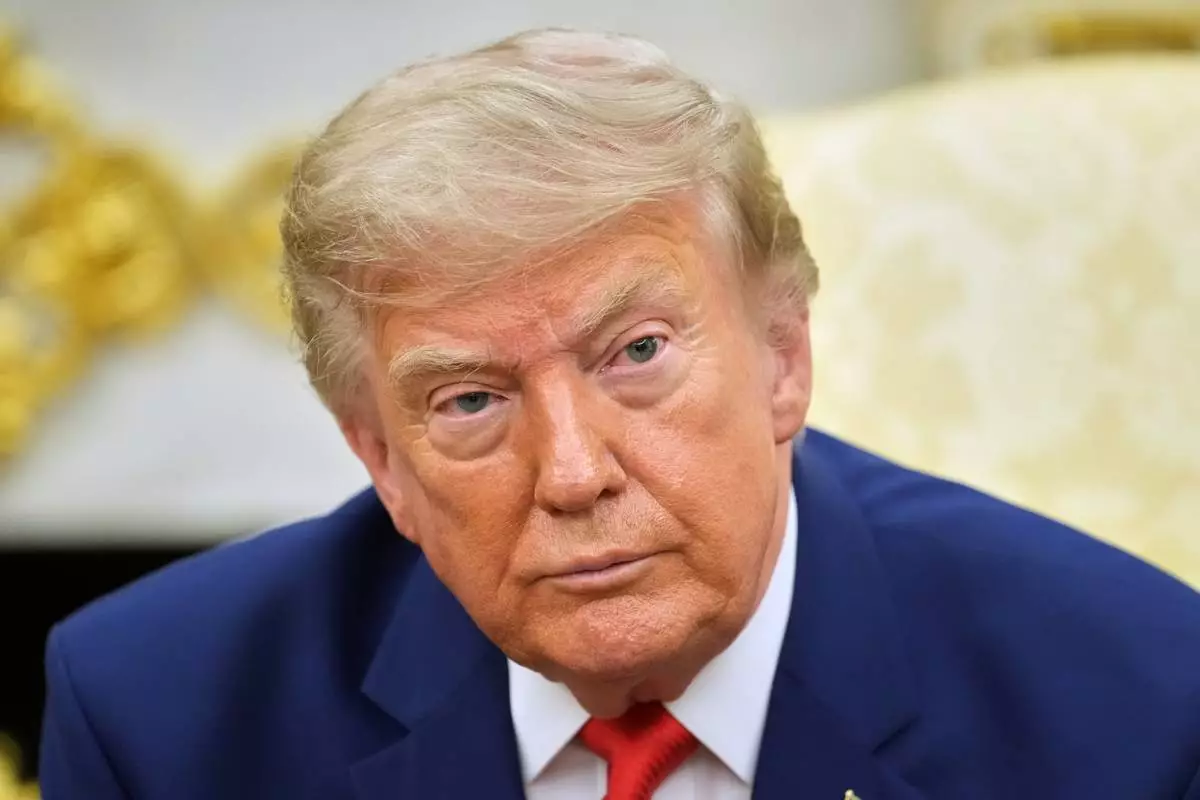
Lebanese President Joseph Aoun listens as he meets with President Donald Trump in the Oval Office at the White House, Tuesday, July 21, 2026, in Washington. (AP Photo/Mark Schiefelbein)