The meeting between the Chinese and U.S. presidents which captured worldwide attention resulted in the most important political consensus on building a constructive bilateral relationship of strategic stability.
This new positioning not only provides strategic guidance for the bilateral relationship over the next three years and beyond, but also injects much-needed stability and certainty into the world.
U.S. President Donald Trump paid a state visit to China from May 13 to 15. It was the first visit by a U.S. president in almost nine years, and followed the two leaders' meeting last October in Busan, South Korea.
During the nearly nine hours of interactions, including formal talks, a welcoming banquet and smaller‑group exchanges, the two sides deepened mutual understanding, enhanced trust and advanced practical cooperation. President Xi also accepted President Trump's invitation to pay a return state visit to the United States in the autumn of 2026, underscoring that head-of-state diplomacy remains the anchor of the relationship.
At a time of mounting global uncertainty and accelerating changes unseen in a century, the consensus sends an important message: China and the United States should choose dialogue over confrontation, cooperation over conflict, and stability over turbulence.
The agreement represents an important attempt to answer the defining questions of the 21st century: Can China and the United States overcome the Thucydides Trap and create a new paradigm of major-country relations? Can the two countries meet global challenges together and provide greater stability for the world? Can they build a bright future together for the bilateral relations in the interest of the well-being of the two peoples and the future of humanity?
As Xi explained, the "constructive strategic stability" should be a positive stability with cooperation as the mainstay, a sound stability with moderate competition, a constant stability with manageable differences, and an enduring stability with promises of peace.
Analysts say these four dimensions form an integrated vision for how the two major powers should coexist, a strategic blueprint that serves the interests of both nations and meets the world's expectations.
The new positioning is not just a slogan; it must be translated into actions of moving toward the same direction. The most critical thing is to respect each other's core interests and major concerns.
The Taiwan question is the most important issue in China-U.S. relations and concerns the political foundation of bilateral ties. During their meeting, President Xi stressed that maintaining peace and stability in the Taiwan Strait is the greatest common denominator for both sides, and the U.S. side must handle the Taiwan question with the utmost prudence. During the summit, the Chinese side felt that the U.S. side understands China's position, attaches importance to its concerns, and, like the international community, neither recognizes nor accepts Taiwan secession. Meanwhile, economic and trade relations should continue to serve as the 'ballast' and 'propeller' of China-U.S. relations. With over 7,000 Chinese companies in the United States and around 80,000 U.S. firms in China — and American companies have led in exhibition space at the China International Import Expo for seven consecutive years — the two economies are deeply intertwined. After seven rounds of trade talks over the past year, a hard-won stabilization has been achieved, which both sides value.
During this summit, the Chinese side once again welcomed the United States to strengthen mutually beneficial cooperation with China. President Trump encouraged the American business leaders accompanying him, including NVIDIA's Jensen Huang and Apple's Tim Cook, to expand their engagement with China. They praised China's innovation capacity, its strong market and promising growth outlook.
As the most important bilateral relationship in the world today, China-U.S. relations not only bear on the well-being of more than 1.7 billion people in the two countries, but also affect the interests of over 8 billion people worldwide.
The two leaders also exchanged views on the Middle East, the Ukraine crisis and the Korean Peninsula. China elaborated its position on the Middle East that force cannot solve the problem and dialogue is the only right way. On Ukraine, both expressed a desire to see an early end to the war and agreed to stay in communication for a political solution. They also pledged mutual support for the success of this year's APEC Economic Leaders' Meeting and the G20 Summit.
This summit has provided the world with stable expectations, as stability between China and the United States is not just a bilateral matter but indeed a key factor in maintaining peace, balance and predictability in the international order.
This year marks the beginning of China's 15th Five-Year Plan and the 250th anniversary of American independence. In this critical year, guided by the new bilateral paradigm, the giant ship of China-U.S. relations has set sail on a new journey.
The task now is to translate the leaders' vision into concrete policies and actions, making 2026 a historic and landmark year. Time will tell that the great rejuvenation of the Chinese nation and the goal of 'making America great again' can go hand in hand, complement each other, and benefit the world.
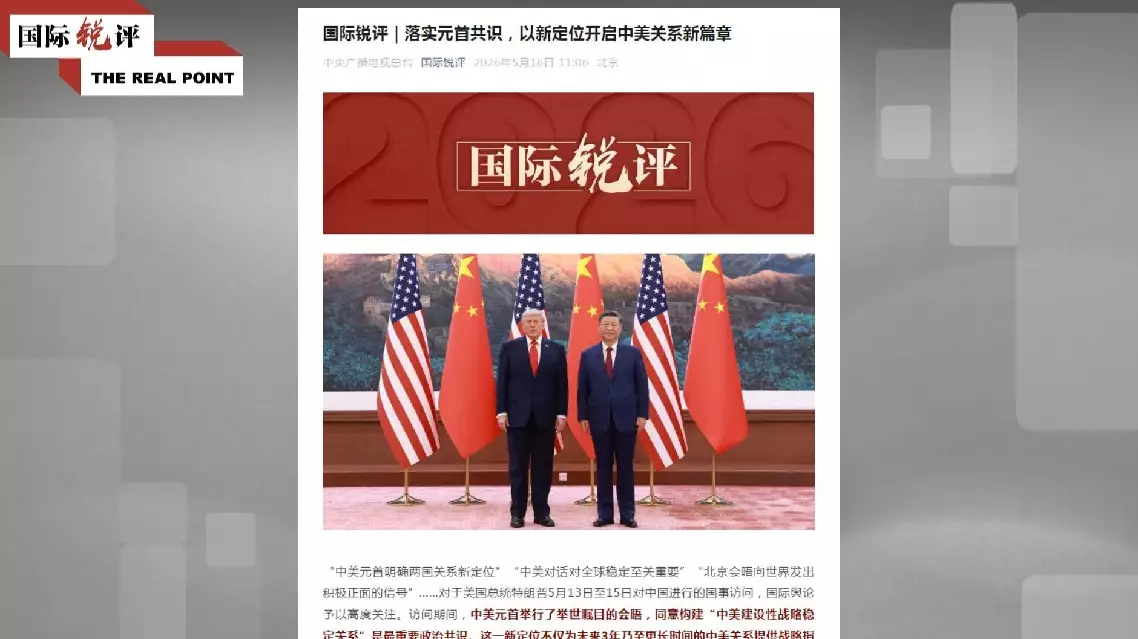
New bilateral paradigm opens constructive chapter for China-US relations: commentary