NEWPORT NEWS, Va. (AP) — A former assistant principal at an elementary school in Virginia is due in court for trial, accused of ignoring warnings that a 6-year-old student brought a loaded gun to school that was later used to shoot his first-grade teacher.
Ebony Parker's criminal trial is set to start Monday in Newport News, Virginia.
Parker is charged with eight counts of felony child neglect, one for each of the eight bullets in the gun that was brought into the classroom of Richneck Elementary schoolteacher Abby Zwerner in January 2023, prosecutors have said. Each count carries a maximum penalty of five years in prison upon conviction.
The charges allege Parker “did commit a willful act or omission in the care of such students, in a manner so gross, wanton and culpable as to show a reckless disregard for human life,” according to court documents.
Criminal charges against school officials following a school shooting are quite rare, experts say. The shooting sent shock waves through this military shipbuilding community and the country at large, with many wondering how a child so young could gain access to a gun and shoot his teacher.
Last November a jury awarded $10 million to Zwerner, siding with her claims in a lawsuit that Parker, an ex-assistant principal, ignored repeated warnings that the child had a gun.
Zwerner was shot as she sat at a reading table in her classroom. Sher spent nearly two weeks in the hospital, required six surgeries and does not have the full use of her left hand. A bullet narrowly missed her heart and remains in her chest.
Parker was the only defendant in the lawsuit. A judge previously dismissed the district’s superintendent and the school principal as defendants.
The lawsuit said Parker had a duty to protect Zwerner and others from harm after being told about the gun. Zwerner’s attorneys said Parker failed to act in the hours before the shooting after several school staff members told her that the student had a gun in his backpack.
Zwerner testified she first heard about the gun prior to class recess from a reading specialist who had been tipped off by students. The shooting occurred a few hours later. Despite her injuries, Zwerner was able to hustle her students out of the classroom. She eventually passed out in the school office.
Zwerner is scheduled to testify in the criminal case, according to court records.
The student’s mother was sentenced to nearly four years in prison for felony child neglect and federal weapons charges. Her son told authorities he climbed to the top of a dresser to retrieve the gun from his mother's purse.

FILE - Former Richneck Elementary School assistant principal Ebony Parker looks back into the courtroom during Abby Zwerner's lawsuit against her on Oct. 28, 2025, in Newport News, Va. (Stephen M. Katz/The Virginian-Pilot via AP, Pool, File)
WELLINGTON, New Zealand (AP) — They call themselves the Flying Kiwis, an eclectic group of New Zealanders from around the world who, whenever their national soccer team plays a major match, assemble to provide raucous and usually outnumbered support.
The deliberate irony: Kiwis — the eponymous bird from which New Zealanders take their nickname — are flightless.
Since 2009 the Flying Kiwis have followed the New Zealand men's team at home and overseas and they'll be at the World Cup, offering a small island of loud, proud and distinctly Kiwi support.
In 2009, New Zealand played Bahrain in a two-game qualifying series, with the winner advancing to the 2010 World Cup in South Africa. After the first leg in Bahrain ended in a 0-0, New Zealand needed a win in the return match at home to qualify for the World Cup.
Matt Fejos, who was then a university student and, he admits, not a hard-core football fan, wanted to lend as much spirit as possible to the New Zealand team.
“So I got a credit card with a $1,000 limit and I bought 32 tickets for my mates and we wanted to do all we could, so we got banners and we got the coveralls saying Flying Kiwis and we got New Zealand flags,” Fejos said. “That was a pretty memorable moment for anyone who was there and for football to arrive in New Zealand a little bit.”
Now those friends are spread around the world and have brought in other friends to the Flying Kiwis.
“I had 10 years living in the UK, so with the Confederations Cup in Russia in 2017, there were 30 of us who went to that and it was kind of a special experience,” Fejos said. Russian people “organized a friendly game between our fans and their fans and it brought in another kind of meaning for me: that you’re doing it for your team but actually in far away places you might be the first New Zealanders they’ve ever met, so you’re kind of representing your country.
“To connect with the world through the global language of football is a beautiful thing and a beautiful way to travel.”
The Flying Kiwis had to find their way to their own brand of fandom. Soccer is not the major sport in New Zealand, where rugby holds sway. The soccer traditions that are firmly fixed in the culture of other countries don’t exist at home, so Fejos and his friends have made their own.
The Flying Kiwis support section is usually small in number compared with the fan bases of New Zealand’s opponents but, Fejos said, “There’s advantages to being so small — we can be really unified.”
The New Zealand team will probably need all the support it can get at the World Cup. Ranked No. 85 in the world, they are drawn in Group G against No. 9 Belgium, No. 21 Iran and No. 29 Egypt.
“There’s so much more belief (among the New Zealand team) because of where the players are playing,” Fejos said of the foreign-based national team members. “There’s so many more playing at a top, top standard and in these difficult environments, these really charged atmospheres with crazy passionate fans. So they’re used to playing under that pressure as well.”
The kiwi isn't the most intimidating of national symbols compared with other mascots such as eagles or lions.
“Sometimes it can seem a bit funny or deprecating but it’s a thing that means a lot,” Fejos said. “The Kiwi is a flightless bird but when you consider the challenges that we face: we’re so isolated, so far away from the world, the professional game is very young here, there are not many professional academies or opportunities.
“Despite that, I think it’s incredible for some of those (New Zealand) players to play in some of the best leagues of the world and to take it to the world at a World Cup."
Fejos said the “metaphor means a lot, defying expectations overseas.”
“People think of us as a rugby country, and probably as hobbits, but that allows us to go in with that underdog mentality, fearless,” he said. "We want to stamp our mark and show them something different.”
AP soccer: https://apnews.com/hub/soccer
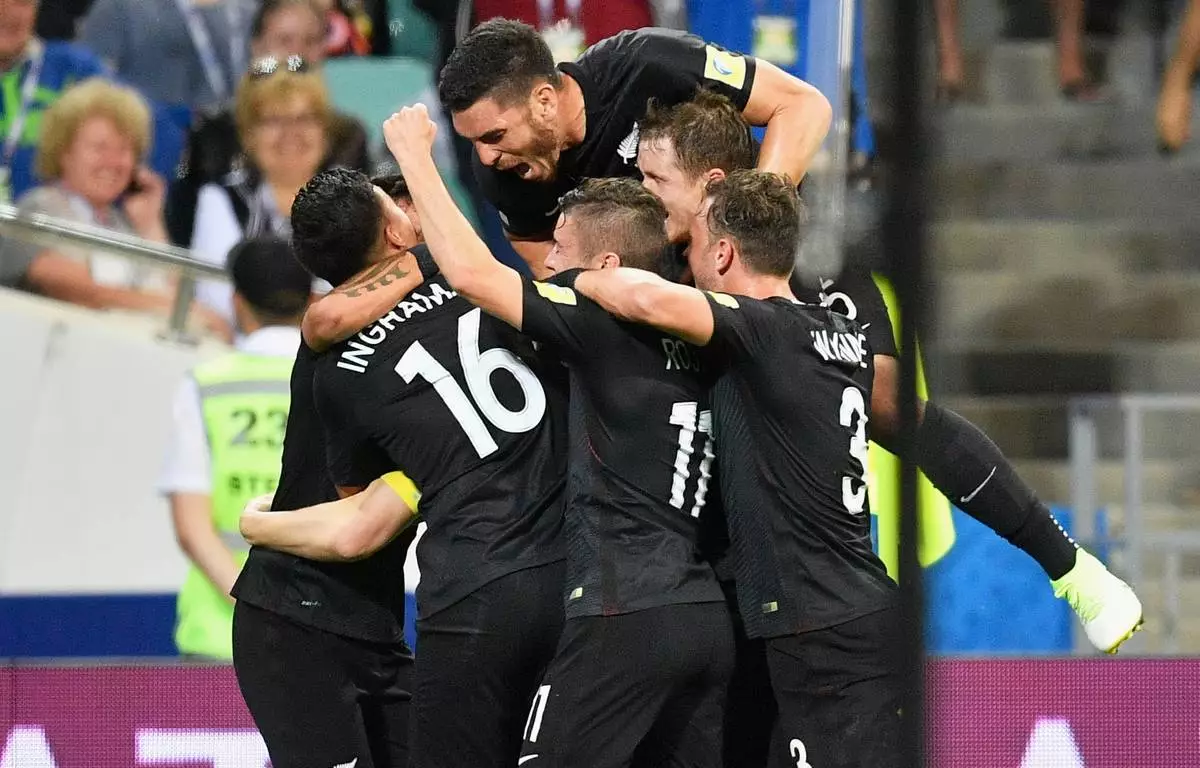
FILE - New Zealand's players celebrate after Chris Wood scored during their Confederations Cup Group A soccer match against Mexico in Sochi, Russia, June 21, 2017. (AP Photo/Martin Meissner, File)