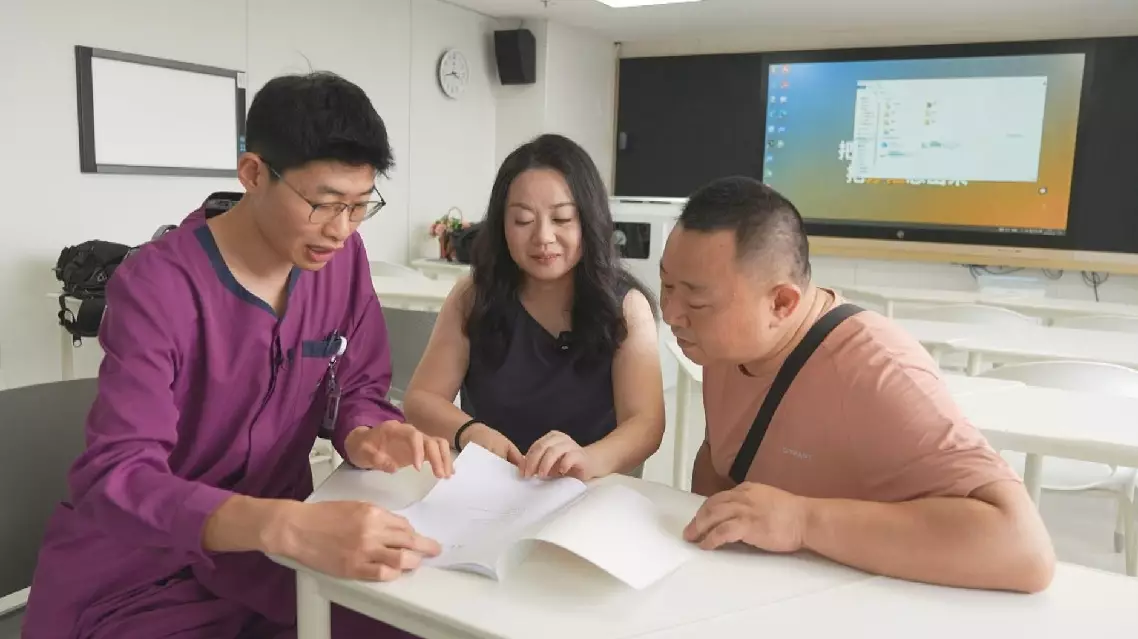
Sun Guotao, a male nurse at the Center of Critical Care Medicine of the First Hospital Affiliated to the Army Medical University (AMU), has been recording "missing moments" for patients during their intensive care unit (ICU) stay, filling the gaps in their memories with diary entries.
While still an intern at a hospital in Lanzhou, northwest China's Gansu Province two years ago, Sun began using his time off to write diaries documenting what the patients experienced while unconscious in the ICU.
After graduating last year and joining the First Hospital Affiliated to the AMU, Sun carried this habit with him.
"The ICU is an isolated place, no family members, no friends, and the patients may experience pain from various invasive procedures. After being discharged from the ICU, they may show symptoms of anxiety or depression, which may have a significant psychological impact on them. As an observer, writing those moments into a diary for them may serve as a source of encouragement," Sun explained the reason for this habit.
ICU work has always been high-intensity for nurses like Sun: turning and patting the patients' backs once every two hours, keeping a constant eye on the vital signs on the monitors.
By the end of a shift, Sun's uniform is often soaked through with sweat.
Sun has completed diaries for over 40 patients. Before each entry, he seeks the family's consent.
He started by writing by hand, then switched to a computer. In addition to recording facts, he also pastes photos of key moments.
"After work, I may spend one or two hours recalling what happened to the patients that day and what their family members said. Sometimes I would use my phone to record. If I'm unsure about something, I would ask the doctor in charge or check the medical records to see what changes occurred that day," he said.
Xiao Dandan, a patient, was admitted to the ICU due to an acute heart attack over a month ago.
Her condition was critical. She was groggy and connected to numerous medical tubes. When she fully regained consciousness, she simply could not recall the memories of that time until she opened the diary.
Xiao Dandan's husband said that during her days in the ICU, he could only see her for a little over ten minutes each day through the visitation window.
The diary filled in the days and nights he could not witness and the moments he could not be by her bedside.
This work now is no longer something Sun does alone.
Sun's colleagues in the department support him wholeheartedly and have formed an "ICU Diary Group," taking turns to take photos, take notes, and organize records for patients.
What started as one person writing has become a collective effort. The diary has turned nursing theory into reality.
Studies have shown that ICU diaries can effectively reduce the incidence of post-traumatic stress disorder (PTSD) in patients, as well as alleviate anxiety and depression.
Sun recalled how his own mother was once in the ICU, an experience that gave him deeper empathy for patients' family members.
"I was once a family member of an ICU patient. When I was in middle school, my mother was also in the ICU. Now, I can understand what family members are going through, both from a patient's perspective and from a medical worker's perspective. We not only need to be skilled medical personnel, but also must offer warmth to our patients. I want to be a nurse who brings warmth to patients," Sun said.
ICU nurse writes diaries to fill patients' missing memories