Belarus said Monday it launched joint drills with Russia to practice the use of nuclear weapons that Moscow has deployed on the territory of its neighbor and ally.
Belarus' authoritarian President Alexander Lukashenko has allowed Russia to deploy some of its tactical nuclear weapons to his country. In December, Russia also announced that its latest intermediate range nuclear-capable Oreshnik missile system entered service in Belarus, which borders Ukraine and NATO members Poland, Latvia and Lithuania.
The Belarusian Defense Ministry said that the drills will involve missile units and warplanes.
“During the exercise, in cooperation with the Russian side, it is planned to practice the delivery of nuclear weapons and preparations for their use,” the ministry said in a statement. It said the drills will focus on training forces to move covertly across large distances.
It said the maneuvers had been planned in advance and weren’t aimed against any third countries.
Lukashenko has ruled the nation of 9.5 million with an iron fist for more than three decades. His government has been repeatedly sanctioned by the West for its crackdown on human rights and for allowing Moscow to use its territory for the invasion of Ukraine in February 2022.
In 2024, the Kremlin released a revised nuclear doctrine that placed Belarus under the Russian nuclear umbrella. Russian President Vladimir Putin has said that Moscow will retain control of its nuclear weapons deployed to Belarus, but would allow its ally to select the targets in case of conflict.
Russia has used a conventionally armed version of the Oreshnik — Russian for hazelnut tree — to strike facilities in Ukraine on two occasions — in November 2024 and then again in January.
Putin has claimed that Oreshnik’s multiple warheads plunge at speeds of up to Mach 10 and can’t be intercepted, and that several such missiles used in a conventional strike could be as devastating as a nuclear attack.
Intermediate-range missiles can fly between 500 to 5,500 kilometers (310 to 3,400 miles). Such weapons were banned under a Soviet-era treaty that Washington and Moscow abandoned in 2019.
Belarusian opposition leader Sviatlana Tsikhanouskaya criticized the drills, saying that the deployment of Russian nuclear weapons has “turned Belarus into a target.”
“Lukashenko has turned Belarus into a platform for Russian threats, but Belarusians don’t need these weapons,” Tsikhanouskaya told The Associated Press. “Only a free Belarus will become a source of security, not nuclear blackmail, in Europe.”
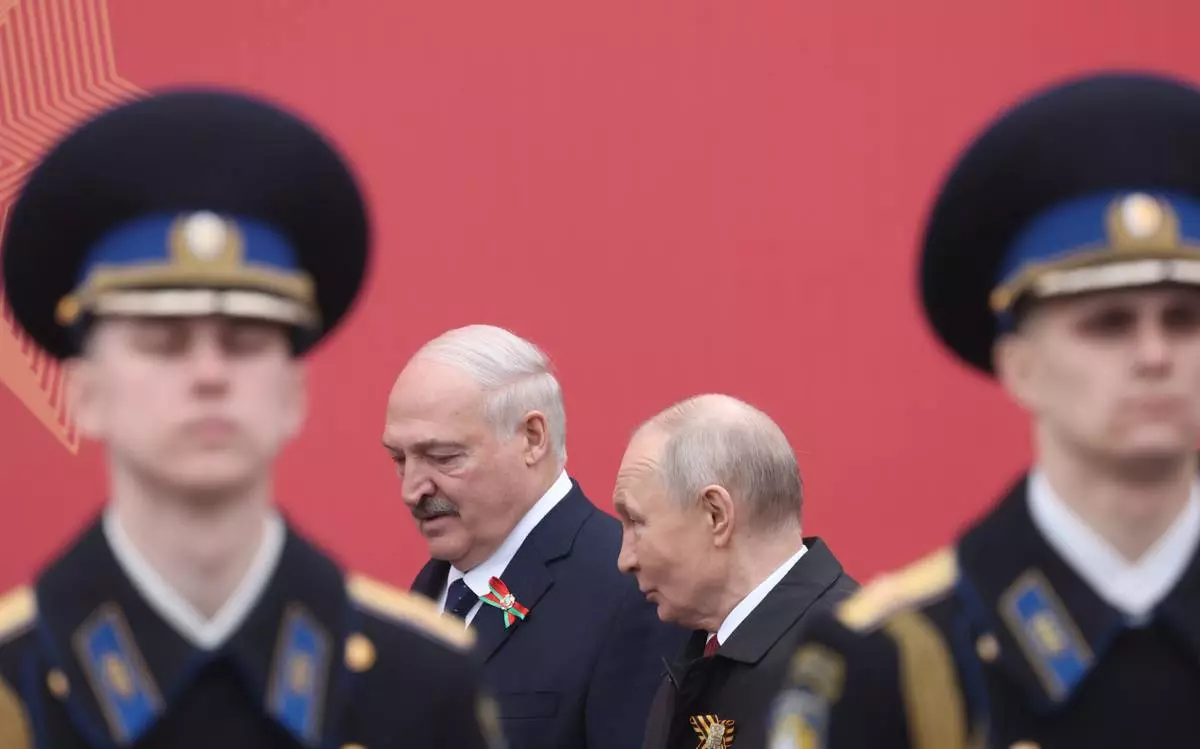
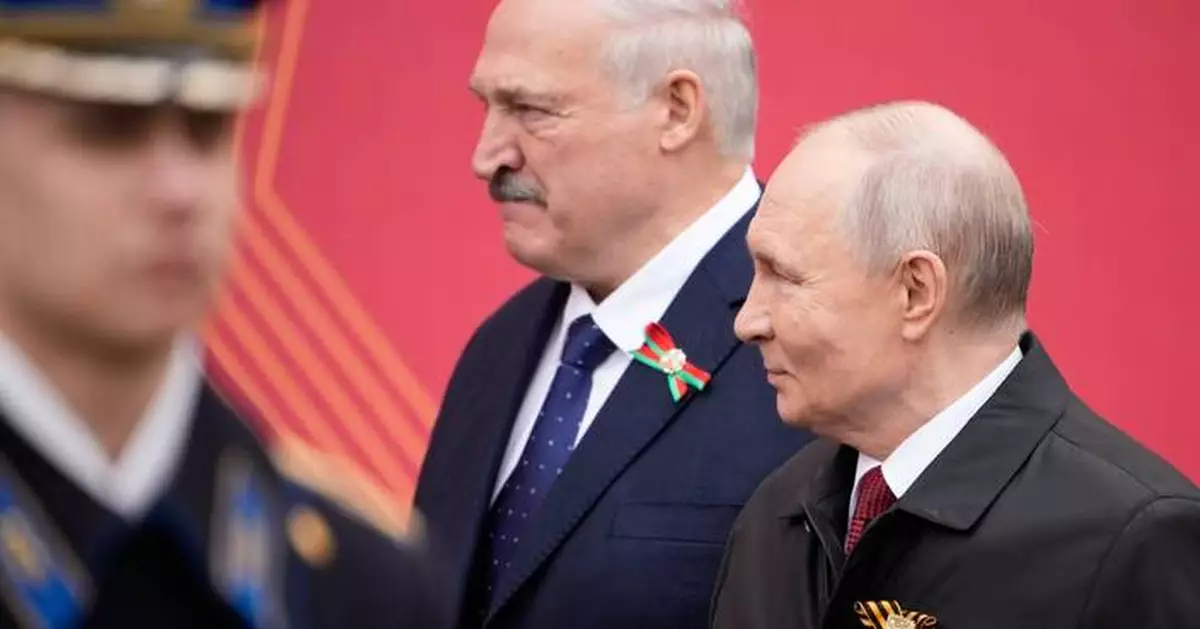
Belarusian President Alexander Lukashenko, centre left, and Russian President Vladimir Putin arrive for the Victory Day military parade in Moscow, Saturday, May 9, 2026, during celebrations of the 81st anniversary of the Soviet Union's victory over Nazi Germany during the World War II. (Maxim Shipenkov/Pool Photo via AP)
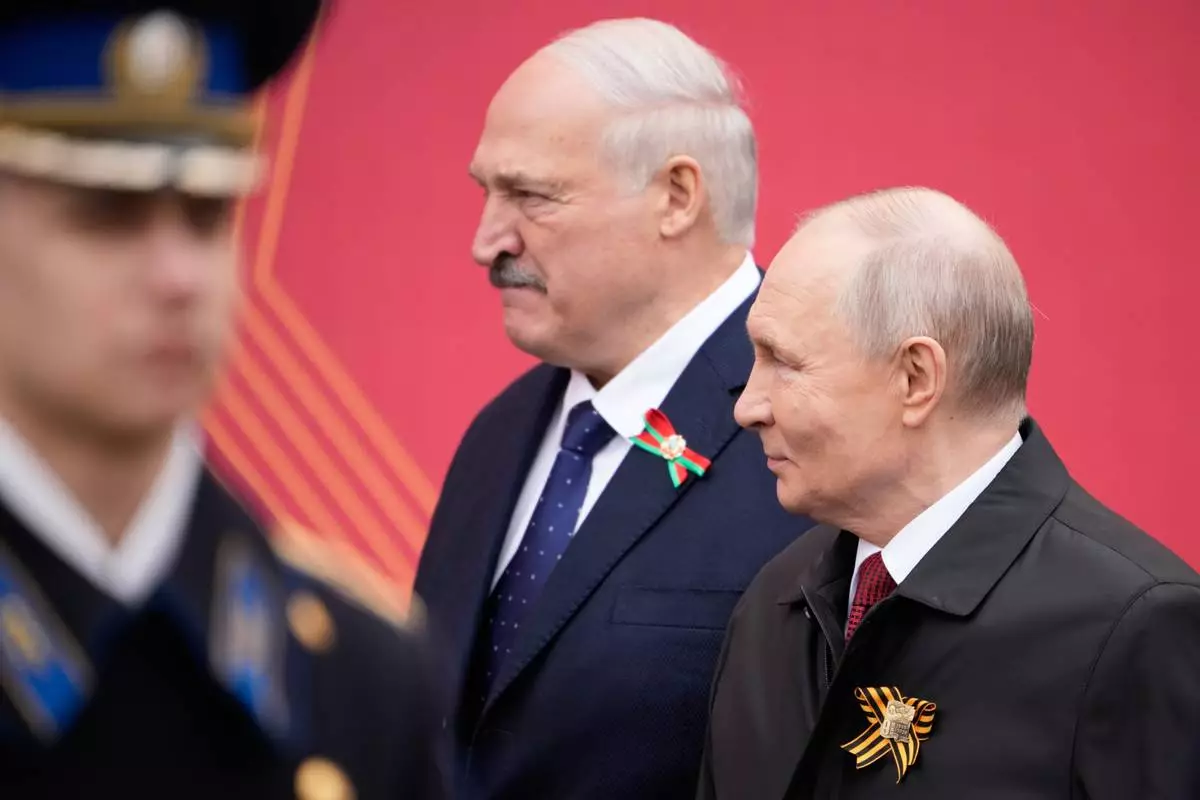
From left, Belarusian President Alexander Lukashenko and Russian President Vladimir Putin attend the Victory Day military parade in Moscow, Saturday, May 9, 2026, during celebrations of the 81st anniversary of the Soviet Union's victory over Nazi Germany during the World War II. (AP Photo/Pavel Bednyakov, Pool)
ACWORTH, Ga. (AP) — Georgia Rep. Mike Collins, who wants to take on Democratic Sen. Jon Ossoff in November, happily calls himself a warrior for President Donald Trump and his “Make America Great Again” movement.
Although it's a sensible calling card for anyone vying for a Republican nomination these days, even some of his supporters have a few concerns ahead of Tuesday's primary.
Gary Waldrep, a local party committee chairman, asked Collins at a recent campaign stop how he was going to win over at least a few of the “middle-of-the-road” voters who may have been turned off by Trump.
The question reflected Republican anxiety about the party's chances in Georgia, where Democrats have demonstrated strength in recent U.S. Senate elections and Ossoff is no longer considered as easy of a target as he once was.
“I watch the polls just like everybody else,” Waldrep said. “I know it’s going to be close.”
Collins is competing for the Republican nomination with Rep. Buddy Carter and Derek Dooley, a lawyer and former college football coach who is backed by outgoing Georgia Gov. Brian Kemp. Trump has not endorsed a candidate, raising the likelihood of a June 16 runoff that would burn more time and money before the party can focus on defeating Ossoff.
If Ossoff loses, Democrats have almost no chance of winning a Senate majority. He's the only senator from his party running for reelection in a state that Trump won two years ago.
Trump carried Georgia in two out of his three campaigns. Republicans control the Atlanta statehouse. But in the last six years, Ossoff and Sen. Raphael Warnock have won a combined three Senate contests, each time defeating a Republican who pledged fealty to Trump.
For this year's campaign, Kemp rebuffed Senate Republican leaders' encouragement to challenge Ossoff and declined to endorse either Collins or Carter. Instead, he recruited Dooley, a childhood family friend who is the son of legendary coach Vince Dooley, and tried to convince Georgia Republicans to take a chance on the first-time candidate.
“My goal is here is to win our Senate seat back,” Kemp said Friday as he introduced Dooley at a gun store in Douglasville. “We need a political outsider to do that.”
Dooley, 57, said in a recent interview that there are few if any policy differences among the candidates, “and so electability is everything.” And in his television advertising, he attempts to split the difference between Trump's base and the broader electorate.
“I’m gonna work with President Trump, but for you,” he tells voters in one spot.
Collins, 58, is a two-term House member who owns a trucking company and boasts of a “grassroots operation out there pounding the pavement across this state.”
The second-term House member has the advantage of representing a district east of Atlanta, putting him in the media market of the state’s population center. And he sponsored the Lakin Riley Act, named for a Georgia nursing student killed by a man who was also charged for being in the U.S. illegally. The law, signed by Trump last year, requires that immigrants accused of a range of crimes be held without bond.
“I have proven that I can deliver for the state of Georgia,” Collins said in Acworth. “I can even do it with bipartisan legislation. And I never compromise my conservative values.”
Collins also has a brash social media presence has both boosted his identity as a firebrand in Trump's mold and drawn criticism. Among his most controversial posts was sharing a video in 2024 of University of Mississippi students, nearly all of them white males, taunting a Black woman.
“Ole Miss taking care of business,” Collins wrote.
Carter is in his sixth term but represents a Savannah-based district, a less populous corner of Georgia that's rarely a launching pad for statewide campaigns. He's pulled back on advertising in the closing weeks before the primary, suggesting that he's lacking adequate financial support.
The 68-year-old pharmacist has targeted a House ethics investigation into whether Collins abused taxpayer funds by hiring the girlfriend of his former chief of staff — now his campaign adviser — for work that the woman allegedly did not perform.
“If taxpayers can’t trust you to properly steward their money, how can they trust you to be a U.S. senator?” Carter asked Collins in a recent debate.
“Buddy,” Collins shot back, “I can tell through the voice that you know how the polling is going out there.”
Dooley, meanwhile, is attempting to vault over his more experienced competitors.
“I come from a whole different world than they come from,” he said. “Both of those guys represent everything that I’m running against. I want to change how Washington does its business, and I want people up there for the right reasons.”
Kemp ran through a list of first-term Republican senators who did not hold elected office before, including Ohio's Bernie Moreno, Montana's Tim Sheehy and Pennsylvania's Dave McCormick.
“If you look around the country where Republicans have been successful beating Democratic incumbents, it has been political outsiders that have been victorious,” Kemp said.
The point, Dooley said, is that “you've got to have somebody that's going to stay on offense" without having a record to defend.
“It comes down to who can beat Jon Ossoff,” he said.
Barrow reported from Douglasville and Atlanta.
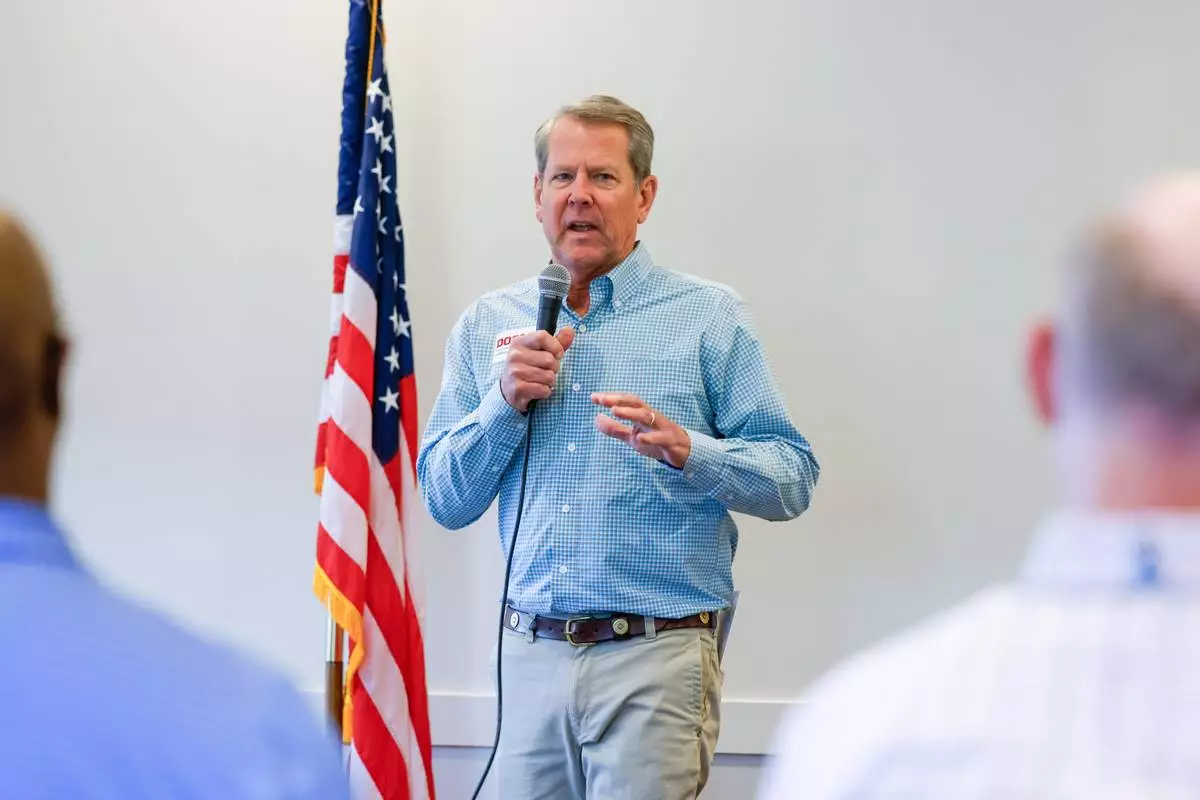
Gov. Brian Kemp speaks during a campaign stop for Republican U.S. Senate candidate Derek Dooley at Farmview Market in Madison, Ga., on May 8, 2026. (Arvin Temkar/Atlanta Journal-Constitution via AP)