NEW YORK--(BUSINESS WIRE)--May 20, 2026--
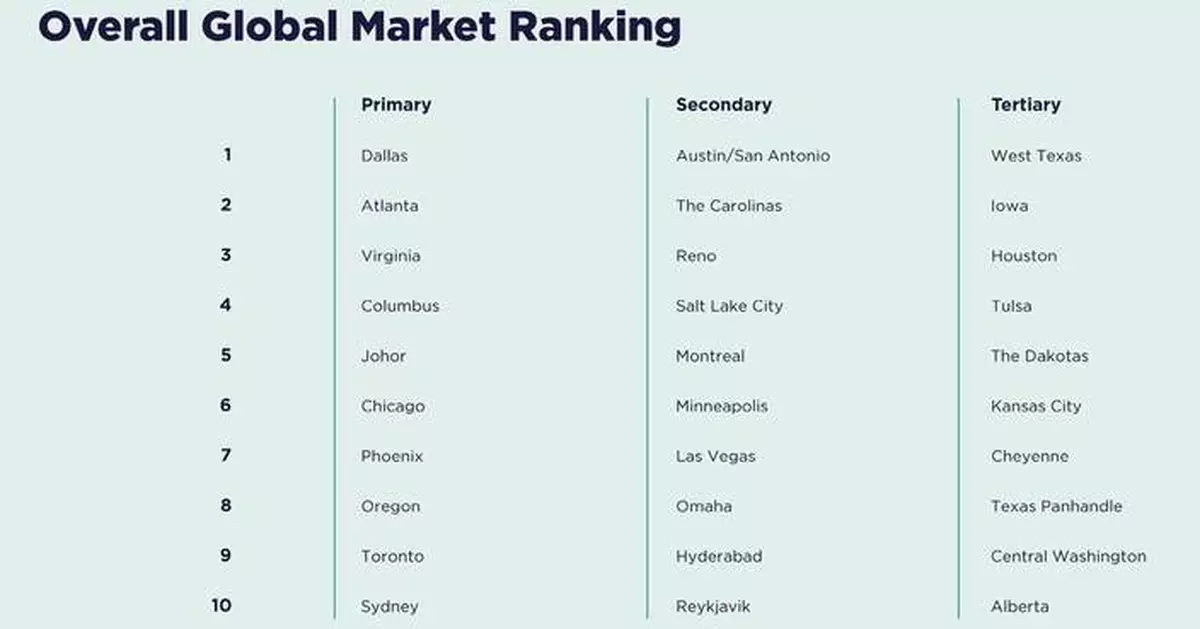
Global data center markets are entering a new phase of expansion defined not simply by growth, but by increasingly strategic and selective development, according to Cushman & Wakefield’s 2026 Global Data Center Market Comparison report. For the first time, Dallas ranked as the No. 1 primary data center market in the world, followed by Atlanta (2), Virginia (3), Columbus (4) and Johor (5). Austin-San Antonio and West Texas led the secondary and tertiary market rankings, underscoring Texas’ growing importance as a large-scale AI infrastructure hub.
This press release features multimedia. View the full release here: https://www.businesswire.com/news/home/20260520183490/en/
Driven by accelerating AI adoption, cloud computing demand and digital infrastructure investment, global capacity under construction approached 31.7 gigawatts (GW) in 2025, more than doubling from 12.5GW reported in the prior edition of the report. At the same time, developers, occupiers and investors are facing intensifying constraints tied to power availability, land use, permitting timelines and growing regulatory scrutiny.
“The global data center industry has entered a period of managed growth,” said John McWilliams, Head of Data Center Insights at Cushman & Wakefield. “Demand fundamentals remain extraordinarily strong, but the industry is no longer operating in an environment of unconstrained expansion. Power delivery timelines, land availability, community sentiment and regulation are now playing a much larger role in determining where and how data centers get built.”
The report analyzes 107 global markets across 24 variables tied to commercial real estate fundamentals, power infrastructure, development activity, regulation and operational risk and provides a more forward looking approach to evaluate market dynamics than previous editions.
Americas Continue to Dominate Global Development Activity
The Americas remain the center of global data center development activity, accounting for approximately 80% of all capacity currently under construction worldwide.
Virginia maintained its position as the world’s largest data center market with 11.3GW of operational capacity, while Texas emerged as one of the industry’s fastest-growing and most scalable regions as large scale data center development activity expands into numerous parts of the state.
The report highlights West Texas as a rapidly growing AI infrastructure hub, with 2.9GW currently under construction, exceeding the entire amount of capacity underway across the EMEA region.
“The scale of development occurring across parts of the U.S. is unprecedented from a commercial real estate perspective,” McWilliams said. “Developers are increasingly prioritizing markets that can provide scalable land, reliable power infrastructure and a regulatory environment supportive of long-term expansion.”
Across the Americas, preleasing activity remains exceptionally strong. Approximately 89% of capacity currently under construction is already pre-committed when hyperscale self-build activity is included, underscoring continued imbalance between supply and demand.
The report also notes that planned capacity across the Americas increased more than fourfold year-over-year, rising from 46.1GW in 2024 to 191.3GW by the end of 2025.
Power Availability Continues to be a Defining Commercial Real Estate Variable
According to the report, access to power has remained one of the defining variables shaping global data center development strategy.
Globally, average power delivery timelines for new large-load requests now stand at 4.4 years, with timelines extending to approximately five years across both the Americas and EMEA.
As a result, developers are increasingly pursuing powered land opportunities, integrating private generation into projects and expanding into secondary and tertiary markets where infrastructure constraints may be less severe.
“The industry’s focus has shifted from simply securing land to securing deliverable power,” said McWilliams. “That dynamic is fundamentally reshaping data center real estate strategy worldwide.”
The report also identifies growing divergence between markets able to support long-term AI infrastructure expansion and those facing mounting regulatory, infrastructure or community-related barriers to growth.
About the Report
The 2026 Global Data Center Market Comparison evaluates 107 global markets using 24 variables across market fundamentals, terrestrial considerations, power infrastructure and political/regulatory conditions. The report examines operational capacity, development pipelines, vacancy, absorption, cloud presence, land availability, power delivery timelines and other factors influencing global data center development decisions.
The full report can be found here.
About Cushman & Wakefield
Cushman & Wakefield (NYSE: CWK) is a leading global commercial real estate services firm for occupiers and investors with approximately 53,000 employees in over 350 offices and nearly 60 countries. In 2025, the firm reported revenue of $10.3 billion across its core service lines of Services, Leasing, Capital markets, and Valuation and other. Built around the belief that Better never settles, the firm receives numerous industry and business accolades for its award-winning culture. For additional information, visit www.cushmanwakefield.com.
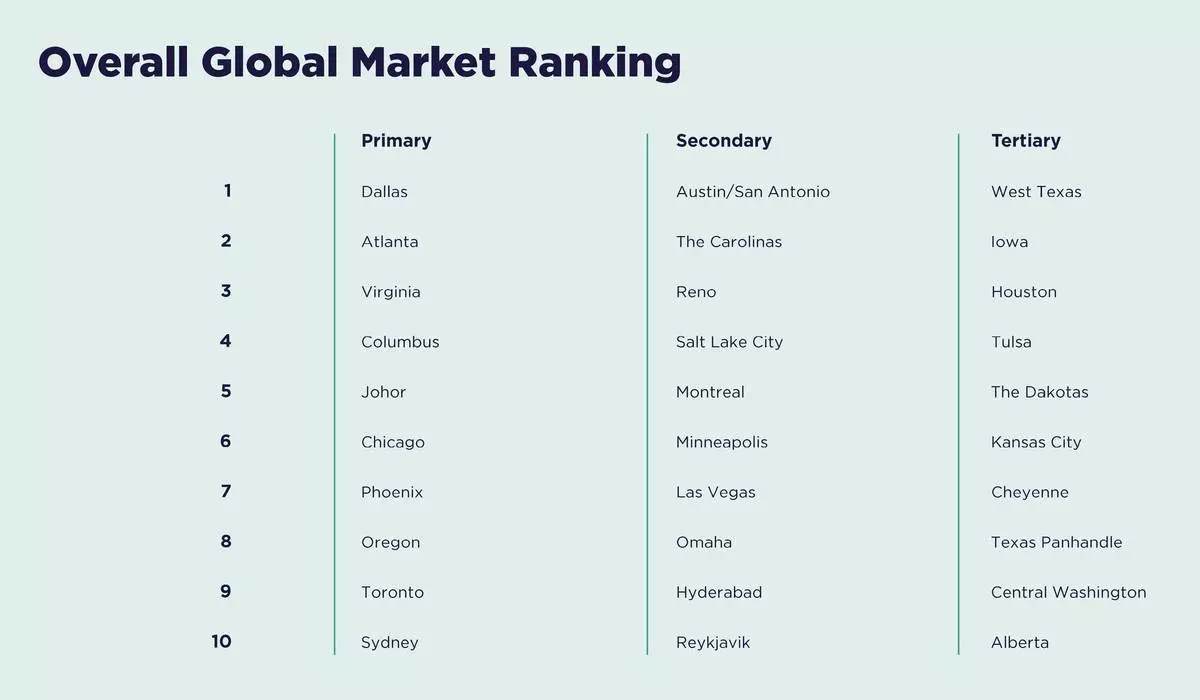
Top cities for data centers as ranked by Cushman & Wakefield's 2026 Global Data Center Market Comparison