Villagers who once struggled to survive on barren land in southwest China's Xizang Autonomous Region have seen their life improve remarkably since relocating to a new village about a decade ago under a government poverty alleviation initiative.
On the banks of the Lhasa River lies Sanyou Village -- the first poverty-alleviation resettlement village relocated in Xizang.
In 2006, the Lhasa government spent about 40 million yuan (about 5.7 million U.S. dollars) to build 184 houses on what had been rocky land.
Sanyou is not a traditional Tibetan village name. Translated as "three haves," the name is shortened from "have health, house and jobs."
Sanyou's residents came from 10 villages in Qushui County. Houses in Sanyou are mostly two-story buildings with white walls, golden-lacquered doors, and yards.
Though some villagers hesitated at first about leaving their old villages, many volunteered as soon as they learned about the news.
Built in just five months, the small village is now brimming with happiness as every resident has housing, a job, and access to healthcare.
An American journalist recently visited the village to see for himself the real life of local residents.
"When I heard we could move into a new village, I was overwhelmed with joy. Back in the old village, it was tough to build a house on our own. We didn't have the manpower and the resources. So when I heard the government was building new homes for us and that we could move in, I felt thrilled. That's why I signed up and volunteered to relocate," said Wangdu, a villager.
Today, the village is home to a "happiness station" that cares for the elderly and those unable to live independently, a kindergarten, and even factories and workshops.
The factories and workshops are rented out to small business owners, bringing income to the village while also creating jobs for locals.
Behind all this is the tireless work of grassroots cadres, passing the baton year after year.
"We now have quite a few village-based officials. The main goal is to ensure the villagers' life, including their income and education, continue to improve. Every year, we have rotating officials assigned to base in villages across the region, to supervise or offer support wherever and whenever needed," said Huade Mallah, first secretary of the CPC branch of Sanyou Village.
This year marks the 75th anniversary of the peaceful liberation of Xizang. Over the past decades, Xizang has undergone a profound transformation across various fields.
In 1951, the average life expectancy stood at just 35.5 years. Today, that figure has more than doubled, reaching 72.5 years. The population has also grown from 1.2 million to over 3.6 million.
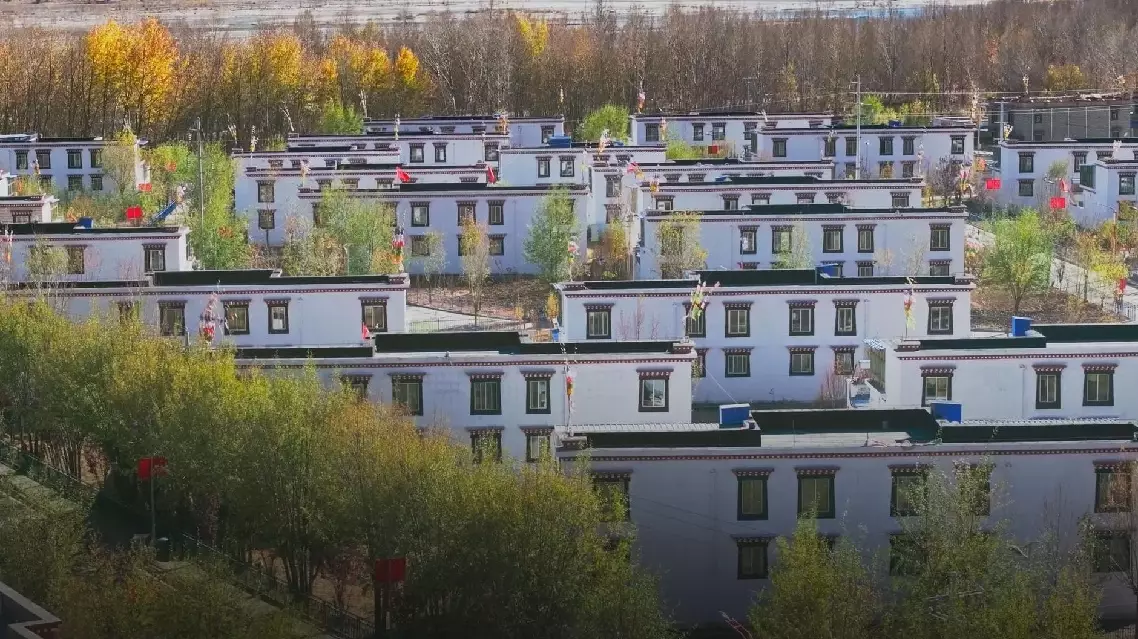
Relocated Tibetan villagers experience remarkable life improvement