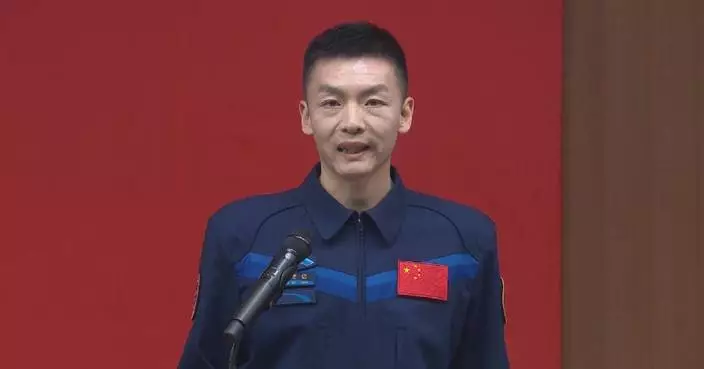
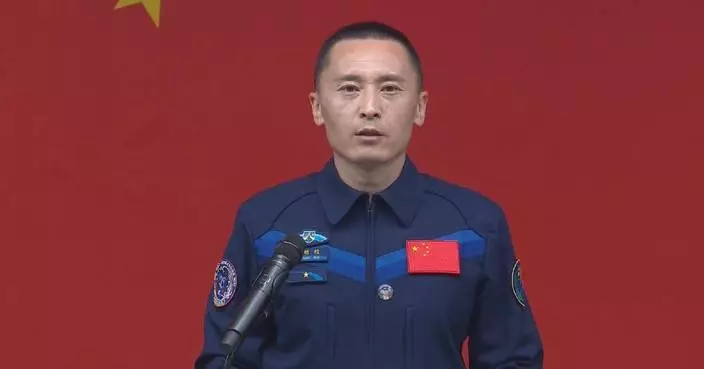
Chinese astronauts Zhu Yangzhu, Zhang Zhiyuan and Lai Ka-ying said they have been well prepared for the Shenzhou-23 crewed spaceflight mission and are confident to perform their respective duties as a flight engineer, a spacecraft pilot and a payload specialist.
The Shenzhou-23 crewed spaceship is scheduled to be launched at 23:08 Sunday from the Jiuquan Satellite Launch Center in northwest China, the China Manned Space Agency announced at a press briefing on Saturday.
Zhu once participated in the Shenzhou-16 space mission. Zhang and Lai come from the third and fourth batches of astronauts, respectively, and will embark on their first spaceflight mission.
"This time I will be the commander, meaning that I should have an overall understanding and coordination of the entire mission. The commander is required to consider more about how to deal with emergency situations, how to make decisions, and how to coordinate task arrangements. I feel a greater responsibility and a more glorious mission," said Zhu Yangzhu, commander of the Shenzhou-23 crewed spaceflight mission.
Before being selected, Zhang served as a fighter pilot in the Chinese People's Liberation Army (PLA) Air Force.
In addition to his main job as a spacecraft pilot, Zhang is also responsible for recording relevant data in space life science and human research.
"I will actively cooperate with the ground crew and truthfully and objectively report my physical condition and any related changes to them, so as to provide more intuitive data and results for their scientific research," said Zhang Zhiyuan, an astronaut of the Shenzhou-23 crewed spaceflight mission.
Born and raised in Hong Kong, Lai had worked for the Hong Kong Police Force before being selected as an astronaut. She has a doctoral degree in computer forensics.
Her dream of space exploration, like many others, was ignited in 2003, when China sent its first astronaut Yang Liwei into space.
"I saw some clips on the news with my family, in which Yang chatted with overseas Chinese. One of them told Yang that the higher our Chinese spacecraft fly, the higher we Chinese people can hold up our heads. The statement was quite touching, and I couldn't help shedding tears. At that time, the might of our country impressed my deeply," said Lai Ka-ying, another astronaut of the Shenzhou-23 crewed spaceflight mission. Lai joined the astronaut corps in August 2024.
"First of all, I would like to pay tribute to those female astronauts. They are all particularly outstanding women. Wang Yaping and Liu Yang are pilots, Wang Haoze is an engineer, and I am a payload specialist, so we play different roles in the spaceflight mission. I will mainly take charge of the payload and conduct precise experiments. Moreover, as I come from the Hong Kong Special Administrative Region (HKSAR), I have an additional task: to serve as a bridge between the HKSAR, the Macao Special Administrative Region and the aerospace industry of our motherland," Lai said.
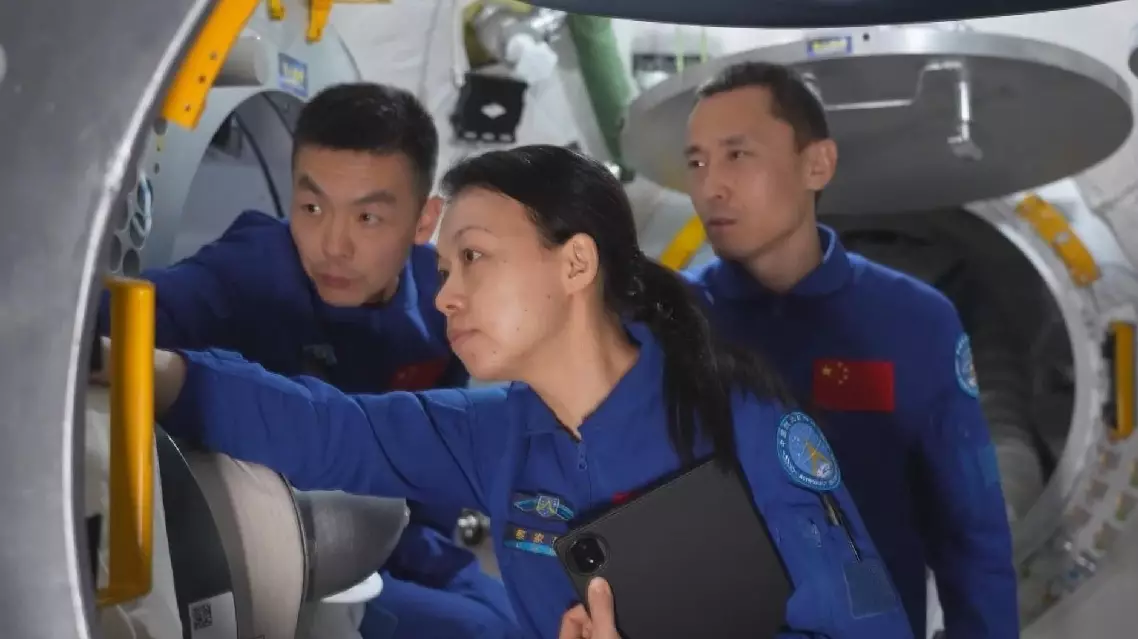
China's Shenzhou-23 crew well prepared for glorious mission