CINCINNATI (AP) — The first time 5-year-old Calvin Owens went outside in more than a month, he met up with his canine friend Hadley on a hospital patio. Despite being tethered to equipment with wires and tubes, the little boy managed to stand up near his wheelchair long enough to toss her a ball.
He smiled as she ran to fetch it. Caregivers cheered.
Click to Gallery
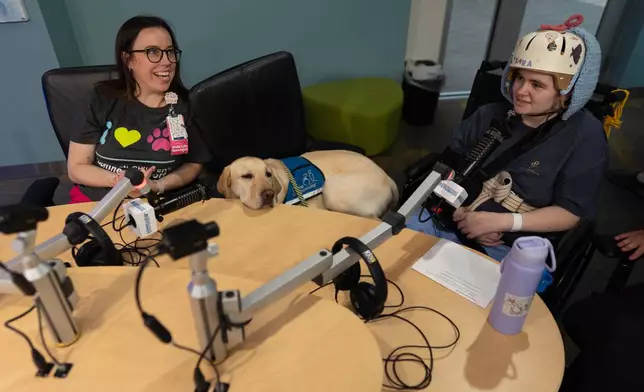
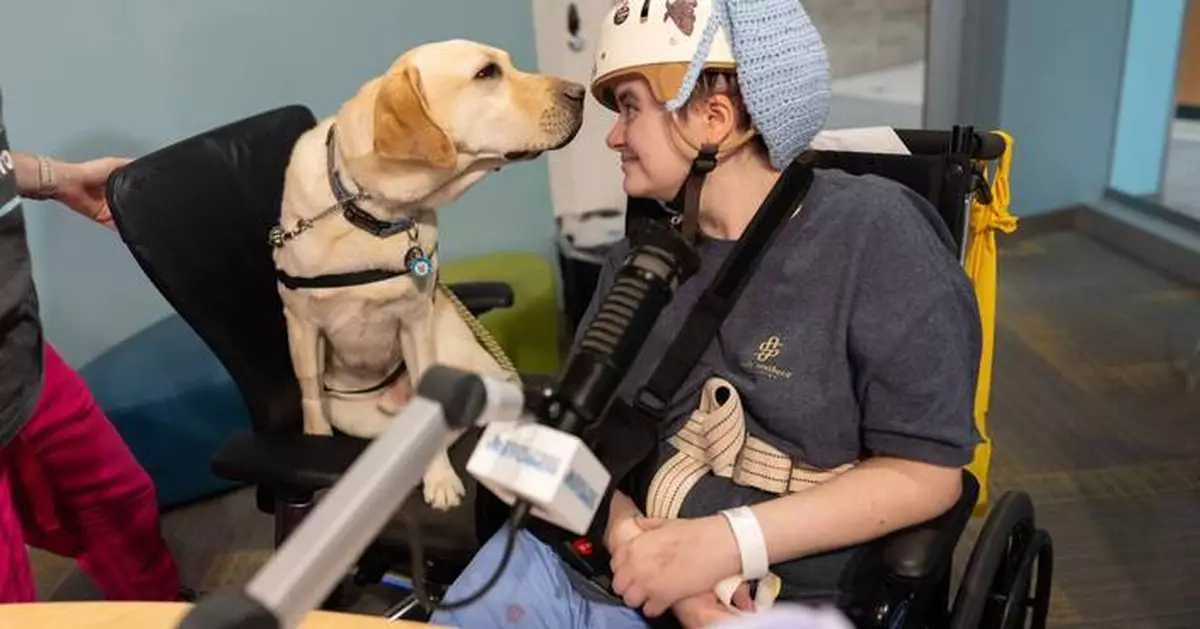
Cincinnati Children's Hospital Child Life Specialist Maggie O'Grady, left, and facility dog Grover, center, work with patient Kira Hodge at the hospital's Seacrest Studios to produce a closed-circuit television show beamed into patient rooms, at Cincinnati Children's Hospital in Cincinnati, Monday, May 4, 2026. (AP Photo/Carolyn Kaster)
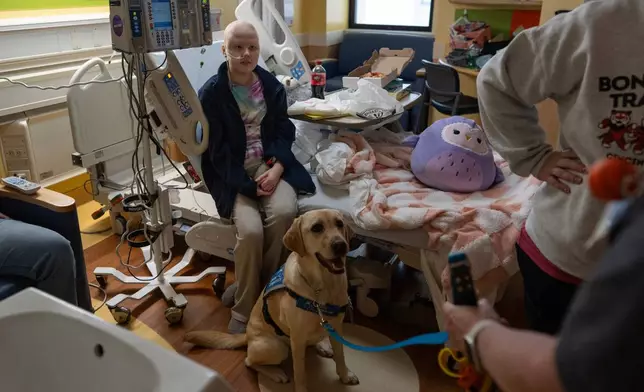
Cincinnati Children's Hospital facility dog Hadley sits at the feet of 11-year-old Bethany Striggles, who recently finished a chemotherapy treatment for bone cancer, in her room at Cincinnati Children's Hospital in Cincinnati, Monday, May 4, 2026. (AP Photo/Carolyn Kaster)
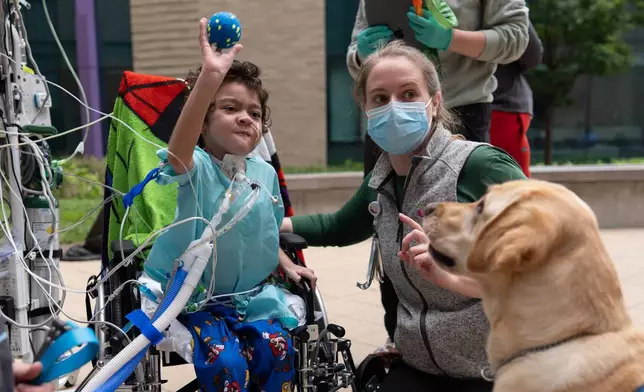
Five-year-old patient Calvin Owens throws a ball for facility dog Hadley with physical therapist Paige Torbet, right, during a physical therapy visit on the patio of Cincinnati Children's Hospital in Cincinnati, Monday, May 4, 2026. (AP Photo/Carolyn Kaster)
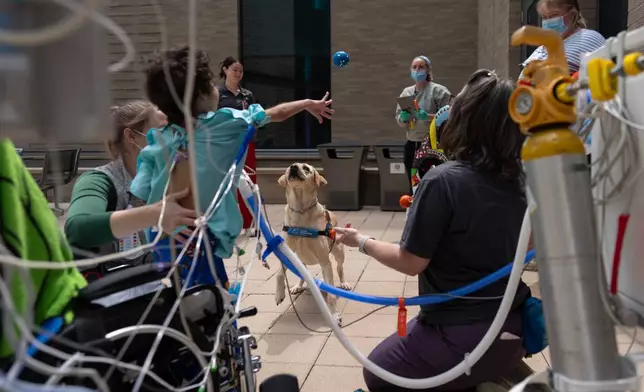
Five-year-old patient Calvin Owens, second from left, throws a ball for facility dog Hadley with physical therapist Paige Torbet, kneeling left, and child life assistant Schellie Scott, kneeling right, during a physical therapy visit on the patio of Cincinnati Children's Hospital in Cincinnati, Monday, May 4, 2026. (AP Photo/Carolyn Kaster)
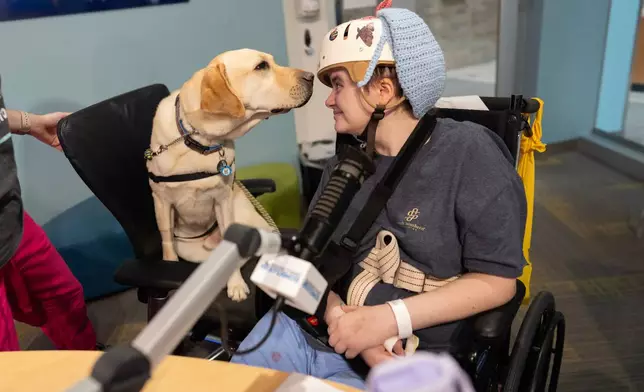
Cincinnati Children's Hospital facility dog Grover, left, looks to patient Kira Hodge at the hospital's Seacrest Studios as they produce a closed-circuit television show beamed into patient rooms, at Cincinnati Children's Hospital in Cincinnati, Monday, May 4, 2026. (AP Photo/Carolyn Kaster)
“Look how good you’re doing!” said Hadley's handler, Schellie Scott.
Such small victories and moments of joy are common whenever Hadley or one of the other three facility dogs at Cincinnati Children’s Hospital show up. These furry caregivers aren’t the typical therapy dogs volunteers bring to hospitals to comfort patients. They are specially trained, full-time working dogs that provide emotional support during stressful procedures, motivate kids to move around and make hospitals seem less scary. And experts say their ranks are growing at children’s hospitals across the nation.
A mounting body of research shows that even short interactions with facility dogs can improve children’s overall well-being, decrease the pain they feel and reduce signs of stress, like cortisol levels and blood pressure.
“These dogs are making a real difference,” said Kerri Rodriguez, director of the Human-Animal Bond Lab at the University of Arizona. “They can provide a little bit of normalcy, a little bit of comfort, in a really stressful, sterile environment that kids might not feel comfortable in.”
Although no one tracks the number of facility dogs in children's hospitals, Rodriguez points to the continual growth of the annual Facility Dog Summit, where handlers and other participants network and where attendance nearly doubled from 2024 to 2025. Other types of hospitals also have full-time dogs, but experts say children's hospitals account for most of the expansion in programs. One large nonprofit, Canine Assistants in Georgia, has a specific children’s hospital initiative through which it has placed more than 80 dogs nationally.
Dogs have been on the job for years at places such as Mount Sinai Kravis Children’s Hospital in New York, Norton Children’s in Louisville, Kentucky, and St. Louis Children’s Hospital. And new programs keep sprouting up. In March, Johns Hopkins Children’s Center in Maryland introduced its first two facility dogs.
Hospitals generally get the dogs from nonprofits. Organizations such as Canine Companions, where Cincinnati Children's gets its dogs, breed, raise and train them, then place them with hospital staff members but still own them. Dogs and handlers live and work together.
Although hospitals don’t pay for the dogs, they’re responsible for costs such as food and veterinary care, which can add up, especially since most are larger breeds like Labradors or golden retrievers. Hospitals usually fundraise or seek grants to cover the costs.
Experts say the benefits of these sorts of “animal-assisted therapies” are clear. A 2022 study Rodriguez coauthored analyzed a survey conducted across 17 children's hospitals. Pediatric health professionals described how facility dogs provided a comforting presence, built rapport, and normalized the hospital environment for children and families. A 2021 study in the Journal of Pediatric Nursing concluded that animal- assisted therapies were beneficial for controlling pain and blood pressure in children and teens. Other research also found these therapies reduce anxiety and pain and can even improve heart and lung function.
Facility dogs are allowed in more sensitive areas of the hospital than volunteer dogs, and sometimes serve particular hospital units. Opal, one of two St. Louis dogs, splits her time between the pediatric behavioral health unit and the child protection program.
No matter where the dogs work, keeping them clean is key.
Hadley, in Cincinnati, is bathed twice a month because she works in the cancer and blood diseases area, where kids might have reduced immunity. She gets even more baths, or cleanings with special wipes, if she’s potentially exposed to germs. Handlers use leashes and balls that can be easily cleaned, and people must sanitize their hands before and after touching the dogs.
If a patient is in isolation, the dog stays outside the room. The one exception is if a dying child wants a dog to be close. In those cases, caregivers say concerns about germs are outweighed by the need to ease fears and provide comfort.
Hadley’s workday starts whenever her handler Scott — whose job as a child life assistant involves keeping patients' lives as normal as possible — arrives at the hospital. Hadley mostly sees patients, but also gets breaks when she can just do what she wants.
On a recent morning, the Labrador-golden retriever mix raced around a grassy dog play area with her canine co-worker, Grover. While Grover is calm and chill, Hadley gets so excited she shakes her head to toss balls to herself.
“Hadley loves life,” Scott said. “Hadley lives big.”
Inside the hospital, the dogs get constant attention. For handlers, "it's like being the assistant to a famous person,” joked Scott.
Signs of the dogs’ celebrity status are everywhere.
They appear on closed-circuit television shows filmed by the hospital and beamed into patient rooms. Photos of the dogs, themed for holidays or events, line the hallways. And there are mailboxes where kids can drop letters or pictures for the dogs and get replies.
Patients can also get trading cards for each dog with stats like breed and birthday, bandanas to decorate for their furry friend, or little stuffed dogs. Caregivers create books featuring the dogs to show kids about procedures or treatments they’re about to undergo.
Kids hospitalized for long stretches get to know the dogs well.
Aspen Franklin, a 14-year-old fighting a life-threatening immune disorder, has been coming to the hospital since she was a toddler and was recently hospitalized for weeks. At times, Hadley has snuggled beside her in bed.
“She has a calming presence,” Aspen said. “That is a comfort to me.”
Like other facility dogs, Hadley also helps her family cope. When Aspen's younger brother Emory donated his cells for her bone marrow transplant, Hadley spent time with him — and other visiting siblings.
Having Hadley around “is really nice because they’re away from their animals at home,” said their mom, Brittney Franklin, whose family has two dogs and a cat.
Franklin recently watched as Aspen painted with Hadley. The dog couldn’t go in her room so soon after her transplant, so Aspen dabbed colors on a small canvas and handed it to Scott, who put it in a plastic bag and smeared peanut butter on top. Just outside the room, Hadley eagerly licked it up. A piece of abstract art emerged.
Hadley’s next patient was Calvin, the little boy she met on the patio. Calvin has a rare, severe type of childhood arthritis and recently had a bone marrow transplant. Though he could only stand for a few moments at a time, he made the effort repeatedly to play with Hadley.
“He’s such a strong little man,” Scott said.
After Calvin went inside, Hadley met up with 11-year-old Bethany Striggles, who recently finished a chemotherapy treatment for bone cancer. The girl hurled the ball all the way down the hallway, and Hadley bounded happily to retrieve and gently return it. Bethany rewarded her with an ice pop.
“She helps me exercise more,” Bethany said. “She’s energetic and happy and always likes to see me.”
But Hadley does eventually tire. When that happens, she goes back to an office affectionately known as her lair, where she has treats, toys and a big dog bed.
Above the bed is a bulletin board covered with drawings, photos and notes. One, written on orange construction paper, contains a small, pink handprint and the words: “Thank you for being my BEST FRIEND.”
The Associated Press Health and Science Department receives support from the Howard Hughes Medical Institute’s Department of Science Education and the Robert Wood Johnson Foundation. The AP is solely responsible for all content.
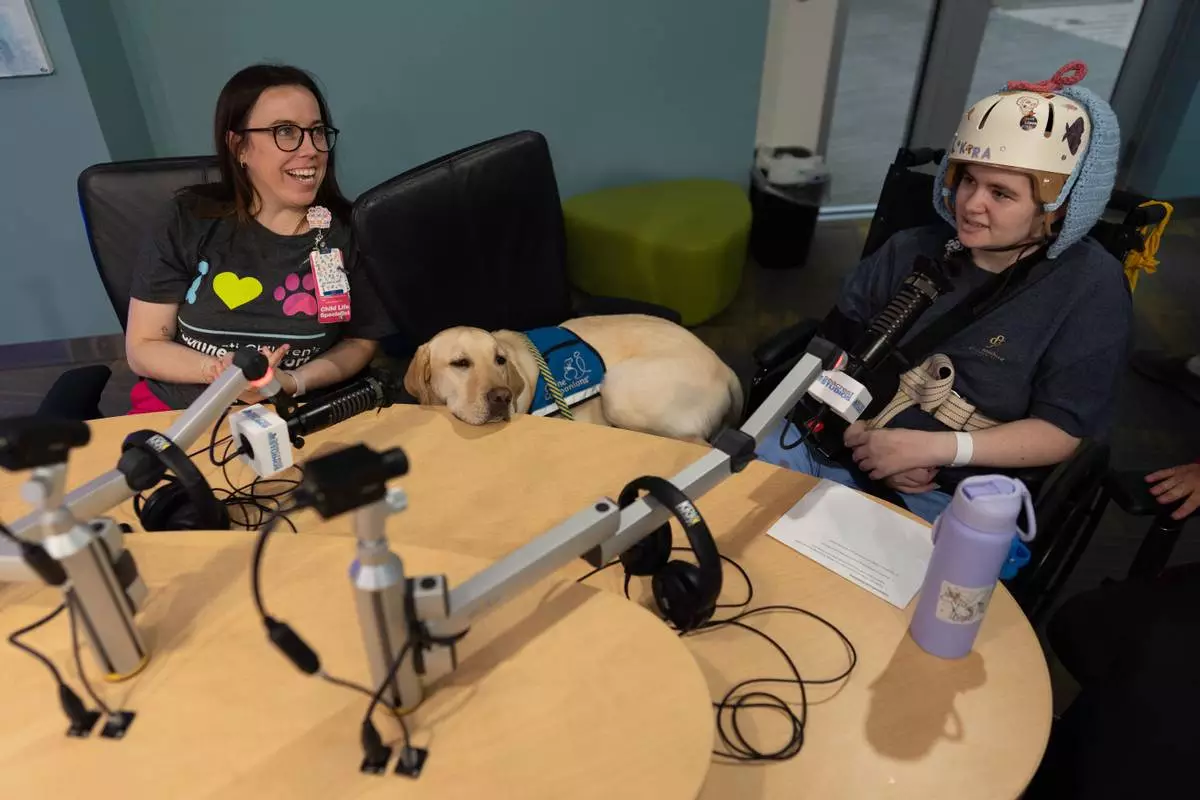
Cincinnati Children's Hospital Child Life Specialist Maggie O'Grady, left, and facility dog Grover, center, work with patient Kira Hodge at the hospital's Seacrest Studios to produce a closed-circuit television show beamed into patient rooms, at Cincinnati Children's Hospital in Cincinnati, Monday, May 4, 2026. (AP Photo/Carolyn Kaster)
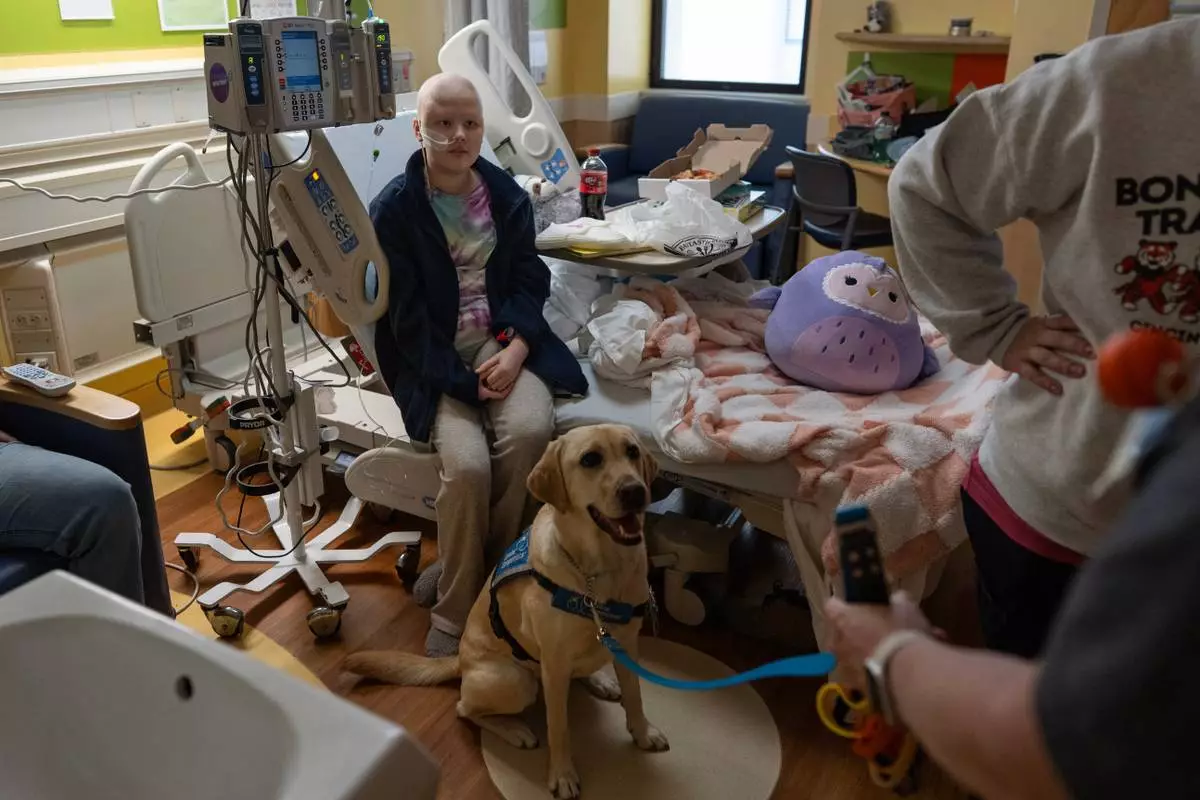
Cincinnati Children's Hospital facility dog Hadley sits at the feet of 11-year-old Bethany Striggles, who recently finished a chemotherapy treatment for bone cancer, in her room at Cincinnati Children's Hospital in Cincinnati, Monday, May 4, 2026. (AP Photo/Carolyn Kaster)
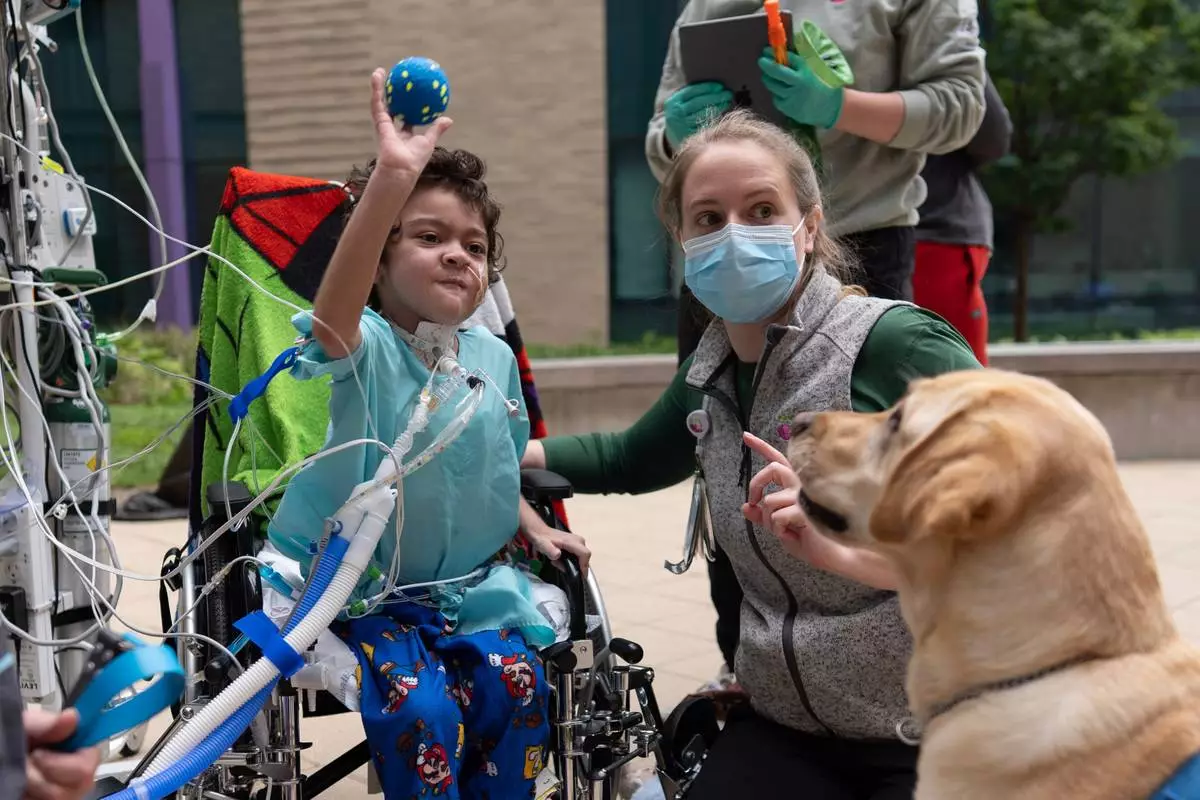
Five-year-old patient Calvin Owens throws a ball for facility dog Hadley with physical therapist Paige Torbet, right, during a physical therapy visit on the patio of Cincinnati Children's Hospital in Cincinnati, Monday, May 4, 2026. (AP Photo/Carolyn Kaster)
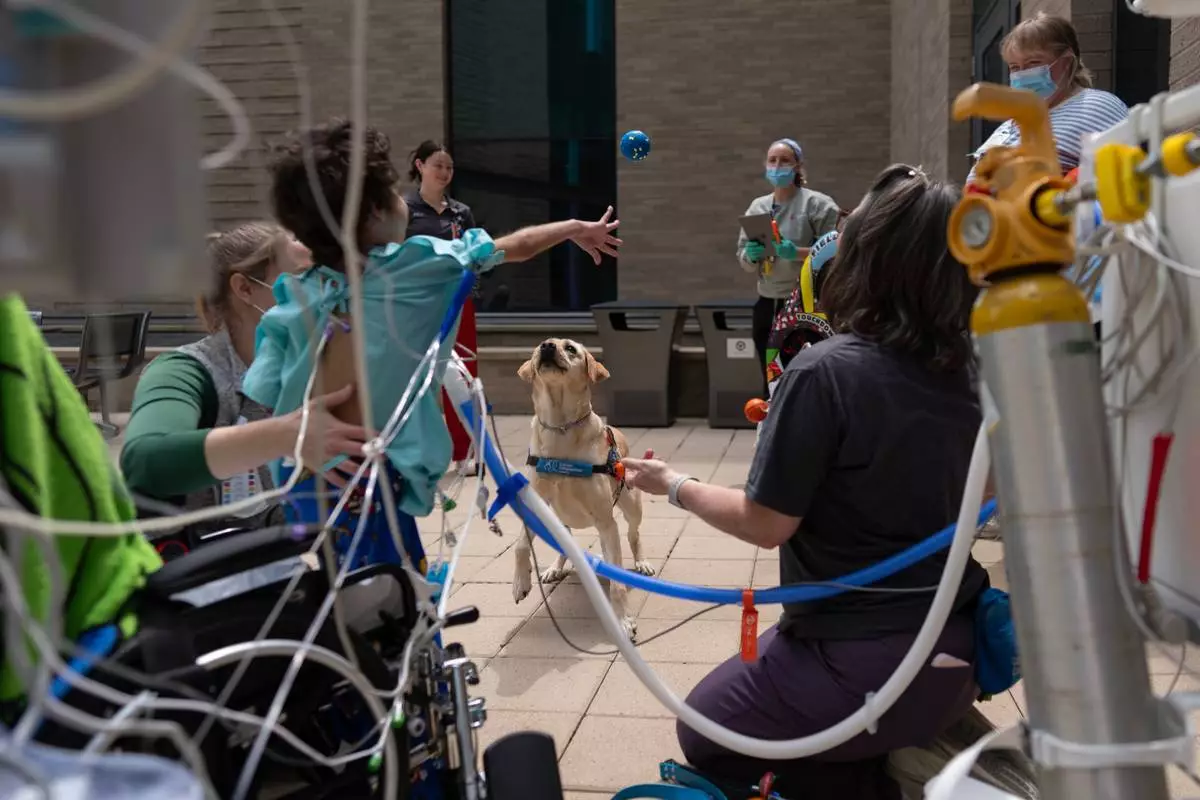
Five-year-old patient Calvin Owens, second from left, throws a ball for facility dog Hadley with physical therapist Paige Torbet, kneeling left, and child life assistant Schellie Scott, kneeling right, during a physical therapy visit on the patio of Cincinnati Children's Hospital in Cincinnati, Monday, May 4, 2026. (AP Photo/Carolyn Kaster)
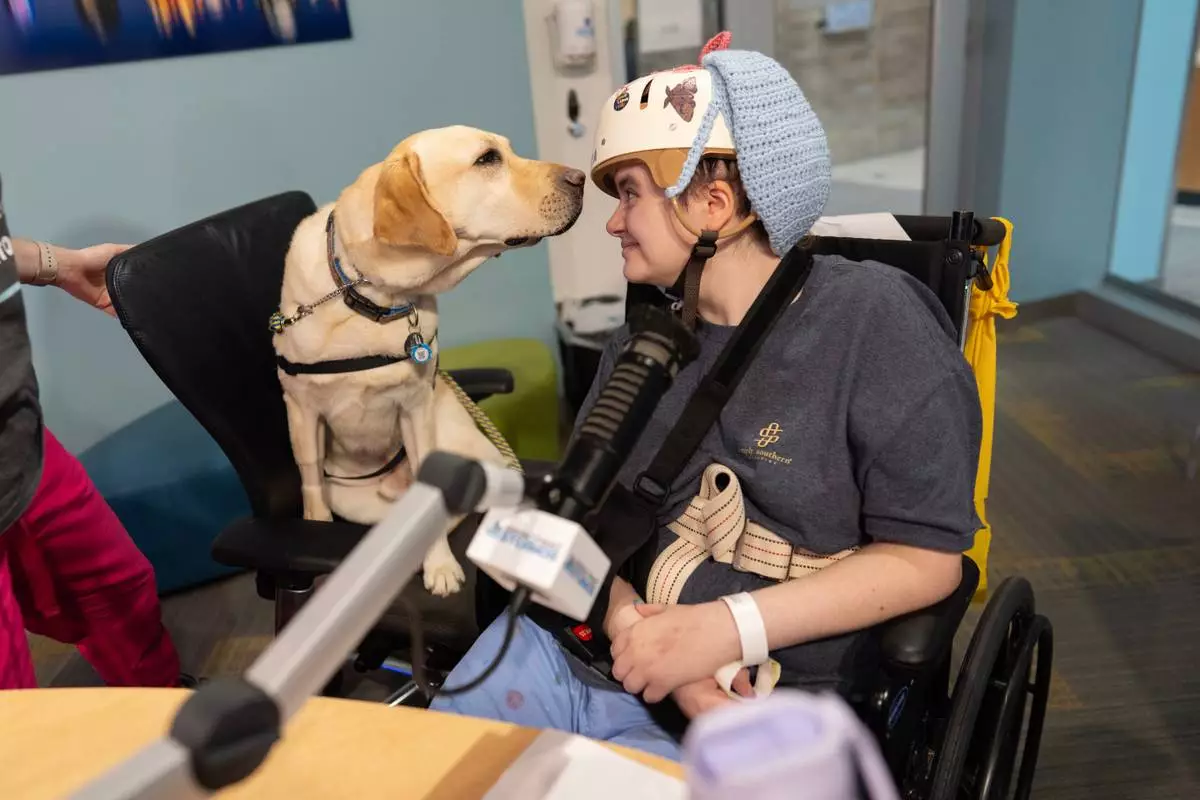
Cincinnati Children's Hospital facility dog Grover, left, looks to patient Kira Hodge at the hospital's Seacrest Studios as they produce a closed-circuit television show beamed into patient rooms, at Cincinnati Children's Hospital in Cincinnati, Monday, May 4, 2026. (AP Photo/Carolyn Kaster)