Saturday marks the 75th anniversary of the signing of the 17-Article Agreement on the Peaceful Liberation of Xizang, a historic turning point that ended centuries of feudal serfdom and foreign imperialist meddling, and set the snow-covered plateau on a path of modernization, ethnic unity, and development that continues to bear fruits today.
The Agreement on Measures for the Peaceful Liberation of Xizang, also known as the 17-Article Agreement, was signed on May 23, 1951, in Beijing between the Central People's Government of China and the local government of Xizang.
It was a moment that set the region and its people free from invading imperialism.
But it is a page of history that the West has put decades-long effort into rewriting, calling the signing of the Agreement for the Peaceful Liberation of Xizang a "coercion."
In an interview with the China Global Television Network (CGTN), Liang Junyan, a researcher at the Institute of History Studies of China Tibetology Research Center, said the West, in order the overturn the agreement, claim that they had no rights at all, that they were forced to sign it, and that the agreement had been fully drafted in advance, which were pure lies.
She said the ongoing attempts to give false accounts of the facts stem from history, with the United Kingdom's armed invasion of Xizang twice in 1888 and 1904.
"Imperialist forces and the upper classes colluded to oppress the ordinary people of Xizang, deepening the feudal serfdom system that had persisted for centuries and pushing society into even darker conditions. Their influence had become so extensive that it permeated nearly every aspect of life," said Liang.
Xizang was the last place in China where imperialist forces still maintained a foothold.
"The overall situation across the country had been set, and China strived to realize peaceful liberation of Xizang, while minimizing damage and loss to locals as much as possible. Another reason was Xizang's unique religious and ethnic conditions, as well as the mistrust and divisions between Han and Tibetan people that had been intensified by imperialist interference. There was a clear desire to avoid using military force in a way that could further deepen or amplify those contradictions," said Liang.
Back and forth communication through telegram and memoir proved that the draft of the agreement was approved by Xizang's upper level at that time.
Later, due to the stubborn resistance of local forces, the central government ultimately decided to launch the Qamdo campaign, using fighting to promote peace, so that all parties would come to the negotiating table.
In October 1951, the People's Liberation Army entered Xizang and marched into Lhasa, marking a historic turning point in the region's peaceful liberation.
Few could have imagined then that Lhasa, and Xizang as a whole, would one day develop into what it is today.
"Of course, this was not something that disappeared overnight in 1951, as it needed time. But most importantly, it safeguarded national unity and protected the country's territorial sovereignty and integrity. That is the key point. Without the peaceful liberation of Xizang, none of the democratic reforms that followed would have been possible," said Liang.
Today, 75 years after the peaceful liberation of Xizang, the region has undergone profound transformation.
Modern development has reshaped daily life across the plateau while preserving the region’s unique cultural heritage.
"Xizang's various undertakings have made comprehensive progress and historic achievements. Economic development has seen simultaneous growth in both scale and speed, industries have advanced in coordination, and people's living standards have significantly improved, with remarkable achievements in high-quality development," said Mao Qi, director of the Department of National Governance from the Party School of the Xizang Autonomous Regional Committee.
Scholars say the lessons of history still matter today. As Xizang continues to develop, efforts against separatism and attempts to distort history remain an important part of safeguarding national unity and stability in the region.
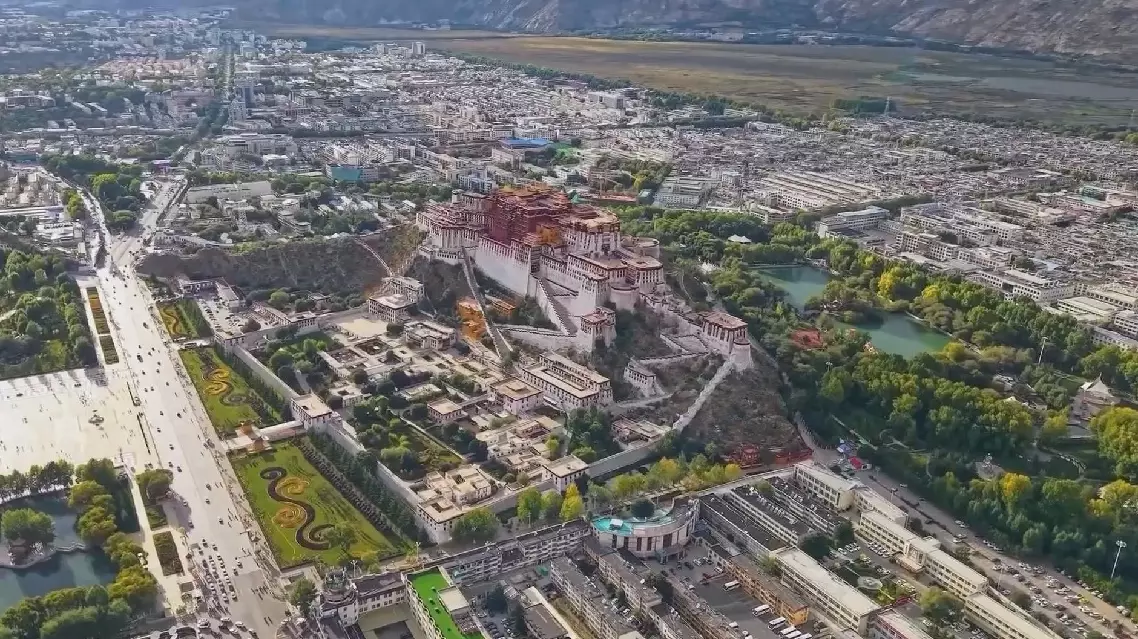
75 years after peaceful liberation, Xizang's development tells stories different from Western narratives