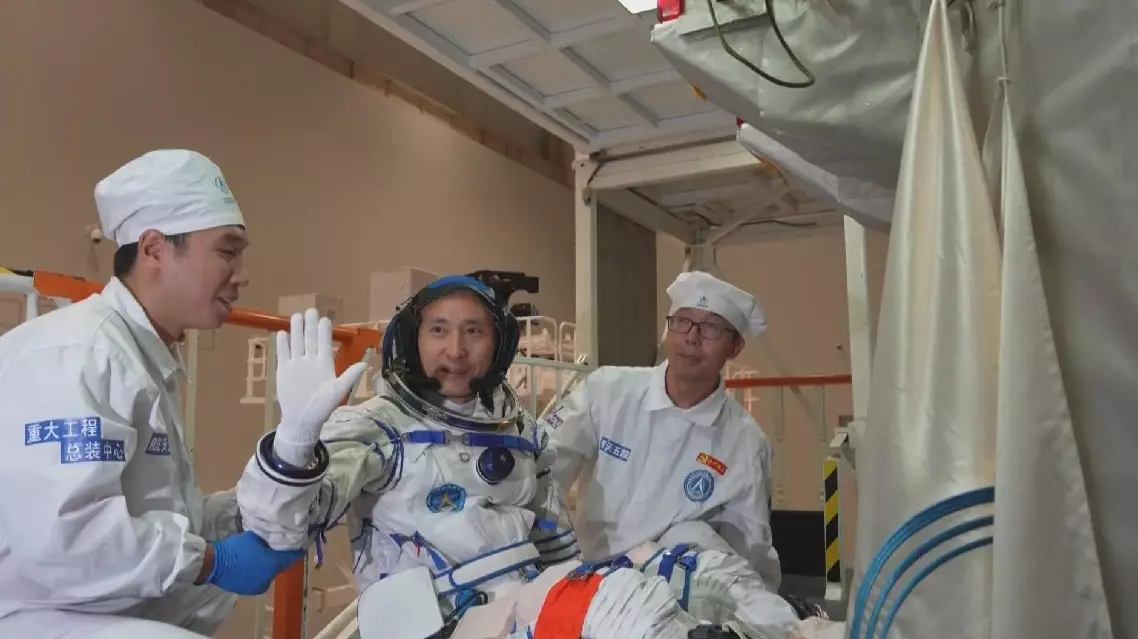
Astronaut Zhu Yangzhu, who flew on the Shenzhou-16 manned flight mission as a flight engineer, is now commanding the Shenzhou-23 manned flight mission, the first time a third-batch astronaut and a space flight engineer has taken the role of a mission commander.
Zhu said he has "reset" his mindset and is leading his team to achieve "zero error, zero mistake" in a mission that includes multiple historic firsts.
The Shenzhou-23 crewed spaceship is scheduled to be launched at 23:08 Sunday (Beijing Time) from the Jiuquan Satellite Launch Center in northwest China, the China Manned Space Agency (CMSA) announced on Saturday.
Zhu, together with crew members Zhang Zhiyuan, a spacecraft pilot and a former fighter pilot of the Chinese People's Liberation Army (PLA) Air Force, and Lai Ka-ying, a payload specialist who has become the first astronaut from the Hong Kong Special Administrative Region (HKSAR) after previously serving in the Hong Kong Police Force, will carry out the upcoming mission.
For Zhu, the transition from an engineer to a commander means moving from "doing one thing well" to "overseeing the whole picture and leading the team."
"After each mission, we recover physically and reset our mindset. We must gradually let go of all the honors we've received, reset our mentality, and start from scratch. All training must begin anew, refreshing everything to make our foundation stronger and more solid. We need to adjust our condition as quickly as possible, adapt to the Earth's environment, return to our pre-flight level, and bring our knowledge, skills, physical condition and psychological state to an optimal level, all while waiting to be selected again," Zhu said.
Zhu has set two special "formulas" for the crew: one for unity and one for capability.
"Our goal is what I've mentioned before: 1+1+1 equals 1. For our crew, in terms of coordination, unity and mindset, we aim for 1+1+1 equals 1, complementing each other's strengths and integrating as one. In terms of operational and technical capability, we aim for 1+1+1 greater than 3, maximizing our strengths and achieving the best possible results. So ideologically and psychologically, 1+1+1 equals 1, and in technical ability, 1+1+1 is greater than 3. In our work, we follow this principle, and through integration and practice, we strive toward a single goal, that is, unity within the crew, and unity between the crew and ground control," Zhu said.
The Shenzhou-23 mission features several firsts: it is the first time a third-batch astronaut serves as commander; it includes the first one-year in-orbit stay for a crew member; and it marks the first time an astronaut from the HKSAR flies into space. Zhu emphasized that these "firsts" reflect the rapid development of China's manned space program and the shared national pride.
One member of the crew will stay in orbit for one year, the longest single mission so far. Though the exact astronaut has not been announced, Zhu said he has prepared physically, psychologically and technically for the challenge.
A ground psychological support team has designed a "ground-space synchronized check-in" activity, where astronauts and their families share daily records to provide emotional support during extended missions.
"We are fully prepared. The nation's interest is above all else. Wherever the nation needs me, that is my choice. Since we have chosen this cause, we go forward without hesitation. We focus on one thing, dedicate ourselves to that one thing, and do every step of it well. As the saying goes, a thousand-mile journey begins with a single step. Take every step well, and before you know it, you will have reached the summit," Zhu said.
From engineer to leader, Shenzhou-23 commander ready for mission with "reset" mindset