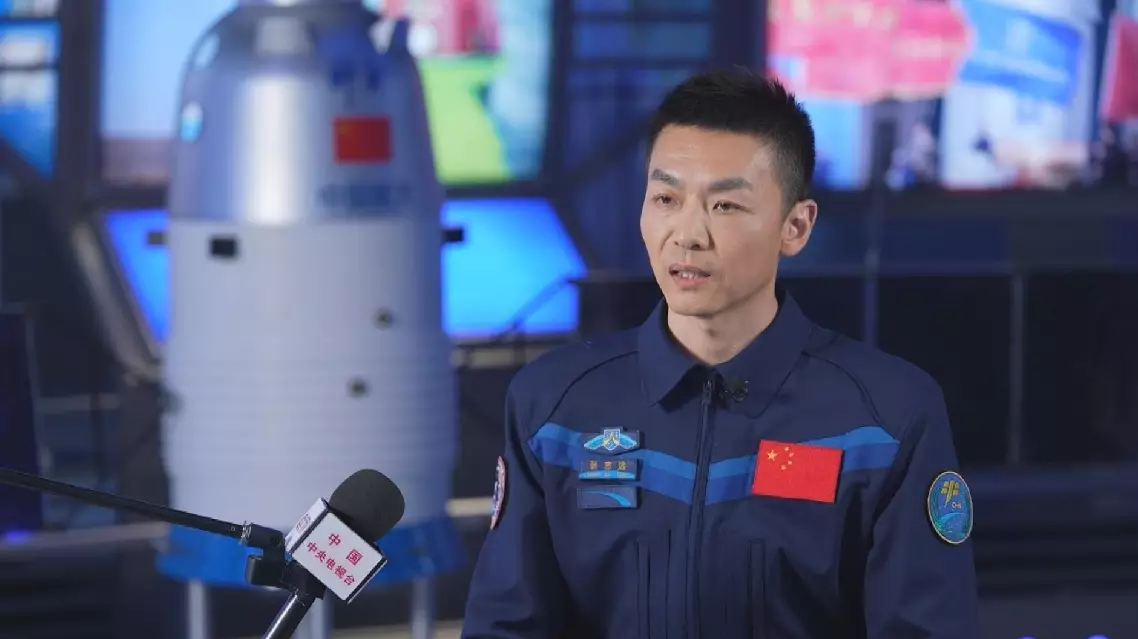
Among the crew for the Shenzhou-23 manned spaceflight mission scheduled for launch on Sunday, Zhang Zhiyuan is the No. 2. Before joining the People's Liberation Army Astronaut Corps, Zhang was an elite fighter pilot in the Chinese Air Force -- a background that has prepared him for his upcoming journey to the stars.
The Shenzhou-23 crewed spaceship is scheduled to be launched at 23:08 on Sunday (Beijing Time) at the Jiuquan Satellite Launch Center in the northwest, the China Manned Space Agency announced on Saturday.
Zhang, the spacecraft pilot, together with commander and flight engineer Zhu Yangzhu and payload specialist Lai Ka-ying, will fly in the upcoming mission.
Born in 1986 in Baiyin City, north China's Gansu Province, Zhang graduated from the Air Force Aviation University and served as a combat pilot before being selected as one of China's third batch of reserve astronauts in September 2020. His path to space began with a leap of faith.
"Being able to participate in the selection was actually a matter of chance. Since childhood, astronauts in our hearts have represented an extremely lofty career, representing our nation's scientific and technological strength. When we first heard about this opportunity, I decided to give it a try. Whether I could get selected, let's wait and see. With such a relatively relaxed mindset, I took an active part in the selection and was very cooperative," said Zhang.
The transition from cockpit to spacecraft demanded more than technical skill, it requires a complete mindset shift. Zhang had to overcome challenges of unlearning established habits and building new ones suited to spaceflight.
Over more than five years of rigorous training from centrifuge tests to underwater extravehicular simulations, he worked closely with teammates and mentors to master over 200 training modules.
"By the time I came to the astronaut corps, I was already 35 years old, when I had already developed certain ingrained habits and perspectives in terms of operational practices and mindset. But after I came here, I had to break away with them, and cultivate new concepts and habits to adapt to this entirely new profession. For nearly five years, I have been preparing myself in this regard. I also feel very fortunate, as just because there are such outstanding teammates, they have greatly motivated me, especially in theoretical studies, where they have helped me greatly. Now I feel that my current state should be up to the required standard," said Zhang.
Among the most demanding preparations was China's first astronaut cave training mission late last year. Zhang and his teammates spent six days and five nights in a cave with average temperatures of 8 degrees Celsius and humidity nearly 99 percent. Together they explored the cave, conducted scientific research, and fulfilled logistics management in an isolated and extremely dark environment.
"The cave training has significantly enhanced our adaptability to special environments, which I believe will be extremely helpful for this mission. Although one is in space and the other underground, both involve confronting extremely harsh conditions. Since our team was the first group to enter the cave, we had to grope a lot. But to my surprise, everyone demonstrated an exceptionally strong sense of responsibility for the mission," said Zhang.
As the Shenzhou-23 mission prepares for launch, with one crew member scheduled for a year-long stay aboard China's space station, Zhang has focused on mitigating the physiological impacts of long-duration spaceflight. Working with ground support teams, he has developed personalized countermeasures based on lessons from prior missions.
"Regarding how to cope with the effects of the space microgravity environment on the human body, I have actively collaborated with ground support personnel to develop personalized exercise prescriptions and training methods based on my physical condition. I have also drawn valuable insights from the experiences of veteran astronauts and some teammates who have already performed spaceflights. They have summarized some highly effective methods, particularly concerning exercise routines and dietary adjustments, which I find especially enlightening. Therefore, I am particularly eager to see whether applying these proven methods during my time in space can yield new positive outcomes," he said.
With the launch approaching, Zhang remains grounded in purpose: to contribute to China's growing presence in space and to inspire the next generation reaching to the stars.
Former fighter pilot set for maiden spaceflight