China unveiled its first full-life-cycle management service platform for humanoid robots in Beijing on Friday, enabling traceability of all humanoid robots in the country from assembly to scrapping.
From now on, every humanoid robot made in China will be assigned a unique four-segment identity code to ensure its traceability from research and development to production, market authorization, sales, usage, scrapping, and recycling.
Established by the Humanoid Robots and Embodied Intelligence Standardization Technical Committee of the Ministry of Industry and Information Technology, the full-life-cycle management system will ensure humanoid robots remain under control to prevent risks and improve accountability.
"It ensures the rigidity of management by comprising the country code, enterprise code, product code, and serial number, which guarantees global uniqueness, traceability, type differentiation, and individual tracking of humanoid robots. On the other hand, it provides technical flexibility for enterprises by allowing them to customize codes, fully taking their existing coding systems into account," said Dong Jian, director of the Information Technology Research Center at the China Electronics Standardization Institute.
So far, the platform has already covered more than 100 humanoid robot enterprises across China and has completed full-life-cycle ID code assignment for over 200 product models and more than 28,000 robots.
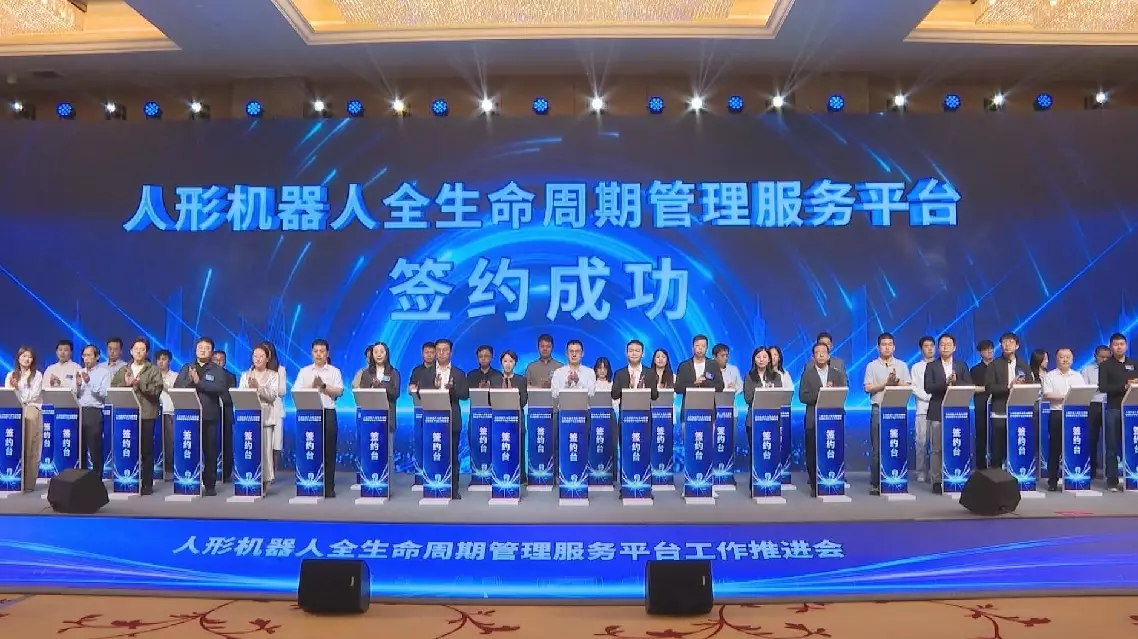
China launches first digital ID system for humanoid robots

The 32nd Asia-Pacific Economic Cooperation (APEC) Ministers Responsible for Trade Meeting concluded in east China's Suzhou on Saturday, yielding fruitful results and laying significant groundwork for the APEC Economic Leaders' Meeting in November.
The trade ministers' meeting focused on "building an open and predictable regional and multilateral economic and trade order" and "fostering new engines of innovative and dynamic trade and investment cooperation."
Chinese Commerce Minister Wang Wentao briefed the media on the meeting's outcomes at a press conference.
Wang said the meeting issued a joint statement titled the Suzhou Statement, and approved the latest edition of the APEC Roadmap for Innovative, Competitive and Resilient Services.
All parties agreed to advance policy innovation and reform in services trade, build an open and predictable investment environment, improve regional trade facilitation and supply chain resilience, strengthen standards coordination, and enhance intellectual property protection, Wang told the media.
He also said that substantial progress was made on a framework document for regional digital trade cooperation and the ministers emphasized promoting inclusive AI development, strengthening AI-related trade, and bridging the digital divide to ensure shared benefits from digital transformation.
The minister noted that the outcomes of the meeting demonstrated strong cooperation willingness, highlighted an innovation-oriented approach, and reflected inclusiveness and shared benefits. "The fact that Asia-Pacific economies can come together, uphold the original aspiration of promoting trade and investment liberalization and facilitation while supporting economic growth and prosperity, and engage in in-depth discussions on the important issue of 'where multilateral and regional economic and trade cooperation is headed,' fully demonstrates that open regionalism and true multilateralism enjoy broad support, and that mutual success and shared development serve the fundamental interests of all economies," Wang said.
2026 APEC trade ministers' meeting concludes with fruitful results