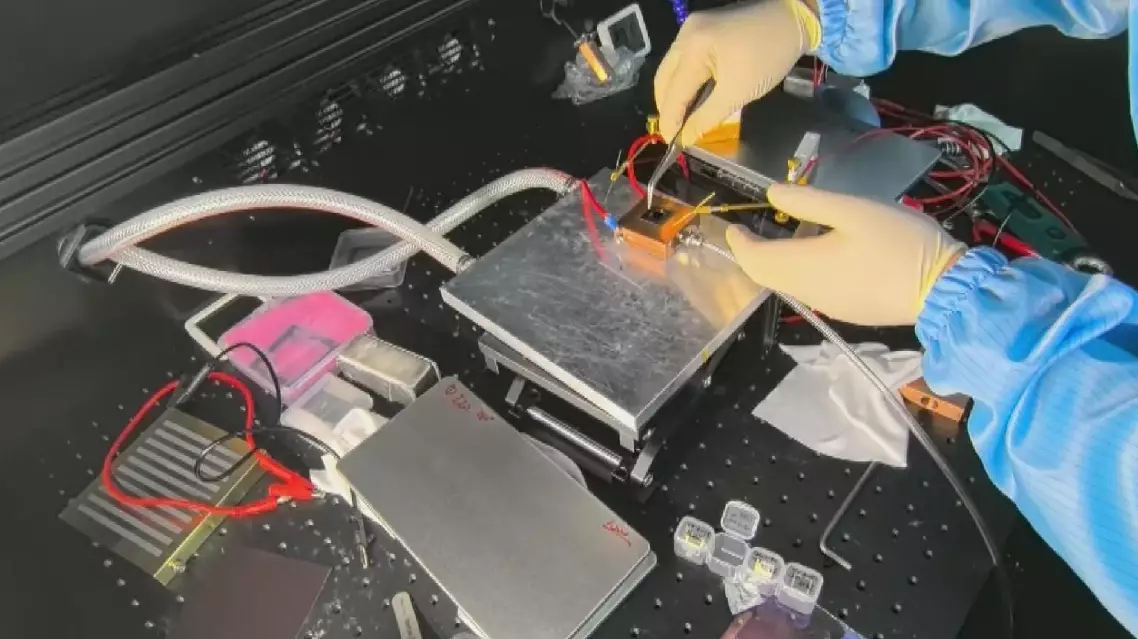
China's Shenzhou-23 mission will carry two types of perovskite solar cell materials and devices to the country’s space station for scientific experiments to verify their performance in the harsh environment of space and support future space energy systems.
Perovskite solar cells represent a third-generation photovoltaic technology that directly converts sunlight into electricity, fundamentally different from the energy storage batteries commonly used in daily life and electric vehicles, as those batteries cannot generate power on their own. This emerging technology offers numerous advantages that make it particularly promising for space applications.
Xiong Zhuang, an assistant researcher at the Institute of Semiconductors, Chinese Academy of Sciences, explained the unique properties that set perovskite technology apart from traditional solar cells.
"Perovskite is an artificially synthesized ionic crystal material with an extremely high light absorption coefficient. It can be processed into flexible forms, and its manufacturing processes are very simple and diverse. Solar cells made from this material feature an exceptional power-to-mass ratio, with lightweight, thin, and flexible properties, as well as relatively low processing costs. This makes it the most promising new energy technology for industrial application among the current generation of photovoltaic technologies," Xiong said.
Due to these advantages, perovskite solar cells have emerged as a leading candidate for powering China's space station, deep space bases and other space infrastructure. However, their ability to withstand extreme space conditions, including intense ultraviolet radiation, particle radiation, corrosive atomic oxygen, and drastic temperature fluctuations, remains untested in actual orbital environments.
Shenzhou-23 will deliver both single-junction perovskite and perovskite-based tandem solar cell samples to the space station. They will be used to conduct the first in-orbit performance test of perovskite cells at the space station, obtaining data on conversion efficiency degradation in the extreme space environment.
The upcoming perovskite cell experiment will help researchers better study the performance evolution and failure mechanisms of perovskite materials and devices under extreme conditions such as the space radiation spectrum, high-energy particle irradiation, atomic oxygen, and alternating high and low temperatures. The findings will enable breakthroughs in high-efficiency, high power-to-mass ratio, and low-cost flexible space photovoltaic technologies, providing a critical technological foundation for future low-Earth orbit satellites, deep space exploration missions, and lunar bases.
The Shenzhou-23 crewed spaceship is scheduled to launch at 23:08 Sunday (Beijing Time) from the Jiuquan Satellite Launch Center in northwest China, the China Manned Space Agency (CMSA) announced on Saturday.
Shenzhou-23 to conduct space research on next-gen perovskite solar cells